





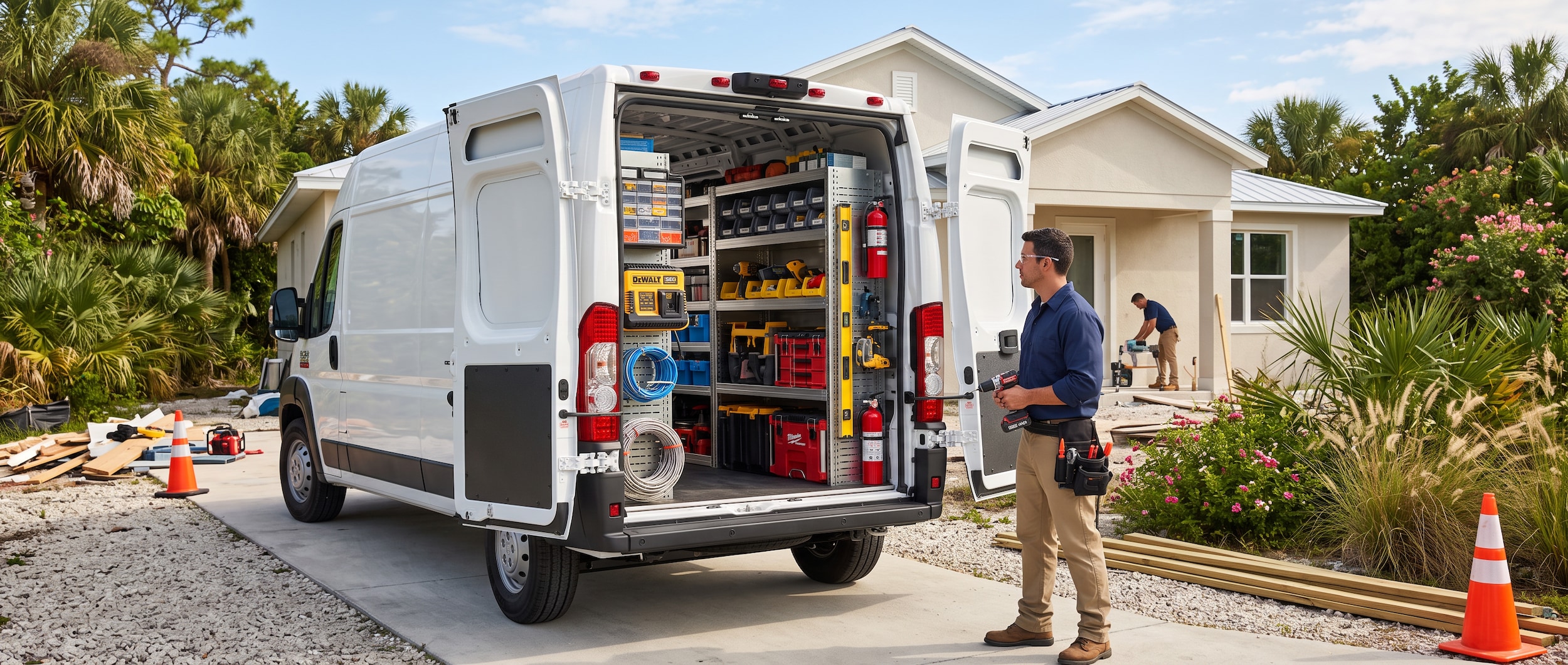
A 2026 Ram ProMaster in High Roof configuration gives Bay County tradespeople a 76-inch stand-up cargo bay, a load floor just 21 inches off the ground, and enough payload to carry a full day's load without sweating the numbers. Get that setup wrong and you'll waste money and lose time on every single job. Get it right and you'll find the van stages itself.
The workday moves fast on the Gulf Coast. You're running from a new-build in Lynn Haven to a service call near St. Andrews, and the van's got to work as hard as you do in 95-degree heat and 80 percent humidity. This guide breaks down the configuration decisions, shelving choices, and pre-order steps that actually matter for electricians and plumbers running routes through Bay County.
What Configuration Do You Actually Need?
The 2026 Ram ProMaster comes in three wheelbase lengths, 118, 136, and 159 inches, plus three roof heights, and while Ram lists maximum cargo space at 524 cubic feet on the Super High Roof extended configuration, that headline number reads impressive on paper but comes out wrong for most Bay County trade rigs. The right pick isn't about the biggest number. Run through the decision table below.
| Configuration | Interior Cargo Height | Cargo Volume | Best Trade Fit |
|---|---|---|---|
| Low Roof 118" WB | 66 in (no stand-up) | 304 cu ft | Light residential, minimal gear |
| High Roof 136" WB | 76 in (stand-up) | 463 cu ft | Most electricians and plumbers |
| High Roof 159" WB | 76 in (stand-up) | 463 cu ft | Long drain augers, long PVC runs |
| Super High Roof 159" WB Ext | 86 in | 524 cu ft | Commercial-scale operations |
Our team keeps pointing tradespeople to the High Roof 136-inch wheelbase as the working answer for Bay County. You stand up inside it, and you'll load easy from that 21-inch floor height. Ram specs a curb-to-curb turning diameter near 40 feet on the 136-inch, which means you'll clear a residential driveway or condo complex without a three-point turn. The 159-inch is the right call if you routinely carry a long drain snake or 10-foot PVC sticks. Know what you haul before you sign.
How the ProMaster Moves and Loads on Gulf Coast Job Sites
The front-wheel-drive layout is what produces that low load floor, and it also tightens the turning radius in a way that matters when you're threading through a neighborhood off U.S. 98 or backing up to a loading dock near Tyndall Parkway. Rear doors swing 260 degrees and fold flat against the body. In tight residential spots, that flat-fold means you won't clip a neighbor's bumper the way a standard swinging door would.
Ram lists a 4,820-pound maximum payload on the 2026 Ram ProMaster depending on configuration. That number deserves real attention here.
Salt air and the sustained post-Hurricane Michael rebuild demand mean Bay County contractors often run heavy, hauling copper wire coils, PVC bundles, cast-iron fittings, drain machines, and hand tools that all add up fast. A traditional steel shelving package from a commercial upfitter weighs between 450 and 700 pounds before you've put a single tool in it. Aluminum shelving packages typically come in under 200 pounds. That 300-to-500-pound difference goes directly back into usable payload. In a market where a plumber might routinely carry 800 pounds of pipe stock on a large job, the math isn't trivial.
Browse available ProMaster stock at Bay Chrysler Dodge Jeep Ram to see current configurations on the lot.
Staging tip: Design your upfit before you take delivery. Ram specs the 2026 ProMaster with flat, wide interior walls to simplify shelving and partition installation. Measure your longest item first (conduit lengths for electricians, auger reach for plumbers), then work backward to shelf depth. A 14-inch-deep shelf on one side still leaves roughly a 47-inch center aisle in the 136-inch van, which is how you work inside on the job.
Gulf Coast material note: Steel shelving in a bay-adjacent market picks up salt-air corrosion faster than you'd expect, especially if your routes include waterfront properties near Panama City Beach or the West End. Powder-coated aluminum or zinc-treated steel brackets are the sensible call here. Generic upfit guides written for inland markets skip this detail entirely.
Ram specs the 2026 ProMaster's load floor at just 21 inches from the ground, the lowest in its full-size class, which directly reduces load-and-unload fatigue across multi-stop trade days in Bay County heat.
Upfit Layouts by Trade
Different trades run different layouts, so where a spool of wire lives in an electrician's van and where a drain machine anchors in a plumber's van aren't the same call, and the breakdown below shows where each profession's gear should actually live inside a 136-inch High Roof ProMaster.
For electricians:
- Driver-side wall: Three adjustable shelf units for wire spools, breakers, fittings, and connectors. Smaller bin slots at eye level for sorted fittings, and you'll stop digging around by flashlight.
- Passenger-side wall: Deeper shelves, 14 to 16 inches, for power tools, drill cases, and meter bags.
- Roof rack: A ladder and conduit carrier on the exterior isn't optional for most residential electricians. Ten-foot conduit sticks don't fit inside a 136-inch van without a pass-through bulkhead or an exterior carrier.
- Partition: A locking bulkhead separates the cab from cargo, protects tools at unattended sites, and it'll keep gear from shifting forward under braking.
- Floor: Rubber mat or plywood decking over the factory floor. Bare metal holds moisture in a high-humidity environment and it'll corrode faster than the interior walls.
For plumbers:
- Driver-side wall: Locked drawer units at the bottom for wrenches, auger heads, and small fittings. Drawers outperform open shelves for heavy loose items on rough coastal roads.
- Passenger-side wall: Open shelves for PVC and copper fitting bins, labeled by pipe size. A plumber who can't locate a half-inch coupling wastes real time on every service call.
- Floor anchor: Drain cleaning machines and water jetters need a floor-mounted anchor ring. The ProMaster's flat FWD floor gives unobstructed anchor placement across the full cargo width, and Ram specs interior cargo width at 75 inches on high-roof models.
- Exterior pipe carrier: A side-mount carrier for long runs keeps heavy PVC off the roof, which matters when you're lifting after six hours on a humid August job.
- Ventilation: A small exhaust vent or battery-powered fan keeps the cargo bay from trapping heat. Rubber gaskets and adhesive fittings degrade faster stored at 120-plus degrees, and you don't want that. Cheap fix for an expensive problem.
Your Pre-Order Upfit Checklist
Walk through this checklist before you sit down with an upfitter, and give it roughly 20 minutes, because that short window of prep up front saves you from a costly re-spec after the van is already built and the shelving is bolted in.
- List your three heaviest items by weight. Add them up, subtract the shelving package weight from your ProMaster's rated payload, and confirm you've got room for everything you carry.
- Measure your longest item. If it exceeds 9 feet, you'll need either a pass-through bulkhead or an exterior roof or side rack on a 136-inch WB van.
- Count your distinct part types. More than 40 SKUs almost always means a bin-based shelving wall, not open shelves.
- Decide on roof height first. The High Roof gives 76 inches of standing clearance, which is plenty for most adults. Super High Roof at 86 inches is the answer for taller crew members or oversized equipment.
- Choose shelving material before the quote. Aluminum for weight savings and salt-air resistance. Powder-coated steel as a middle path. Bare steel only if the van stays well inland.
- Plan the partition. A full locking bulkhead is standard for a working trades van. Go partial only if you sometimes need to pass long items through from the cab.
- Verify the upfitter's fit sheets. Upfit kits are sized by wheelbase, roof height, and model year. A kit for a 136-inch van doesn't fit a 159-inch van. Get the fitment confirmation in writing.
Come see us at Bay Chrysler Dodge Jeep Ram, or give our commercial team a call and we'll walk through your spec before you order.
Go get to work.
Categories:
Social