





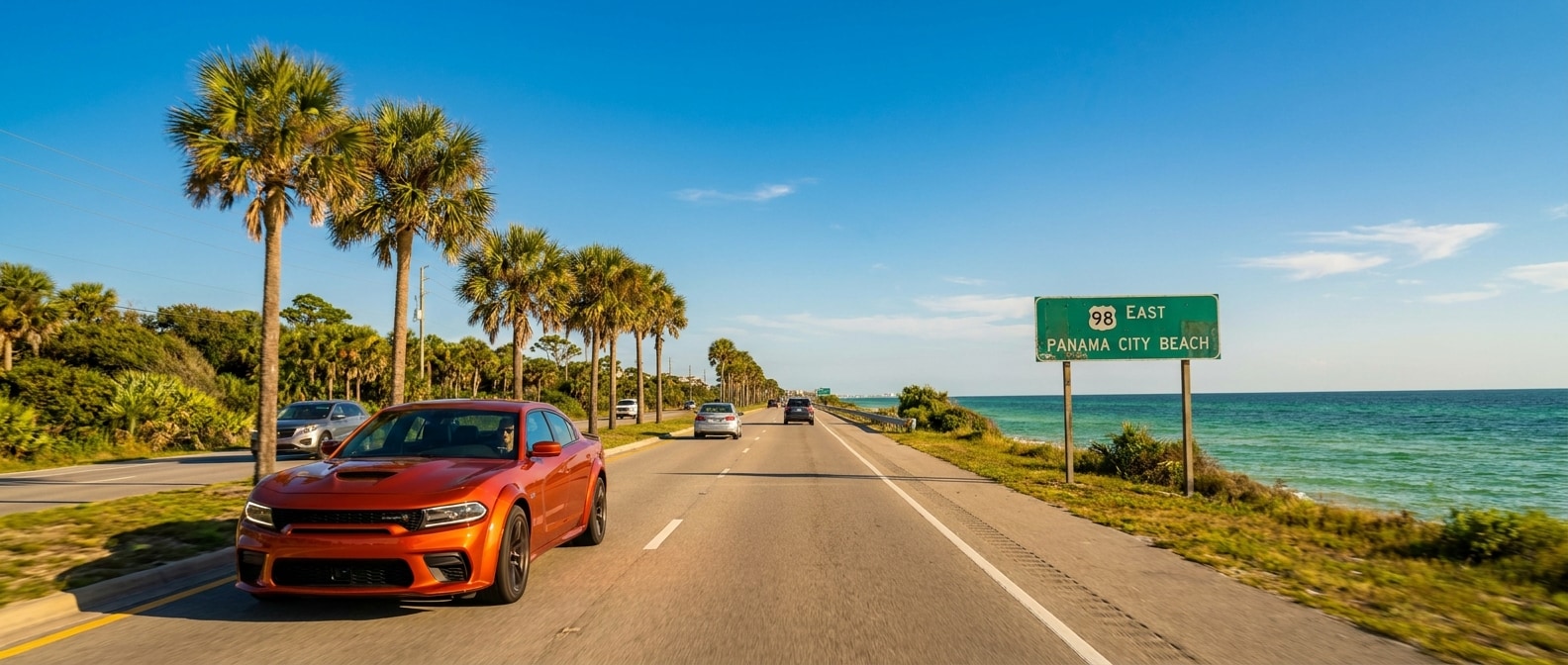
August in the Florida Panhandle is no fun if your car is fighting you. US-98 through Panama City and out toward the beaches stacks up hard in mid-morning tourist traffic, sits dead-stopped between signals, then opens into long flat sweeps where you can finally breathe. Good news is the 2026 Dodge Charger Sixpack was engineered for exactly this kind of split-personality road. It handles both. You just need to set it right.
Bottom line up front. Auto mode for city stretches, Eco for true cruise segments, Sport only when US-98 finally opens up east of town. Ventilated seats on the moment you sit down in August. Run it that way and the Charger becomes a genuinely comfortable long-distance companion, not a punishment for loving a muscle car.
Will Your Comfort Setup Actually Fit US-98's Reality?
The 2026 Dodge Charger R/T isn't marketed as a touring car, yet its specs read like one once you set it correctly, so the answer is a qualified yes, it fits US-98's split reality well when the modes and seats are dialed in, and it wears on you when they're not. The table below maps each comfort and drive-mode setting to what it actually does for you on a typical US-98 run in August (from the stop-light gauntlet through downtown Panama City to the longer coastal sweep heading west).
| Setting / Feature | What It Does | US-98 Fit |
|---|---|---|
| Auto Mode | Balances AWD torque split and throttle response for mixed conditions | Ideal for the stop-and-go corridor through Panama City where signals bunch up |
| Eco Mode | Softens throttle mapping, optimizes torque delivery for efficiency | Best for the longer flat stretches once traffic thins; reduces heat-soak from the turbo at cruise |
| Sport Mode | Sharpens throttle response, adds steering weight, holds gears longer | Reserve for open stretches with room to move; uncomfortable at 5 mph in tourist traffic |
| Wet/Snow Mode | Reduces torque at all four wheels for slip prevention | Worth knowing in Panhandle afternoon thunderstorms; US-98 drains poorly in a hard rain |
| Ventilated Seats (R/T Plus / Scat Pack) | Active airflow through the seat cushion | Non-negotiable in August; leather in direct Florida sun builds heat fast without it |
| 64-Color Attitude Adjustment Lighting (R/T Plus) | Ambient interior light tuning | Not a comfort setting per se, but a lower, warmer color temp reduces eye fatigue on a long afternoon run |
| 8-Way Power Seat (R/T Plus) | Full lumbar and thigh support adjustment | US-98 has long straight segments where the seat position matters more than you'd think over 45+ miles |
| Head-Up Display (R/T Plus) | Projects speed and nav data onto the windshield | Keeps your eyes forward on a busy multi-lane road with frequent signal changes |
*Drive mode information sourced from Dodge's official 2026 Charger specifications. R/T Plus and Scat Pack feature sets confirmed via Dodge product pages.*
How to Load the Settings Before You Roll
You load the Charger's drive modes right on the steering wheel, which is deliberate and useful, because you don't want to dig through a touchscreen while US-98 traffic is moving, though it does mean you should set your defaults in the driveway before you roll instead of hunting for them mid-corridor.
Start in the driveway with seat cooling on and the mode selector on Auto. The 3.0L SIXPACK twin-turbo inline-six makes full torque by 2,500 rpm, so it responds hard at low speeds in Sport, which is the last thing you want at the first dozen signals on US-98. US-98 crosses Panama City and runs west toward the beaches. Our service team sees Charger owners roll in after a summer of Sport mode in city traffic, wondering why their fuel range dropped. The throttle mapping in Sport holds the engine spooled up through intersections, and that costs you on a hot-day stop-and-go run. Keep Sport out of town.
When you clear the dense signal zone and US-98 opens up (roughly past the interchange with US-231 heading west), flip to Eco. The turbos are already up to temperature. Eco doesn't neuter the Charger; it just stops it from hunting the power band unnecessarily on a flat, straight stretch. If you're carrying a passenger and you want a composed, quiet mile, Eco is the setting that delivers it.
Panhandle Thunderstorm Note: Wet/Snow mode exists on the R/T and it matters here. August afternoon storms on US-98 hit fast. The road surface goes from dry to sheeting water in under two minutes. Wet/Snow softens the torque to all four wheels, and with 420 or 550 horsepower on tap, that's the setting that keeps you pointed straight when the sky opens up.
Checklist: US-98 Comfort Prep Before You Leave
Run through this quick list before any August drive on the Panhandle corridor, because the gap between a calm run and a sweaty one is mostly a handful of settings you lock in before you pull out, not anything you can fix once you're already stuck in it.
- [ ] Select Auto mode on the steering wheel before you leave the lot
- [ ] Activate ventilated seats immediately (don't wait until you're already hot)
- [ ] Set cabin temperature to a 5-8 degree differential below outside temp (not max-blast; prevents fogging when you stop)
- [ ] Enable the HUD if your trim has it (frees your eyes from the cluster on a signal-heavy road)
- [ ] Note the weather radar before you go; if afternoon storms are building over Bay County, leave Wet/Snow mode one click away
- [ ] If you're going past 60 miles of continuous highway, shift to Eco after clearing the city (you'll notice the difference in cabin calm and fuel range)
- [ ] On the return run into downtown, flip back to Auto before traffic tightens
The one setting worth a second look: the 64-color interior lighting on the R/T Plus. Set it to a cool white or amber tone for a daytime run rather than the default performance red. It reduces the visual "noise" in the cabin on a long, bright August afternoon on a straight road (a small thing that adds up over 45 miles). Dodge lists this as a comfort and personalization feature, and on US-98 it earns that description.
The Run Done Right
The 2026 Dodge Charger Sixpack is genuinely comfortable on a long Panhandle highway run, and that's a real finding rather than a sales pitch, but the trade-off is an honest one, because the car is heavier than it looks and it's tuned to let you feel the road, so it rewards the right setup and punishes the wrong one. Spelled out, it weighs 4,816 pounds for the Sixpack, and the performance suspension tuning means you feel the road more than you would in a typical sedan. That's what the car is. If you want isolation from every surface, this isn't your vehicle. But if you want composed, powerful, and cool (literally cool, with ventilated seats fighting back against Florida in August), the settings above make the Charger work for you on US-98 rather than against you.
The Sixpack's twin turbos make peak torque by 2,500 rpm and the 8-speed ZF automatic shifts smoothly in Auto. Financing options are available for the full 2026 Charger lineup, including the R/T, R/T Plus, and Scat Pack. Come into Bay Chrysler Dodge Jeep Ram at 636 W 15th St in Panama City and we'll walk you through the trim differences and which feature package makes the most sense for how you actually drive this road.
Set it up, then just drive.
Categories:
Social