





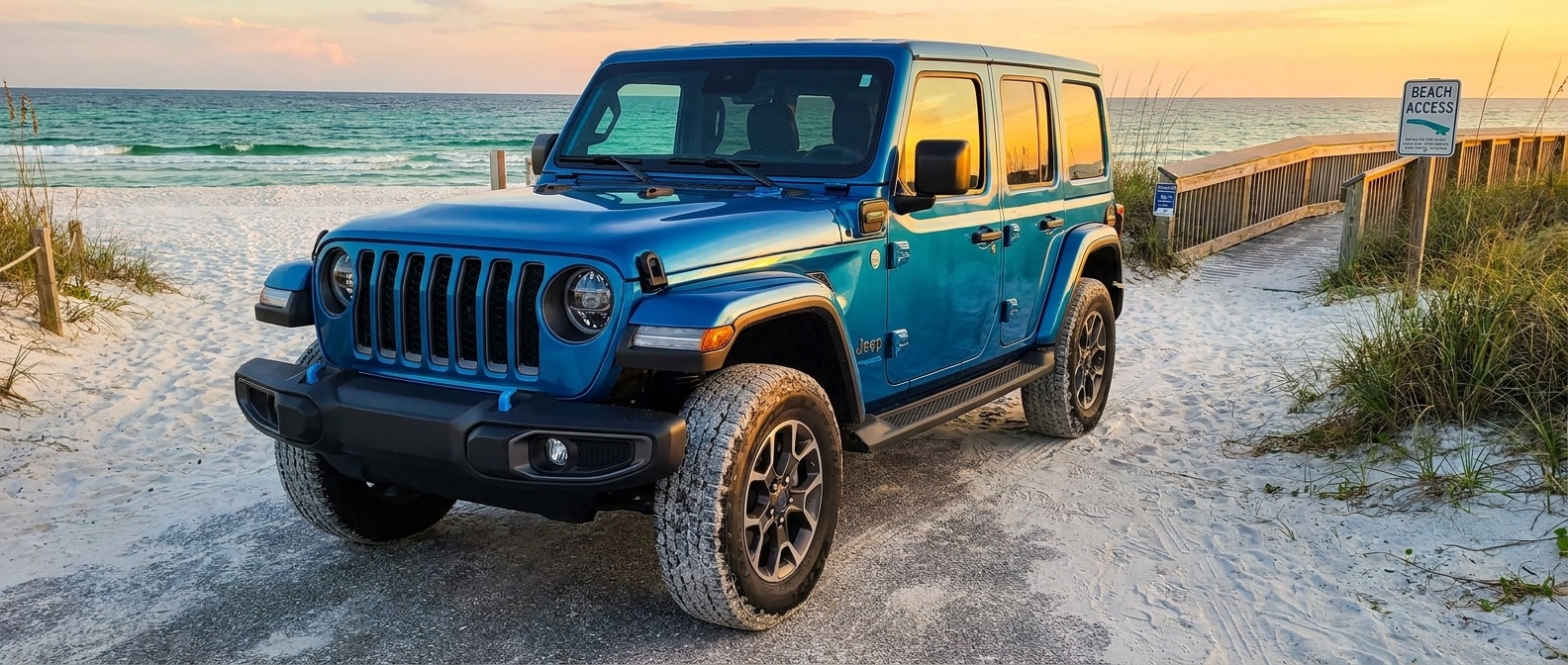
On most days in Panama City, you're not driving far. You cross the Hathaway Bridge, run up Harrison Avenue to Tyndall, or cut over to Lynn Haven. The U.S. Census Bureau puts the average Panama City commute at 24.1 minutes. At typical local speeds on US-98 and US-231, that works out to roughly 12 to 18 miles each way. That range matters when you're weighing the Jeep Wrangler 4xe or Grand Cherokee 4xe.
The 2025 Wrangler 4xe carries an EPA-rated 22 miles of all-electric range. Step up to the 2025 Grand Cherokee 4xe and that number climbs to 26 miles on the EPA estimate. For a lot of Bay County drivers, that means the weekday commute runs entirely on battery. Saturdays at St. Andrews State Park or a run out to the dunes? The gas engine picks right up where the battery leaves off, and you've still got well over 300 miles of combined range on both fuel types.
The core fit is simple. Short local miles on electrons, long adventure miles on gasoline. No charging anxiety, because it's a hybrid first.
A Bay County driver who charges overnight and commutes under 22 miles round-trip can run the Wrangler 4xe's weekday errands entirely on electric power, then use the full combined range for weekend trail runs and beach trips without range stress.
See Jeep Wrangler options in our inventory
Why Does the 4xe Fit Bay County So Well?
The 4xe fits Bay County well because the local geography rewards short, repeated electric legs and the drive modes are engineered around exactly that pattern, though you'll only see the benefit if you can charge at home overnight and keep most of your trips inside that window. The table below maps those local conditions to what the system actually does.
| Bay County Condition / Use | 4xe Feature That Handles It | Why It Matters Here |
|---|---|---|
| Short commute (avg. 24.1 min, ~12-18 mi) | EPA 22-mi electric range (Wrangler) / 26-mi (Grand Cherokee) | Most daily legs stay fully electric, no gas burned |
| Stop-and-go on US-98 and Harrison Ave. | Regenerative braking recharges battery in traffic | Panhandle congestion works FOR your range, not against it |
| Beach and dune access at St. Andrews State Park | Standard 4-wheel drive with trail-capable ground clearance | Sand access stays in reach without swapping to a second vehicle |
| Summer heat and AC demand | Electric motor handles cabin cooling load without combustion engine cycling on | Battery range impact is real but the system manages it better than stop-start gas engines |
| Long weekend drives to Destin or Tallahassee | 2.0L turbo gas backup, 300+ miles combined range | You're not hunting a charger on the Panhandle; you fill up at any station |
| Hurricane-season prep driving | eSave mode preserves battery charge for when you need it | Hold full electric range in reserve for post-storm errand runs |
The Powertrain Actually Helps on Panhandle Roads
Put the Wrangler 4xe in Electric mode for the morning run down 15th Street and you'll notice two things right away, a cabin quieter than you'd expect from something with a solid axle, and instant torque off the line that handles Panama City Beach traffic better than the gas engine manages on its own. The EPA rates the combined system output at 375 horsepower and 470 lb-ft of torque for both the Wrangler 4xe and the Grand Cherokee 4xe. That's not a modest number.
The Wrangler 4xe packs a 17.3 kWh lithium-ion battery paired with a 2.0-liter turbocharged four-cylinder and two electric motors running through an 8-speed automatic. On gasoline after the battery depletes, both vehicles return 20 mpg combined for the Wrangler and 23 mpg combined for the Grand Cherokee (per EPA). Neither figure is spectacular for highway cruising, but it's where you'd expect a boxy 4x4 with off-road-spec tires to land.
On short, repeated local legs, the real efficiency story comes together. Charge it at home overnight, leave full, arrive at Tyndall or Gulf Coast State College on battery, come home. Plug in. Repeat. That cycle is where the 4xe makes financial sense in a way that long-highway-only usage doesn't.
Browse Grand Cherokee options at Bay Chrysler Dodge Jeep Ram
Per NHTSA (Campaign 25V-741): Chrysler issued a recall covering 320,065 Jeep plug-in hybrids, including 228,221 Wrangler 4xe units from the 2020 through 2025 model years, over a high-voltage battery defect. A completed remedy is the one thing you need confirmed in writing.
Local Tip: St. Andrews State Park sits three miles east of Panama City Beach on US-98. The access roads into the park are packed sand rather than technical rock crawl, which lands them squarely in the 4xe's capable-but-comfortable zone. You'll get there on battery from most Bay County neighborhoods, then leave with the gas engine ready for the return trip, no charger required.
The Discontinued Status Is an Honest Part of This Conversation
Yes, the discontinuation is real and worth saying plainly, because Stellantis confirmed in January 2026 that the Wrangler 4xe and Grand Cherokee 4xe are both done after the 2025 model year, and that plain fact shapes how you'll approach buying one. No 2026 4xe is coming.
The tradeoff is straightforward. On one side, there's no new 4xe on order, plus a recall history that deserves scrutiny. On the other side, the used market now holds a concentrated supply of 2022 through 2025 units, recall remedies are being completed, and the platforms themselves, the Wrangler JL and Grand Cherokee WL, continue in production with gas powertrains and full parts availability for the foreseeable future.
For a Bay County buyer who wants the electric-commute benefit and Jeep capability without paying new-truck pricing, a well-vetted 2024 or 2025 4xe with a confirmed recall remedy can be a genuinely sound choice. We look at these carefully, because a completed NHTSA recall and a clean inspection matter far more than the model year, and we'll tell you exactly what we find.
Browse pre-owned Jeep inventory
How to Match the Right 4xe to How You Actually Drive in Bay County
The Wrangler 4xe is the right call if you want the open-air option and occasional off-road access to spots like the trails around St. Andrews or the undeveloped sections along the Panhandle coast, and the Grand Cherokee 4xe is the better call if your daily driving leans toward comfort and space. Its body-on-frame feel and removable doors and roof don't pretend to be a crossover. They're not. The tradeoff is a firmer ride on US-231 and a tighter back seat.
The Grand Cherokee 4xe gives you the same electric-commute math (actually a bit better, 26 miles on battery versus the Wrangler's 22) in a much quieter, more comfortable package. It'll seat five adults without complaint, carry more cargo, and handle the school run to Bay Haven the same day it handles a weekend trail detour. If the Wrangler's character feels like more vehicle than your daily use demands, the Grand Cherokee 4xe is the sharper answer.
Both pair electric daily driving with the gas-engine range you'll want for anything the Florida Panhandle throws at you. Both carry Trail Rated badges.
Categories:
Social