





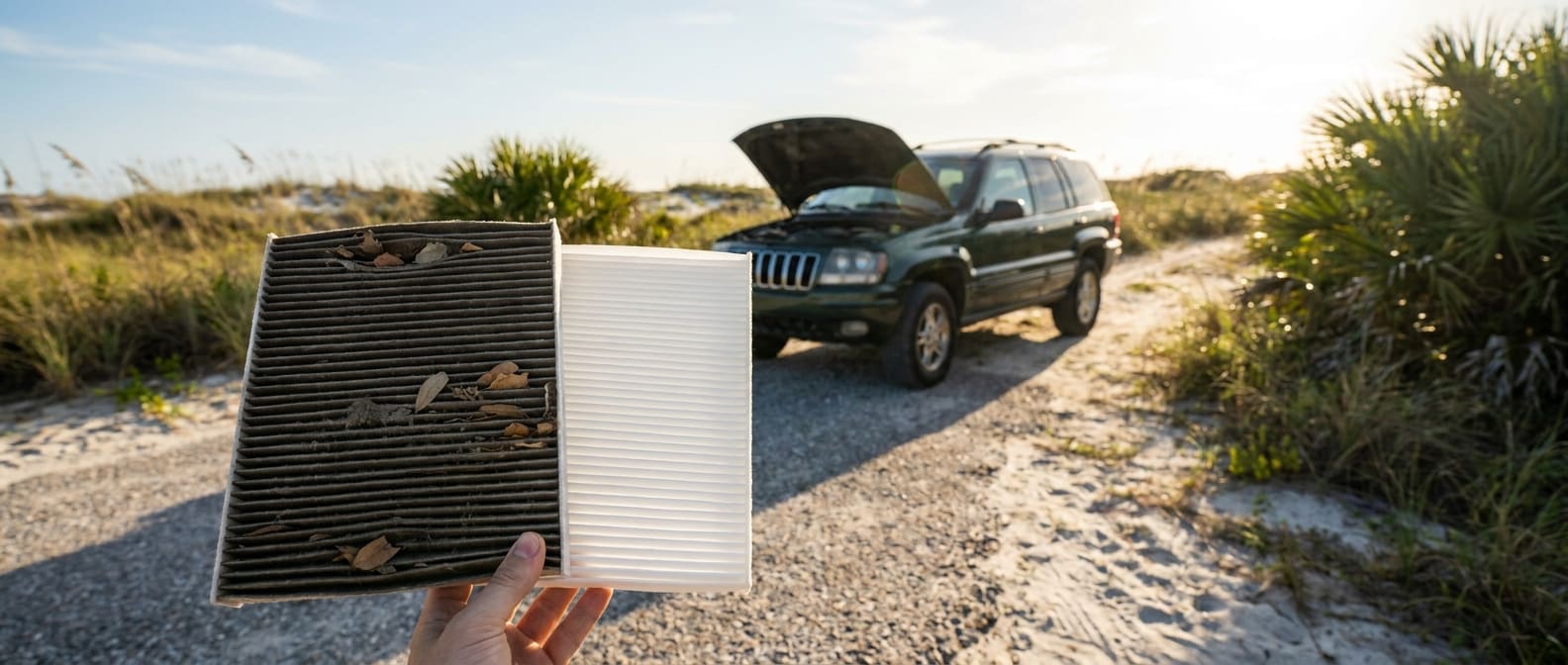
If you drive anywhere near the Gulf Coast, your cabin air filter is fighting three stressors at once, the kind drivers in drier states don't face. Humidity sits between 72% and 77% essentially year-round. Salt air travels up to 20 miles inland from the Gulf. And the pollen calendar runs nearly the entire year across tree, grass, and weed seasons. That combination loads a filter faster than the standard 12,000-to-15,000-mile replacement interval assumes, and a clogged filter in a Florida August means a weaker A/C exactly when you need it most.
Schedule a service appointment here to get yours checked before the heat really bites.
What's Actually Getting Into Your Filter on the Florida Panhandle?
Open any owner's manual and the answer reads 'dust and pollen,' and that's true as far as it goes, but Panama City hands your filter all of that plus salt air and mold-friendly humidity that inland drivers rarely fight, so the load your filter carries here runs heavier and more varied than the manual assumes.
Humidity and mold. Panama City's relative humidity stays between 72% and 77% through the year, with August being the single wettest month. When humidity consistently climbs above 60%, organic material trapped in a filter becomes a breeding ground for mold spores. Mold isn't a theoretical concern in the Panhandle. A truck that sat over a long weekend can greet you Monday morning with a musty vent smell. It seems to come from nowhere.
Salt air from the Gulf. Salt particles don't stay on the beach. They travel inland on Gulf breezes, bond with morning dew and evening humidity, and work their way into every intake path on your vehicle. Those paths include the fresh-air duct that feeds your cabin air filter. The coating those particles leave on filter media accelerates clogging. The buildup corrodes the HVAC housing too.
Pollen without a real off-season. In the Florida Panhandle, tree pollen peaks in late winter and spring, grass pollen picks up through summer, and weed pollen runs into fall. Weed pollen is active right now in August. The Panhandle doesn't give pollen a real off-season, so a filter that entered spring at half capacity hits summer grass season already struggling.
The practical result is simple. A filter that might hold up for 15,000 miles of driving in a dry climate can reach its effective limit in 8,000 to 10,000 miles of Panama City driving. You'll feel it worst through the peak pollen and humidity stretch from spring through late summer.
| Stressor | What It Does to Your Filter | Panama City Intensity |
|---|---|---|
| Humidity (72-77% year-round) | Promotes mold growth on filter media; adds weight to debris | High, year-round |
| Gulf salt air (travels up to 20 miles inland) | Coats media, accelerates clogging, corrodes housing | High near the coast |
| Pollen (trees, grasses, weeds in sequence) | Loads media rapidly during peak seasons | High, near year-round |
| Sand / beach particulates | Adds abrasive debris on beach-access routes | Moderate to high |
Does a Dirty Cabin Air Filter Actually Hurt Your A/C?
Yes, a dirty filter really does hurt your A/C, and in August you'll feel it more than any other month because the cooling load peaks, though the fix itself stays quick and inexpensive. Your HVAC system cools air by passing it over a cold evaporator coil and then pushing that conditioned air through the cabin via the blower motor, and the cabin air filter sits right in that airflow path.
When it's restricted, vent temperature can still measure in the 40-to-55-degree Fahrenheit range at the evaporator, but the volume of cold air reaching the back seats drops dramatically. You end up turning the fan to maximum and wondering why you're getting half the output you paid for.
The problem isn't refrigerant. It's airflow. The fix is cheap.
The blower motor is the other casualty. When restricted airflow forces the motor to work harder than it was designed to, wear accumulates faster. A motor that should last the life of the vehicle can fail early when it's been straining against a clogged filter through two or three Florida summers. Replacing a blower motor is a significantly larger job than swapping a filter at a service visit.
The Jeep Grand Cherokee and the Jeep Wrangler both see their cabin filter loaded aggressively in coastal conditions. The Wrangler especially, since owners running with the top or doors off don't filter that incoming air at all until the top goes back on, and by then they've already cycled far more particulate through the fresh-air intake.
In Panama City's coastal climate, inspect your cabin air filter every six months rather than once a year, and replace it immediately if you detect a musty odor from the vents.
Service team note: When a customer tells us the A/C feels weaker but the refrigerant checks out fine, one of the first things we do is pull the cabin air filter. Restricted airflow and low refrigerant throw similar symptoms at the vent, yet they're completely different fixes. Left too long, a clogged filter turns into a blower motor conversation. A same-day filter swap is the inexpensive fix. Catch it early.
Which Type of Cabin Air Filter Should Panama City Drivers Choose?
There are three types to choose from, and the right pick depends on what you're most trying to block, so there's no single answer that fits every driver here. Standard paper handles pollen and dust, activated carbon adds odor and gas control, and HEPA-grade chases the finest particles, each with its own tradeoff.
| Filter Type | What It Traps | Best For | Limitation |
|---|---|---|---|
| Standard paper / particulate | Dust, pollen, larger debris | Low-humidity inland drivers | Doesn't address odors or mold |
| Activated carbon | Dust, pollen, plus exhaust gases and odors | Coastal drivers, allergy sufferers, heavy beach-access use | Costs more than paper |
| HEPA-grade / electrostatic | Fine particles down to 0.3 microns, including mold spores and fine pollen | Passengers with respiratory conditions; anyone dealing with Gulf salt air | Not available for every model; verify fit |
For everyday Panama City driving, an activated-carbon filter is the practical choice. The carbon layer does two things a basic paper filter won't: it captures the gases and exhaust fumes that come with Gulf traffic and beach parking lots, and it addresses odors before they hit the cabin. That musty smell after a humid week? An activated-carbon filter manages it far better than a standard element. HEPA-grade filtration is genuinely useful for anyone with asthma or severe allergies, but verify that the filter fits your specific vehicle before purchasing. Not every Ram 1500 or Jeep Grand Cherokee trim accepts a HEPA-format filter in the factory housing.
Ram 1500 owners who drive construction or work routes through Bay County get the most from a carbon upgrade, since they're dealing with job-site dust, highway exhaust, and coastal air on the daily commute.
How Often Should You Replace Your Cabin Air Filter If You Live Here?
The standard manufacturer recommendation runs every 12,000 to 15,000 miles or once a year under normal driving conditions, but Panama City doesn't qualify as normal, so the calendar alone will steer you wrong here. For Panhandle drivers, inspecting the filter every six months is the right baseline. Replace it when you see it, not just when the calendar says so.
A faster set of symptoms tells you it's past time:
- Musty or stale smell from the vents when the A/C first kicks on
- Noticeably weaker airflow even at high fan speeds
- Windows that fog in the morning and take longer than usual to clear
- An uptick in sneezing or eye irritation specific to time spent in the vehicle
- Visible discoloration, debris, or any dark spotting on the filter media
Check the filter at every oil change interval, and you'll put eyes on it every three to four months without tracking a separate maintenance calendar. Our service team can pull and inspect it in a few minutes during any routine visit.
Schedule a Cabin Air Filter Inspection
Frequently Asked Questions
Is the cabin air filter the same as the engine air filter?
No. These are two separate filters serving different purposes. The engine air filter protects the engine by blocking debris from the intake. The cabin air filter sits in the HVAC system and cleans the air coming into the passenger compartment. Both need regular attention, but they're not interchangeable parts. In coastal Florida conditions, both tend to load faster than standard intervals predict.
Can a clogged cabin air filter cause a musty smell in my truck or SUV?
Yes, and this is one of the most common causes of that odor in Florida vehicles. When the filter traps pollen and organic debris in a humid environment, moisture in the filter media creates conditions where mold and mildew can grow. The smell comes out every time the blower runs. Replacing the filter typically resolves the odor. If the smell persists after replacement, the issue may have spread to the evaporator coil, which requires a different service procedure.
What happens if I ignore the cabin air filter for too long?
The immediate effect is reduced A/C performance and cabin air quality. Longer term, the blower motor works harder than it was designed to, which can lead to premature motor failure. In vehicles used for family hauling (like the Chrysler Pacifica) or commercial service (like the Ram ProMaster), where the HVAC system runs constantly, the strain accumulates faster. Cabin air filter replacement is one of the lowest-cost maintenance items on any vehicle. Ignoring it long enough to require blower motor replacement turns a small expense into a large one.
By the Bay Chrysler Dodge Jeep Ram Team | August 2026
Categories:
Social