





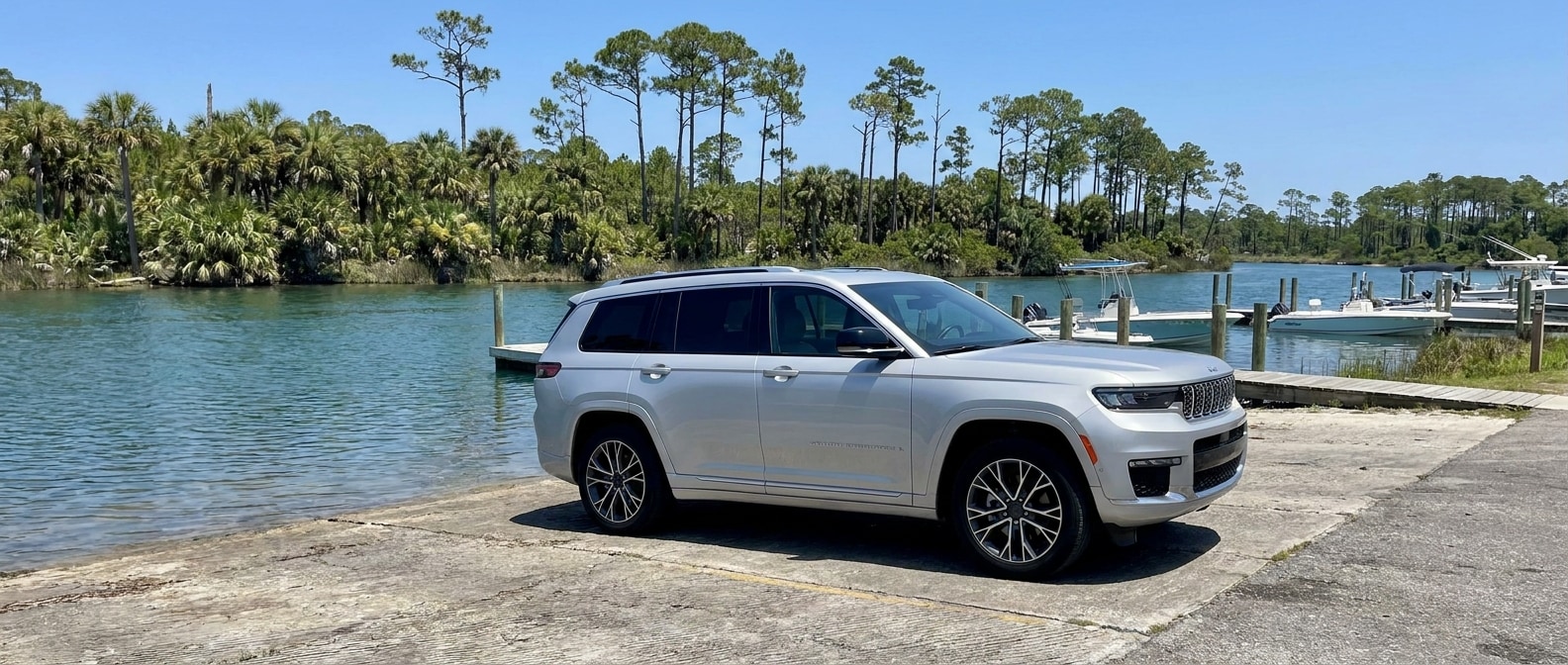
The Jeep Grand Cherokee L arrived for 2021 as the first three-row version of an icon. Five model years sit in the used market now, and they're not all the same truck. Some carry open NHTSA recalls that were never serviced. Some lost a full 1,000 lbs of tow capacity compared to earlier units. And at least one year range has a specific rear suspension defect that NHTSA reopened its investigation on as recently as late 2025. Bay County families deserve the straight story before they sign anything.
Browse our used SUV inventory at Bay Chrysler Dodge Jeep Ram
The short version
- Sweet-spot years: 2022 and 2023, where first-year issues are sorted and the 5.7L Hemi V8 is still an option with a 7,200-lb tow rating.
- The 2021 model year carries the most significant open recall concern. Always run the VIN on NHTSA.gov before buying one.
- The 2024 model year dropped the V8 and reduced maximum tow capacity to 6,200 lbs. Pricing is close to new, making it a harder value case.
- The 2025 model year is barely used metal with a low recall profile. Strong if the discount is real.
- Third-row legroom is 30.3 inches across every year of this generation. Great for kids. Honest but snug for adults.
Which Grand Cherokee L Years Are the Sweet Spot?
The 2022 and 2023 model years hit the right combination of resolved first-year bugs, maximum capability, and realistic used pricing. Both years still offered the 5.7L Hemi V8, which when paired with the factory Trailer Tow Package was rated for up to 7,200 lbs of towing on the Grand Cherokee L. That's a full 1,000 lbs more than any year of this SUV can manage today. For a Bay County family running a 21-foot center console or a dual-axle trailer out to St. Andrews Bay, that extra capacity isn't just a number (it's headroom on a 95-degree August afternoon with a full passenger load).
Cargo space stays consistent across all years. Jeep's published specs put the Grand Cherokee L at 17.2 cubic feet behind the third row with all seats up, 46.9 cubic feet with the third row folded, and 84.6 cubic feet maximum with both rear rows flat. That middle number (46.9 cubic feet) is where most families actually live on a beach run.
| Model Year | Engine | Max Tow (Properly Equipped) | 3rd-Row Legroom | Cargo (3rd Row Up) | Key Recall Watch |
|---|---|---|---|---|---|
| 2021 | V6 or V8 | Up to 7,200 lbs (V8) | 30.3 in | 17.2 cu ft | Rear coil spring (verify service on NHTSA) |
| 2022 | V6 or V8 | Up to 7,200 lbs (V8) | 30.3 in | 17.2 cu ft | Coil spring (many remedied), airbag software |
| 2023 | V6 or V8 | Up to 7,200 lbs (V8) | 30.3 in | 17.2 cu ft | Coil spring (some units), camera cable |
| 2024 | V6 only (V8 discontinued mid-year) | 6,200 lbs | 30.3 in | 17.2 cu ft | Camera cable, airbag connector |
| 2025 | V6 only | 6,200 lbs | 30.3 in | 17.2 cu ft | Airbag software (software update) |
See available Grand Cherokee models on our lot
Which Grand Cherokee L Years Should You Watch Out For?
Start with the 2021, and go in with your eyes open. It isn't a hard no, but it asks for the kind of due diligence that's easy to skip, because an open coil spring recall on that campaign is a genuine mechanical concern and not a quick software flash. Vet it and you can still land a lot of Jeep.
Per NHTSA, Stellantis recalled over 80,000 units of the 2021-2023 Grand Cherokee L for a rear coil spring defect. Springs may have been installed out of position during prior recall service and could, in rare circumstances, detach while driving. NHTSA reopened its investigation into the issue in December 2025 after at least 20 additional owner complaints suggested the original fix didn't resolve it on every affected vehicle. For a 2021 specifically, run the VIN on NHTSA.gov before anything else.
The 2022 and 2023 share a version of that recall, but the affected production window is narrower and most of those vehicles have been repaired. Their other open campaigns are software-only. NHTSA lists a transmission gear selection indicator glitch (dealers update the shifter module at no charge) and an occupant restraint controller software fix covering 2023-2025 model year units. Software recalls are service appointments, not teardowns.
One separate flag for anyone considering the Grand Cherokee 4xe plug-in hybrid from the 2022-2024 model years. NHTSA issued a fire-risk recall affecting over 35,000 PHEV units. Per the agency, owners of unrepaired 4xe vehicles were advised to park outside and away from structures. The standard V6 and V8 models carry no fire-risk issue.
Explore the Grand Wagoneer for a step-up in interior space
Per NHTSA, rear coil spring concerns affected more than 80,000 units of the 2021-2023 Grand Cherokee L (run any 2021's VIN before you buy).
Which Year Fits Which Bay County Buyer?
You tow a boat and want the highest-rated capacity. A 2022 or 2023 Grand Cherokee L with the 5.7L Hemi V8 and the Trailer Tow Package is the year to target. The tow rating ran 1,000 lbs higher than what the current V6 or Hurricane 4 allows. For a family launching from the public ramps near Shell Island or heading up to Lake Powell with a ski boat, that headroom on a full-load summer day is worth hunting down on purpose.
You want seven seats, reasonable used pricing, and minimal recall exposure. A 2023 Limited or Overland in solid condition is probably the strongest all-around pick right now. Most coil spring recalls on that year have been serviced. The camera cable recall is a straightforward fix. The interior step-up on Limited trim (heated seats, larger Uconnect screen, power liftgate) earns its keep in real daily use.
You want a clean-slate used option and can stretch the budget. A 2025 model year is barely used. The 3.6L Pentastar V6 carries a long field history, and the EPA rates it at 19 city / 26 highway / 22 combined mpg. Recall activity is low (the open airbag software recall is a dealer visit). The tradeoff is price. Expect 2025 units to sit close to new-model territory.
Your priority is the first-year deal and you're willing to vet it properly. A 2021 with documented recall service history and clean records can be a real value. Pull the NHTSA VIN report, get a pre-purchase inspection, and confirm the coil spring work is complete. If all three boxes check, the first-year Grand Cherokee L gives you a lot of three-row Jeep for the money.
A note on the third row. Thirty-point-three inches of legroom is the same across every year of this generation. Teenagers ride fine. A six-foot adult on a two-hour Panhandle road trip will let you know about it. Set those expectations before the third row becomes the deciding factor.
Check financing options at Bay Chrysler Dodge Jeep Ram
Frequently Asked Questions
Which year of the Jeep Grand Cherokee L should I avoid?
The 2021 model year isn't a hard avoid, but it needs the most scrutiny. Per NHTSA, more than 80,000 units of the 2021-2023 Grand Cherokee L were recalled for a rear coil spring defect. NHTSA reopened the investigation in late 2025 after new owner complaints. On any 2021, run the VIN at NHTSA.gov and confirm in writing that the recall was serviced. If that documentation is missing or the recall shows open, pass on that specific vehicle and look at a 2022 or 2023 instead.
How much can a used Jeep Grand Cherokee L tow?
It depends on the model year and engine. The 2021-2023 Grand Cherokee L equipped with the 5.7L Hemi V8 and the factory Trailer Tow Package was rated for up to 7,200 lbs. Once Jeep discontinued the V8 partway through the 2024 model year, maximum tow capacity settled at 6,200 lbs for the 3.6L V6 (which carries through to the 2025 model year and to the 2026 new model as well). For most Bay County boat owners, 6,200 lbs covers a typical 19-to-21-foot rig with room to spare. If you're pulling something heavier, aim at a pre-2024 V8 year on purpose.
Is the Jeep Grand Cherokee L third row actually comfortable?
For kids and shorter adults, yes. Jeep's published specs put third-row legroom at 30.3 inches and headroom at 37.3 inches, consistent across all years of this generation. It's a genuine improvement over minivan-style perches, but it's not a six-footer's long-haul seat. The cargo space behind the raised third row is 17.2 cubic feet (enough for a weekend bag or two but not a full beach-gear haul). Fold that third row down and the space opens to 46.9 cubic feet. Most families with older kids end up using that configuration most of the time.
Categories:
Social