





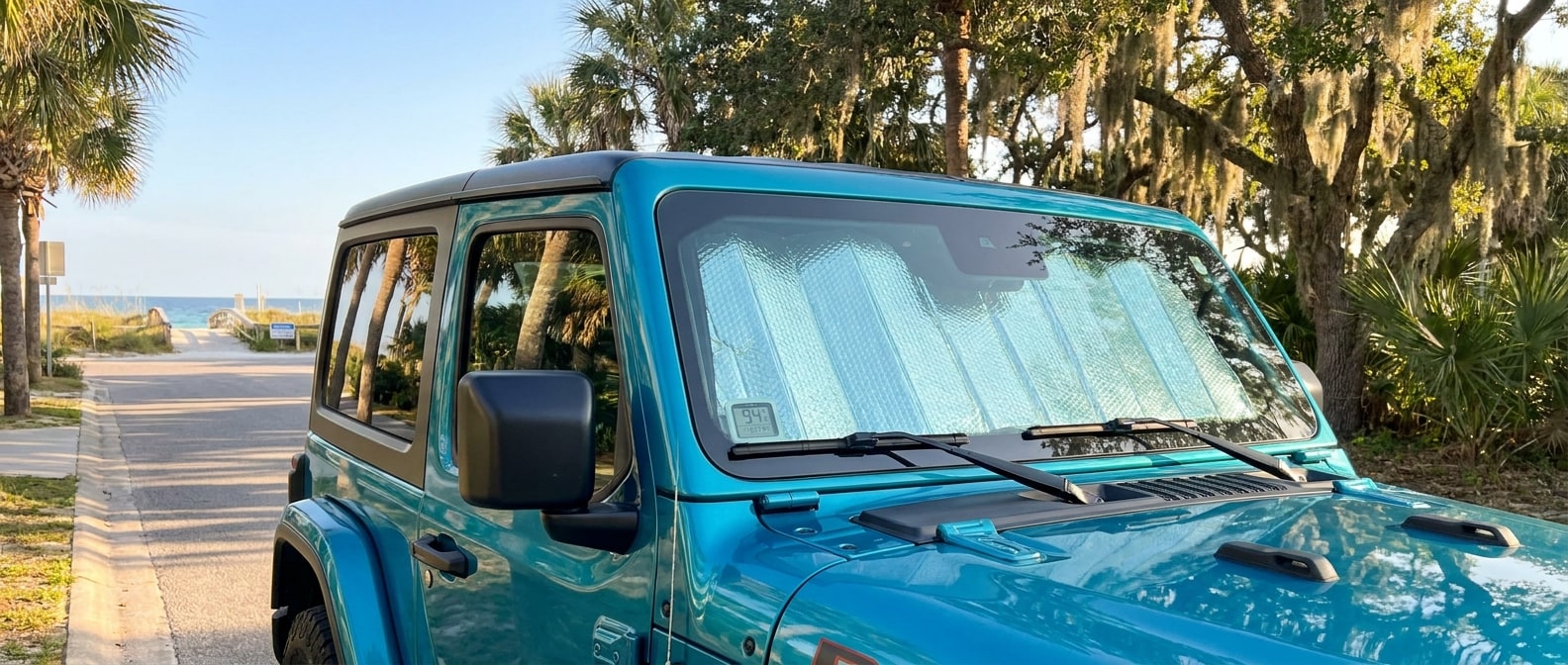
Panama City sits in what climate scientists classify as an "extreme" UV zone during summer. Right now, in August, the UV index here regularly peaks at 11 or 12 around midday. That reading is a health warning for your skin, sure. It's also cooking the plastic on your dashboard, one sunny afternoon at a time.
The National Weather Service reports that a dark dashboard surface inside a parked car can reach 180 to 200 degrees Fahrenheit in direct sunlight. On a typical August day in Panama City, where outdoor air temperatures hit the low 90s and humidity amplifies heat retention inside a closed cabin, that isn't a theoretical risk. It's Tuesday afternoon in a waterfront parking lot. The compounding effect on Gulf Coast vehicles is real, since UV breaks down the chemical bonds in plastic through polymer degradation while the sustained extreme temperatures cook out the plasticizers that keep that plastic flexible. The result is a dashboard that fades first, then crazes, then cracks outright.
The good news is that protecting your dash isn't complicated. It does take a consistent, layered approach, and it means more than tossing a sunshade in the back seat and hoping for the best.
Jeep Wrangler owners, Ram truck drivers, and anyone else parking outdoors near the Gulf in August needs a real plan. Here's what we've worked out based on what we see on vehicles coming through our lot.
How Bad Is the UV Here, Really?
August in Panama City rates as "extreme" on the UV index scale, a full step above "very high," and that classification matters for your interior because the UV your dashboard absorbs compounds instead of stacking up in a straight line. Once you understand that, the rest of the plan makes sense.
Think of it less as arithmetic and more as a snowball. A surface that takes 20 minutes of direct UV one day and another 30 the next takes more damage than the simple sum of those two hits. The chemical damage from that first exposure leaves the material more vulnerable to the second. By the time you spot visible fading or the first hairline crack, the breakdown has been building for months.
Below is a practical breakdown of the protection layers available to you, and what each one actually does:
| Protection Layer | What It Blocks | Effort Level | Real-World Impact |
|---|---|---|---|
| Reflective windshield sunshade | UV + infrared radiation | 30 seconds, every park | Reduces cabin temp by up to 30 degrees F; directly shields the dash surface |
| Window film (legal tint) | UV rays through side glass | One-time professional install | Cuts UV entry from the sides; rear windows on SUVs/trucks can go to 6% VLT in Florida |
| UV-rated dashboard protectant | Surface-level UV absorption | 5-10 minutes, monthly | Replenishes surface protection as it depletes; prevents dry-out cracking |
| Dashboard cover/mat | Direct light contact entirely | Install once, use daily | Physical barrier; zero UV reaches the surface it covers |
| Shade or covered parking | All radiation, all the time | Habit change | Most effective single action; eliminates the source |
The EPA and climate data both back this up. UV exposure doesn't take a break because you drove to the beach for an hour. It piles up on every window-facing surface from the moment the sun hits the glass.
Where and When Does the Damage Happen Most?
Most of the damage happens during the working day rather than on weekend beach runs, because Panama City's UV index climbs to its highest levels between 10 a.m. and 4 p.m., which is exactly when a lot of vehicles sit parked in an exposed lot for hours at a stretch. Your commute is quietly the main event.
The peak lands right at noon to 1 p.m., though the index stays punishing from mid-morning through late afternoon. For anyone parking in an exposed lot at work or near the downtown waterfront, that adds up to five to six hours of direct UV five days a week. Weekend use is the smaller slice of the exposure equation. Your commute does most of the damage.
A few patterns we see on vehicles at Bay Chrysler Dodge Jeep Ram that make the Gulf Coast context specific:
- Open-top and soft-top Jeep Grand Cherokee and Wrangler owners who leave soft windows partially rolled often get more side-glass UV hitting the passenger-side dash.
- Truck owners who park cab-forward (facing south or west for afternoon sun) during work-site days take concentrated late-afternoon UV through the windshield on the driver's side dash.
- Vehicles parked at beach-access areas often face southwest through afternoon hours, which is the highest-intensity angle for direct sun entry into a windshield.
The salt-air humidity here does something drier climates don't. It traps heat inside a closed cabin longer. The National Weather Service data shows that a closed car interior on an 80-degree day hits 109 degrees F in just 20 minutes. In Panama City's August humidity, that cabin holds even more heat, and that sustained warmth is what drives the plasticizers out of the plastic, turning a flexible surface into a brittle one.
One note on Florida tint law, since it comes up often. Under Florida Statute 316.2953, front side windows must allow at least 28% visible light transmission. For SUVs, vans, and trucks, rear side windows and the rear window can legally go down to 6% VLT. That means Wrangler, Ram, and schedule a service appointment customers who drive SUVs or trucks have more rear-window tint options than sedan drivers, which translates to meaningful additional UV blockage on the back half of the cabin.
Schedule a Vehicle Interior Check
Panhandle heat caution: A reflective sunshade reduces cabin temperature by up to 30 degrees F. But it needs to be the right fit. A universal-size shade that leaves gaps on the edges of your windshield still lets direct UV reach the corners of your dashboard. Measure your windshield or buy a vehicle-specific shade for full coverage. Partial coverage still means partial damage.
Your Dashboard Protection Checklist
Print-and-go checklist for Gulf Coast vehicles parking outdoors:
- [ ] Keep a properly sized, reflective windshield sunshade in the vehicle and deploy it every time you park in direct sun
- [ ] Apply a UV-rated dashboard protectant (formulated for hard interior plastics, not a leather conditioner) once a month during summer months
- [ ] Check your window tint: Florida law allows front side windows at 28% VLT minimum; SUVs and trucks can go darker on rear windows, which reduces UV entering the cabin
- [ ] Orient your parking when possible to keep the windshield out of the noon-to-4 p.m. southwest sun angle
- [ ] Wipe down the dashboard with a clean microfiber cloth before applying any protectant; applying product over dust causes micro-scratches that accelerate UV damage
- [ ] Inspect the dash surface every few months for early chalking or dullness. That's the first sign of polymer degradation, not cosmetic wear
- [ ] If you see crazing (fine surface cracks with no depth), act now: deep cracking follows fast, and replacement is significantly more expensive than prevention
Plan Your Protection This Way
Layers work better than any single fix, so build your protection in stages and lean on the easy daily habit first, then add the more involved steps as your parking situation and budget allow. Nobody has to do all of it at once.
A sunshade alone is a strong first step. A sunshade plus monthly UV protectant application cuts the cumulative exposure more than either does alone. Adding legal window tint (especially on the rear windows of a Ram 1500 or an SUV, where Florida law gives you more flexibility) takes the interior UV load down another notch. The habit that makes the biggest single difference, though, is consistent shade parking when you have the choice.
For vehicles that are already showing early UV damage (that dull, slightly chalky texture on a black plastic dash), a good UV-rated conditioner can slow the progression. It won't reverse cracking that's already happened. But it can stabilize surface degradation before it reaches the stage where replacement is the only option.
Now the honest tradeoff. The most thorough protection setup (professional ceramic window film, custom dashboard cover, and monthly protectant) takes some upfront investment of time and, for the film, a shop visit. The cheap, consistent version is a proper reflective sunshade deployed every single time you park outside. It still makes a real difference, reducing the cabin temperature by up to 30 degrees F, which directly slows the rate at which your dash surface loses its plasticizers.
In August on the Gulf Coast, the sun isn't gentle. Plan accordingly, and your interior stays cleaner for longer.
Frequently Asked Questions
Does a cheap sunshade actually protect my dashboard from UV in Florida heat?
A reflective windshield sunshade does two things: it blocks UV from reaching the dashboard surface directly, and it reduces cabin air temperature by up to 30 degrees F according to automotive testing data. The limitation is fit. A universal sunshade that doesn't cover the full windshield leaves UV gaps at the edges where direct sun still reaches the dashboard corners. For Gulf Coast vehicles parking outside daily, a vehicle-specific or properly sized reflective shade is worth the extra investment over a universal one.
How does Florida's window tint law affect how much UV protection I can get on my vehicle?
Under Florida Statute 316.2953, front side windows must allow at least 28% visible light transmission (VLT), which limits how dark front-window tint can be. However, for SUVs, vans, and trucks, Florida law allows rear side windows and the rear window to go down to 6% VLT (a much darker, more UV-blocking film). If you drive a Wrangler, Ram 1500, or any SUV in our lineup, you have significantly more rear-window tint options than sedan drivers, which reduces the UV load entering the back half of your cabin.
How quickly does sun damage actually show up on a dashboard here in Panama City?
Faster than most drivers expect. Panama City's summer UV index hits the "extreme" category (index 11-12) from May through August, and the NWS confirms that dark plastic dashboard surfaces can reach 180 to 200 degrees F in a parked car in direct sun. UV damage begins at the molecular level through polymer degradation before any visible fading appears. By the time a dashboard looks dull or chalky, the degradation has typically been accumulating for several months. Visible cracking usually follows within one to two more summers of unprotected exposure if nothing changes.
Categories:
Social