




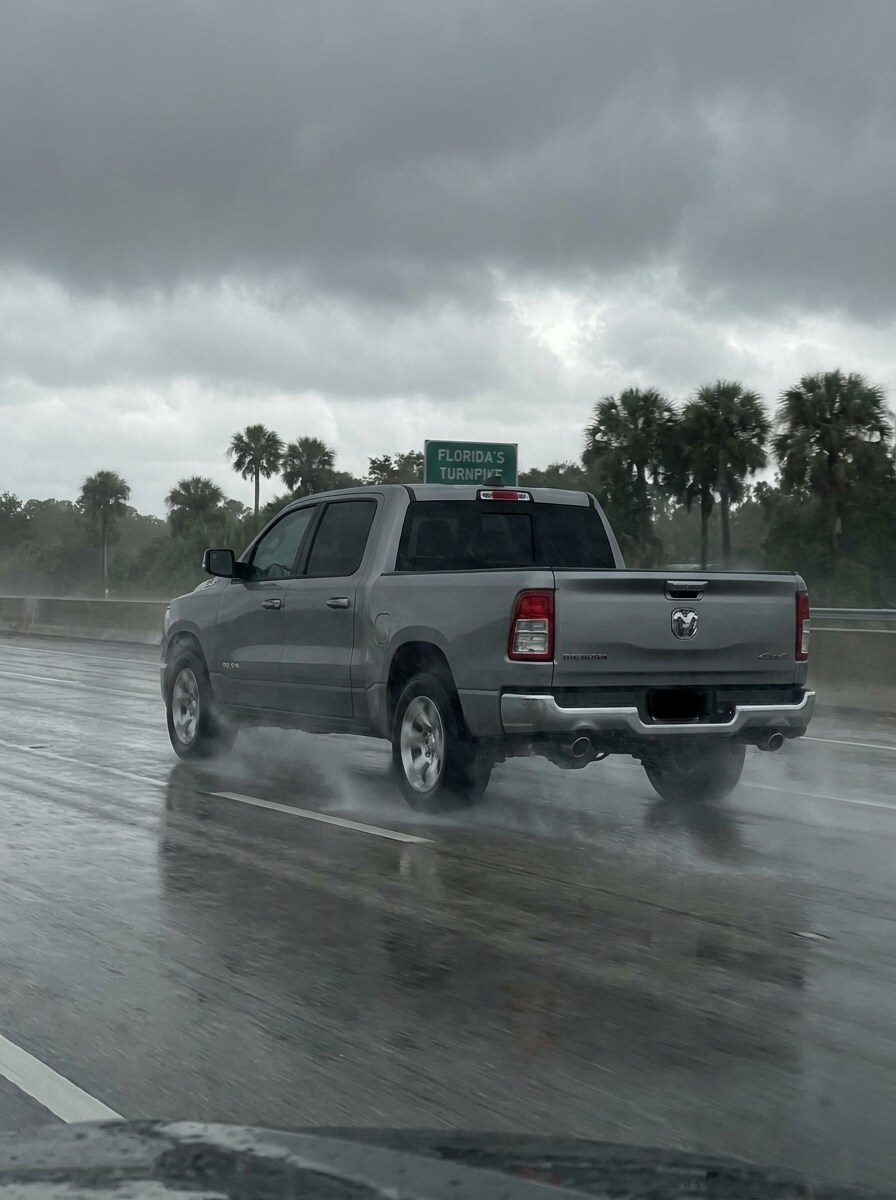
August in Panama City is not a suggestion. Historical climate data shows this month averages right around 10 inches of rain spread across nearly 19 days. We're not talking about a rainy afternoon here and there. We're talking about a sustained wet-road season that lasts from June through September. Tires that perform fine in a Georgia spring shower get outclassed fast down here. For a 2026 Ram 1500, the right choice depends on three things your tire shop may not connect for you. Start with your trim's factory tire size, add the tire category that fits your actual driving pattern, and finish with the UTQG traction grade stamped on the sidewall. Get all three right and the truck does its job. Miss one and you're asking a big half-ton to handle standing water on a wet highway on equipment that wasn't built for it.
Browse our current Ram 1500 inventory to see which trim is right for your situation before you decide on rubber.
- Touring all-season (AA UTQG traction grade): Best pick for daily drivers and highway commuters on Tradesman, Big Horn, or Laramie builds. Most balanced wet-road choice for Florida's rainy season.
- All-season highway truck tire (A grade, load-matched): Right call if you tow or haul regularly and need the load index margin. Gives up some hydroplaning resistance versus a touring tire.
- All-terrain (LT-rated): Factory-correct for the Rebel. Workable for mixed use, but the aggressive tread pattern trades wet-road refinement for dirt capability.
- Check tread depth first: If your current tires are at or below 4/32 inch, the category debate is moot. Worn tread kills wet-road safety faster than any tire brand choice.
- Size matters: The 2026 Ram 1500 runs three different factory widths across its trim range. Stay in your OEM size unless you know what you're changing.
What Actually Matters When Choosing Tires for Wet-Road Ram 1500 Driving?
Four variables make or break a tire decision on a full-size truck in a Gulf Coast summer, and they don't work in isolation. They interact in ways worth walking through before you buy.
| Variable | Why It Matters for the Ram 1500 | Key Spec to Confirm | Tradeoff |
|---|---|---|---|
| UTQG Traction Grade | NHTSA grades wet straight-line braking AA, A, B, C (AA = highest stopping force) | Check the sidewall or product listing | AA grip compounds often wear faster than A-grade |
| Tread depth (current tires) | At 4/32 inch, water evacuation drops sharply; AAA research found up to 87-foot longer wet stopping distance vs new tires | Penny test: Lincoln's head visible = replace | No tire category fixes dangerously low tread |
| Load index | Ram 1500 is heavy; a load index below 121 on a standard-height build is a safety issue, not a comfort preference | Must match or exceed OEM placard rating | Higher load index sometimes means stiffer ride |
| Tire category | Touring all-season vs all-terrain vs highway truck tire. Each has a different wet-groove architecture | Match to how you actually drive (highway, trail, tow) | All-terrain tread grooves aren't optimized for standing water |
One tradeoff is easy to miss here. An aggressive all-terrain looks capable, but its tread void ratio is tuned for dirt, not for the sheet-flow water you hit on US-98 after a thunderstorm rolls in off the Gulf. A good touring all-season with an AA traction grade will out-brake it on wet asphalt. That doesn't make the all-terrain a bad tire.
It's the wrong tool on pavement.
Tread Depth Is the Variable That Overrules Everything Else
Tread depth overrules category, brand, and price, so check your existing tires before you buy anything new. You'll save real money.
When a tire can no longer displace standing water fast enough, it hydroplanes, and NHTSA's own guidance establishes that this is exactly what the tread channels are there to prevent. At 4/32 inch of remaining depth, water evacuation drops sharply. AAA research showed that tires worn to 4/32 inch can increase wet stopping distance by up to 87 feet compared to new tires at 60 mph. Eighty-seven feet. On a truck that already weighs over 4,500 pounds, that number isn't abstract.
The quarter test gives you a quick field read. Insert a quarter into any major tread groove with Washington's head down. If you can see the top of his head, you're at or below 4/32 inch. At that point, no brand name on a new tire matters more than replacing what's on the truck right now.
Schedule a tire inspection with our service team if you're not sure where your tread depth stands.
Matching the Right Tire Category to Your 2026 Ram 1500 Trim
The 2026 Ram 1500 doesn't run one tire size across the lineup. It runs three distinct factory setups depending on trim, and the category decision changes with each one.
See which 2026 Ram 1500 trims we have in stock to confirm your build before comparing options.
Tradesman and Big Horn on 18-inch wheels (275/65R18): These trucks leave the factory on P-metric tires in a highway-biased all-season category. For Panama City daily driving, that setup already handles wet roads well. You'll want at least an A UTQG traction grade, and AA is better. The 275/65R18 footprint is wide enough to channel water effectively. Stay in this size, stay in the all-season category, and put the traction grade ahead of brand recognition.
Laramie and Limited on 20-inch wheels (275/55R20): The step up to 20-inch wheels means a lower-profile sidewall. Lower profile means less sidewall flex to absorb the impact of water-filled road divots, which matters on older Panhandle road surfaces after a heavy rain. The category recommendation stays the same, touring all-season with an AA or A traction grade. Pay attention to the temperature rating on the sidewall, because Florida asphalt holds heat and it doesn't let go quickly. A temperature-A rated tire (highest heat dissipation rating per NHTSA) handles sustained Gulf Coast summer driving better than a temperature-B option.
Rebel on 18-inch wheels (275/70R18 LT): The Rebel is the one trim where the wet-road conversation shifts. It comes factory with LT-rated all-terrain tires. They're built for mixed use, and if you're actually running them on dirt roads, through beach access points, or on trails up near the Apalachicola forest, the all-terrain is the correct tool. Here's the genuine tradeoff. LT all-terrain tires run higher void ratios optimized for ejecting mud and sand rather than channeling sheet water the way a touring all-season does. On wet Florida highway pavement, a comparable all-season will stop shorter. If your Rebel stays on pavement 90 percent of the time, the case for replacing it with a highway all-season at replacement time is real. If it earns that Rebel badge on actual terrain, keep the all-terrain category and replace with an equivalent LT-rated option. Just confirm the load index matches or exceeds the door-jamb placard.
| Pros | Cons |
|---|---|
| All-season touring: strong wet braking, AA traction grades available | Softer compounds may wear faster under heavy towing |
| All-terrain (Rebel): handles sand, dirt, and soft terrain confidently | Lower wet-asphalt performance vs touring all-seasons; noisier on highway |
| Higher load-index truck tire: maintains payload margin | Stiffer ride; can feel harsh on Florida's rougher surface streets |
| OEM size match: no speedometer drift, no suspension stress | Limits some aftermarket upgrade options |
View our current new Ram inventory if you're in the market for a specific trim.
Match the Gear to How You Actually Drive
For a Ram that lives on Panhandle highways in the rain, the simplest answer holds up well. If you drive US-98, US-231, or any Panhandle highway in the rain and your Ram doesn't go off-road, get a touring all-season with a UTQG traction grade of AA or A and a load index that matches your door-jamb placard. You don't need an aggressive all-terrain on pavement, and you don't need a performance summer tire in a climate that runs hot and wet for months. Nothing fancy about it.
If you tow regularly, you'll want to confirm the load index first. A tire rated below the Ram's placard spec is a safety issue regardless of wet-weather performance. If you use the Rebel for actual trail access, keep the LT all-terrain category at replacement time and prioritize load index over everything else.
And regardless of what you buy, check your current tread depth before spending a dollar. Tires at 4/32 inch or below in a rainy season are the problem, not the brand name on the new tires you're shopping.
Our service team can inspect your current tires, confirm your OEM size from your door-jamb placard, and we'll help you sort out whether you need new rubber before the next Gulf Coast storm rolls in.
Frequently Asked Questions
What UTQG traction grade should I look for on tires for a Ram 1500 in Florida's rainy season?
Per NHTSA, traction grades from highest to lowest are AA, A, B, and C. They measure the tire's ability to stop on wet pavement in straight-line braking. For a Ram 1500 driven on wet Gulf Coast roads during Florida's rainy season, June through September, aim for AA or A. The AA grade indicates the strongest wet braking performance in the NHTSA's standardized test. Keep in mind that the traction grade measures straight-line stopping only. It doesn't score hydroplaning resistance or cornering grip, both of which also depend on tread depth and tread groove design.
Do I need different tires on a Ram 1500 Rebel versus a Big Horn for Florida driving?
Yes, and the reason comes down to the factory setup rather than personal preference. The 2026 Ram 1500 Rebel leaves the factory on LT-rated 275/70R18 all-terrain tires designed for mixed on-off-road use. The Big Horn on 18-inch wheels runs a P-metric 275/65R18 all-season highway tire. If your Rebel spends most of its time on pavement, including wet Florida highway miles, a touring all-season replacement will outperform the factory all-terrain in wet straight-line braking. If it earns its trail use, keep the LT all-terrain category but replace with an equivalent LT-rated tire that matches the load index on your door-jamb placard. The Big Horn's all-season setup already suits rainy Florida roads, so you'll replace in kind with an AA or A traction grade.