




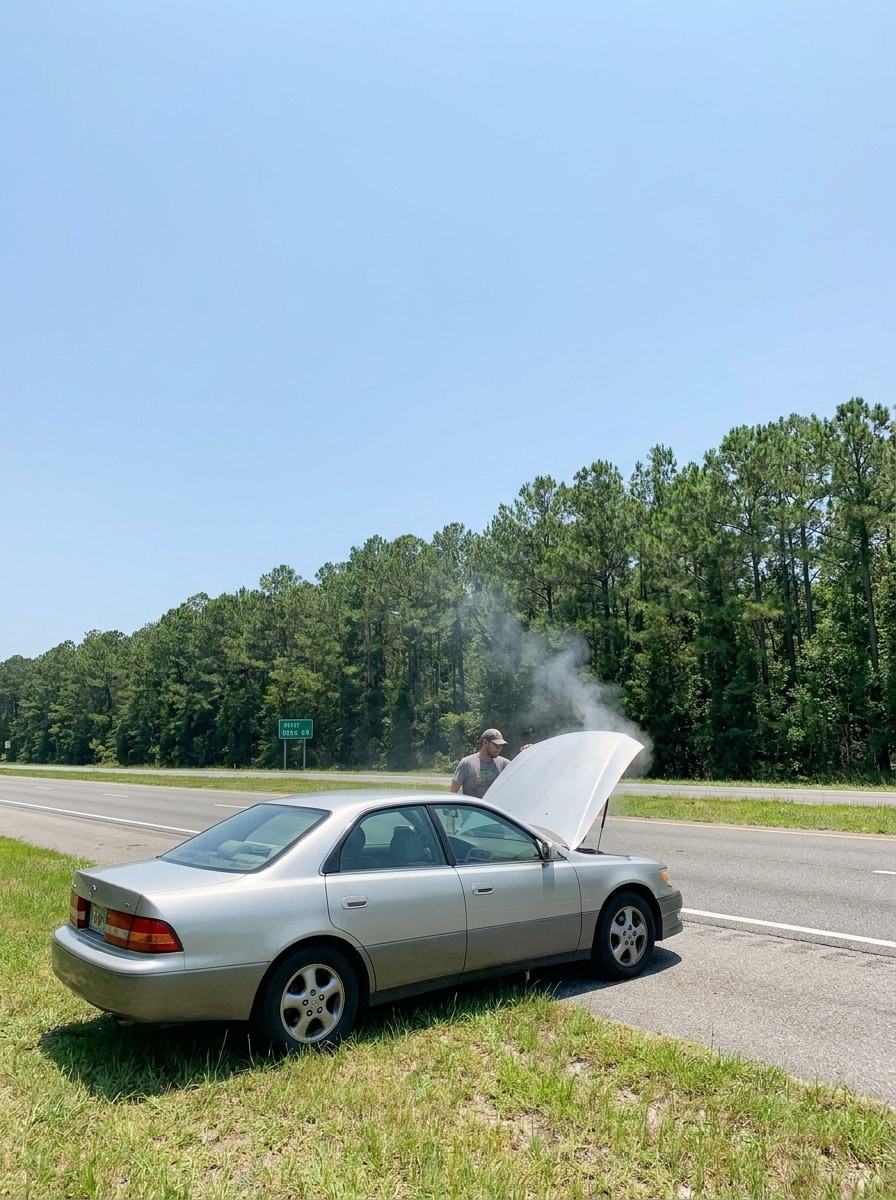
August in Panama City is no month to ignore your dashboard. With a heat index that regularly hits 102 degrees Fahrenheit along the US-231 corridor, your cooling system is already working harder than it would in October. Add stop-and-go tourist traffic between Youngstown Road and the 15th Street intersection, and a marginal cooling system that felt fine in March can fail fast.
The short answer's simple. Pull over, shut the engine off, and don't keep driving to "the next exit." That instinct costs real money and, in the worst cases, a whole engine.
If you're shopping for a vehicle built to handle Florida summer demands, explore the Jeep Grand Cherokee lineup while you're here.
How Does a Cooling System Actually Work?
Your engine runs hot by design, and the cooling system's whole task is to hold that heat inside a tight window rather than remove it, keeping most passenger vehicles between 195 and 220 degrees Fahrenheit. So the goal isn't a cold engine. It's a controlled one, second by second.
Here's how the system does it. Coolant (a 50/50 mix of antifreeze and water) circulates through passages in the engine block, absorbs heat, then travels to the radiator, where airflow strips that heat away before the cooled fluid heads back in. The thermostat plays gatekeeper. When the engine's cold, it stays shut to warm things up fast, and once you hit operating temperature it opens and lets coolant run the full loop. The water pump keeps everything moving. If that pump fails, coolant sits still, and a still engine cooks itself.
On a hot August afternoon on US-231, your A/C is running full blast. That compressor piles extra load on the engine, and the radiator has to fight ambient air that's already near 90 degrees Fahrenheit. The thermal margin between "normal" and "too hot" gets thin fast.
The concept-comparison table below lays out the five major cooling system failures, what causes them, and how quickly each one turns serious.
| Failure | What Goes Wrong | Time to Serious Damage | Key Warning Sign |
|---|---|---|---|
| Low coolant | Not enough fluid to absorb and carry heat | Minutes in heavy traffic | Gauge rises, no visible leak |
| Stuck thermostat (closed) | Coolant can't flow to radiator | 5-10 minutes at operating load | Rapid gauge climb from cold |
| Failed water pump | Coolant stops circulating entirely | Very fast, even at idle | Gauge climbs with no other cause |
| Clogged or leaking radiator | Heat can't transfer to outside air | Slower onset, worsens with speed | Gauge climbs on highway, ok in city |
| Blown head gasket | Coolant enters combustion chamber | Already there; damage is happening | White exhaust smoke, sweet smell |
A stuck-closed thermostat and a failed water pump escalate the fastest, because neither gives you a meaningful warning before the gauge enters the red zone.
What Should You Do the Moment You See the Red Zone?
Stop as soon as it's safe, and though that sounds obvious, the details underneath it decide whether you walk away with a minor cooling fix or a towed vehicle and a warped head. Getting off US-231 and shutting the engine down quickly is the move that keeps the damage small.
First, if you've got a few seconds of warning before the gauge maxes out, kill the A/C right away and crank the heater to full. Yes, the heater. The heater core is a small secondary heat exchanger inside your cabin, and running it pulls heat off the engine and into the passenger compartment, which can buy you 60 to 90 seconds to reach a safe pull-off. Running the heater in August is miserable. Do it anyway. If the gauge starts dropping back toward the middle, you caught it in time.
If the gauge is pegged or you see steam from under the hood, don't open the hood yet. Pull completely off US-231 and shut the engine off. The cooling system is pressurized when hot. Opening the radiator cap on a hot engine can release scalding coolant and cause serious burns. Wait 15 to 30 minutes minimum before you touch anything under there.
Once the engine is fully cool:
- Check the coolant reservoir (the small translucent tank near the radiator, not the radiator cap itself). If it's at or below the minimum line, coolant loss is part of the problem.
- Look under the vehicle. A puddle of green, orange, or pink fluid means an active leak. Don't add coolant and drive on. That leak is still there.
- Add coolant if the reservoir is low and there's no visible leak. Use a 50/50 premix, or plain water in a genuine emergency. Plain water is a temporary fix only and needs to be flushed afterward.
- Start the engine and watch the gauge for two to three minutes. If it climbs again, shut it off. You'll need a tow.
- If the gauge stays in the normal zone, drive directly and carefully to a service shop. No highway speed, no A/C, and keep an eye on that gauge the whole way.
Schedule a Cooling System Inspection
What Damage Are You Risking If You Keep Driving?
Keep driving on an overheating engine and you're trading a small, fixable problem for a big one, sometimes in the space of a few miles. We see both outcomes at the counter, and the difference usually comes down to whether the driver stopped early or pushed for one more exit.
When engine temperature exceeds the normal operating range for even a few minutes, aluminum cylinder heads expand faster than the cast-iron block below them. That uneven expansion warps the head, a warped head can't seal against the block, and the head gasket fails. Once the gasket goes, coolant enters the combustion chamber, oil gets contaminated, and the damage compounds. You'll see white exhaust smoke, a rough idle, and coolant loss you can't explain. At that stage you're well past a coolant flush.
The other failure mode is piston damage. Excessive heat makes fuel detonate early inside the cylinder, and those pressure spikes can chew up pistons and rings in minutes at highway speed. Sustained highway running, like the stretch of US-231 heading toward I-10, produces more combustion heat than city driving does, so it speeds up every one of these failure modes.
The practical takeaway from our service team is plain. A vehicle that gets pulled over right away and towed will almost always have a repairable cooling system problem. A vehicle that drives another five miles trying to make it to a shop often has a warped head or worse waiting for it at the end of that trip. The math is that blunt.
Quick Reference: Cooling System Terms
| Term | What It Means in Plain Language |
|---|---|
| Coolant | The fluid (antifreeze mixed with water) that absorbs engine heat and carries it to the radiator |
| Thermostat | A valve that opens when the engine is warm enough, letting coolant flow to the radiator |
| Water pump | The pump that keeps coolant circulating; if it stops, so does cooling |
| Head gasket | The seal between the engine block and cylinder head; failure here is a serious repair |
What This Means for Your Next Vehicle
Sometimes a cooling failure is just bad luck, a cracked hose or a seized thermostat with no warning at all. A lot of the time, though, it traces back to deferred maintenance on a vehicle that was already dropping hints, and those hints show up plainly in an inspection. Think of a reservoir that kept needing a top-off, a temperature gauge that ran a little high on hot days, a coolant flush that got skipped. Those patterns tell a story.
If you're at the point where you're wondering whether your current vehicle is worth the next repair bill, that's a real conversation worth having. We carry new inventory across the Jeep, Ram, Chrysler, and Dodge lineups, and our team is straightforward about what your repair costs now versus what a newer vehicle's payment looks like over time. No pressure in that conversation. Just honest information.
A vehicle that shrugs off Bay County heat starts with a cooling system that was never pushed past its limit. Protecting that system comes down to the simplest move there is. When the gauge climbs into the red near US-231, the right move is to pull over and shut it down.
Frequently Asked Questions
What does it mean when my temperature gauge goes into the red zone?
It means your engine coolant has climbed past its normal operating range, which sits between 195 and 220 degrees Fahrenheit for most vehicles. The engine's making more heat than the cooling system can carry away. In Panama City's August heat, that happens quickly when the A/C is running, traffic is slow, and a cooling system component (the thermostat, water pump, or radiator) is already marginal. Pull over and shut the engine off. Don't wait to see if it drops on its own while you keep driving.
Can I drive to a shop if my car overheats, or do I need to call a tow?
It depends on what the gauge does after you let the engine fully cool (at least 15 to 30 minutes) and check the coolant level. If the reservoir was simply low, you topped it off, and the gauge settles back into the normal zone after restart with no visible leak under the vehicle, a careful, low-speed drive to a nearby shop is reasonable. Watch the gauge the entire time and keep the A/C off. If it climbs again within a few minutes of restarting, stop immediately and call a tow. Driving on an overheating engine risks warped cylinder heads and head gasket failure, both of which are significantly more expensive repairs than whatever caused the initial overheating.