




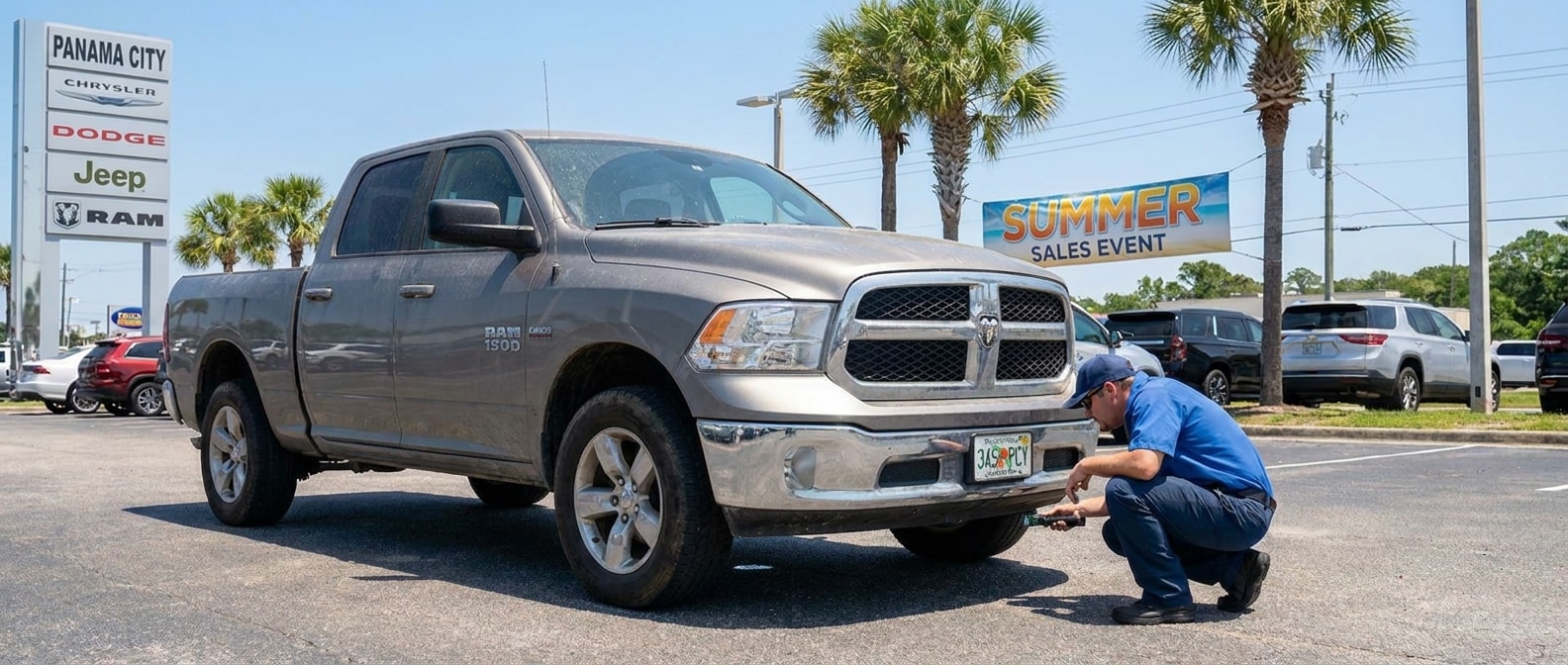
Buying used in Bay County is a genuinely smart move, and it can still go sideways fast if you walk onto the lot without a plan. A methodical, on-site inspection (done by you, before the paperwork) catches the issues that matter most here on the Gulf Coast. Print this checklist, walk it with every vehicle you're serious about, and you'll know what to ask our team before you commit to anything.
Browse our current pre-owned inventory to find a vehicle worth inspecting.
What Goes on the Inspection Checklist?
Work through these items in the order they're listed, since the sequence saves you time and keeps you from doubling back. Start outside in daylight where paint and rust show clearly, then move inward to the flood-check points, and finish with the drive that confirms whatever the static inspection turned up.
DOCUMENTS AND VIN (do this first)
- [ ] Pull the VIN from the dashboard (visible through the windshield, driver's side) and confirm it matches the door jamb sticker and the title
- [ ] Run a free NHTSA recall check at nhtsa.gov using the VIN. Any open safety recall should be resolved before purchase.
- [ ] Check the title brand, since "salvage," "rebuilt," "flood," or "lemon law buyback" all require deeper scrutiny and full disclosure
- [ ] Confirm the odometer reading matches the vehicle history report; per NHTSA, odometer fraud affects a meaningful share of used vehicles each year
- [ ] Verify no lien is outstanding. A vehicle sold with an undisclosed lien cannot legally transfer clean title.
EXTERIOR WALKAROUND (do this in direct sunlight)
- [ ] Look for mismatched paint, uneven body panel gaps, or overspray on rubber trim and glass (signs of prior collision repair)
- [ ] Check all four door jambs for rippled metal or fresh seam sealer, which indicate structural repairs
- [ ] Inspect the undercarriage front to back, where surface rust on suspension components is common, but thick, scaly rust on the frame rails, brake lines, or fuel lines is a structural and safety concern
- [ ] Look for waterlines on the frame or floor pans. A faint tide-mark discoloration is a flood indicator that survives a detail job.
- [ ] Check wheel wells for rust starting at spot-welds or seams; these are the first points to go in a coastal environment
UNDER THE HOOD
- [ ] Oil dipstick, where oil should be amber to dark brown, not milky (milky means coolant mixing in, which points to a head gasket issue)
- [ ] Coolant reservoir should be at the full line and a uniform color; rust-colored coolant means the system hasn't been serviced
- [ ] Check belts for cracking or glazing; hoses should feel firm, not spongy or brittle
- [ ] Look for fresh undercoating spray near the engine bay firewall. Sellers sometimes use it to hide leaks.
- [ ] Battery terminals show white or blue-green corrosion buildup extremely often in Gulf Coast vehicles due to humidity; heavy buildup on a relatively new vehicle suggests neglect
INTERIOR AND FLOOD CHECK
- [ ] Pull back the floor mat edges at the lowest corners. Check the carpet backing for stiffness, discoloration, or a tide-mark line.
- [ ] Check the spare tire well in the trunk for standing rust, staining, or a musty smell
- [ ] Pull the rear seat belts all the way out. Rust on the seat-rail bolt heads (which are normally shielded from moisture) is a strong flood indicator.
- [ ] Check inside the headlights and taillights for condensation or fogging; water intrusion inside sealed lamp housings points to flood or major storm exposure
- [ ] Note any persistent musty or mildew smell. Detailing can reduce it but rarely eliminates it.
ELECTRONICS AND CLIMATE
- [ ] Test every powered window, lock, and mirror; test the horn
- [ ] Run the air conditioning on MAX cold for two minutes. A unit that blows warm after 90 seconds in a Florida August needs immediate attention.
- [ ] Cycle every dash warning light: turn the ignition to "on" without starting and confirm all expected warning lights illuminate, then clear when you start
- [ ] Check the infotainment screen, backup camera, and any driver-assist systems for function
- [ ] Ask about an OBD-II scan (our service team can run one), since it reveals pending fault codes that don't yet trigger a dashboard warning light
TIRES AND BRAKES
- [ ] Check tread depth at multiple points across each tire; uneven wear on the inside or outside edge indicates alignment or suspension problems
- [ ] Confirm all four tires are the same brand and size. Mismatched tires suggest inconsistent maintenance or unreported damage.
- [ ] Listen for brake grinding or squealing on the test drive; feel for vibration or pulling under firm braking
TEST DRIVE
- [ ] Highway speed, where you listen for vibrations or shimmy (wheel balance, suspension wear)
- [ ] At low speed over a rough patch, listen for clunks from the front end (ball joints, sway bar links) and rear (leaf springs, shocks)
- [ ] Transmission shifts should be smooth and prompt; hesitation, hard clunks, or a delay from park to drive are red flags
- [ ] Engine should show no smoke from the tailpipe once warm; a brief puff of blue-gray smoke on cold start that clears quickly is less concerning than persistent white or black smoke
Why These Items Matter More in Panama City Than You Might Expect
Generic inspection guides are written for a national audience, and most of that advice still holds here, but Bay County piles on a few specific hazards that make some line items far more critical than they look on paper. We'll walk through the three that carry the most weight on the Gulf Coast.
The flood history context. Bay County has been part of 30 federal disaster declarations for flooding, hurricanes, or severe storms, according to FEMA data. Hurricane Michael made landfall near Mexico Beach in October 2018 as a Category 5 storm, causing widespread damage to the region per the City of Panama City's official hurricane records. Tropical storm conditions from Hurricane Helene in 2024 were enough to flood portions of Panama City neighborhoods that already dealt with recurring storm drainage issues. All of that history means flood-affected vehicles are realistically present in any regional used-car pool, including ones that were cleaned, dried, and resold without full disclosure.
The flood check items on this list (the floor-mat edges, seat-rail bolt rust, taillight condensation, spare-tire well) aren't paranoia. They're calibrated to this specific market.
Have our service team run an OBD-II scan on any vehicle you're considering before you sign.
The salt-air and humidity layer. The Gulf Coast environment accelerates corrosion in ways inland buyers never deal with. Salt carried in coastal air acts as an electrolyte, speeding up the electrochemical oxidation process on bare or compromised metal. You'll spot it as battery terminal buildup, brake-line surface rust, and weatherstripping deterioration on vehicles that look fine otherwise. When we put a vehicle on our lift for inspection, the undercarriage tells a more complete story than the exterior ever does.
Learn more about what our team looks for in a pre-owned vehicle at Bay Chrysler Dodge Jeep Ram.
The "northern import" complication. Used vehicles routinely travel south from states where winter road-salt treatment is heavy (Ohio, Michigan, Pennsylvania, and the northeast corridor). Those vehicles arrive with existing undercarriage corrosion that accelerates once it meets Gulf Coast humidity. A clean-looking truck from a northern state can hide significant frame-rail or brake-line rust that only shows on a lift inspection.
Key Items vs. Why They Matter Here
| Inspection Item | Why It Carries Extra Weight in Panama City |
|---|---|
| Undercarriage frame rails | Gulf Coast humidity plus any prior storm surge equals accelerated corrosion beyond what the exterior shows |
| Floor-mat corners and carpet backing | Flood-damaged vehicles are periodically recirculated in post-storm used-car markets; stiffness or tide marks survive detailing |
| Battery terminal corrosion | High ambient humidity causes buildup even without neglect; heavy corrosion on a low-mileage battery points to constant moisture exposure |
| Brake and fuel lines | Salt air acts as a corrosion accelerator on metal lines; a northern-import vehicle carries road-salt damage that coastal air compounds |
| Taillight and headlight condensation | Sealed lamp housings should be clear; fogging inside indicates compromised seals from flood or storm water intrusion |
| Title brand check | With 30 federal disaster declarations in Bay County, flood-branded titles are a realistic concern here |
| OBD-II scan | Pending fault codes are common in vehicles prepped quickly for resale; a scan surfaces problems before they appear as dashboard warnings |
Your Print-and-Go Recap Before the Lot Visit
Keep this short version in your pocket for the lot visit, and run all of it in the order below so nothing gets skipped when a salesperson is standing next to you. Every step earns its place.
- VIN and title first. Pull the VIN from the dashboard, match it to the door jamb and title, and run the free NHTSA recall check at nhtsa.gov before you ever open a hood.
- Exterior walkaround in sunlight. Panel gaps, paint match, and the undercarriage. On the undercarriage, surface rust is expected, but scaly rust on brake or fuel lines is not.
- Flood check inside. Floor-mat corners, spare-tire well, seat-belt rail bolts, lamp housing condensation, and the smell.
- Under the hood. Dipstick, coolant color, belt and hose condition, and any evidence of fresh spray covering leaks.
- Electronics and A/C. Every switch, the camera, the climate control. Run the A/C on MAX for at least two minutes.
- Test drive. Highway speed, rough road, firm braking, and a full transmission cycle from park through the gears.
- Ask for the OBD-II scan. Pending codes that haven't lit a dash warning yet are the ones that become your problem the week after purchase.
If anything on this list raises a question, our service team is here for exactly that. Explore financing options at Bay Chrysler Dodge Jeep Ram once you've found a vehicle that clears the checklist.
Frequently Asked Questions
Can I ask the dealership to inspect a used vehicle before I buy it?
Yes, and you should. Our service team can put any vehicle you're seriously considering on a lift, run an OBD-II diagnostic scan, and give you a direct read on undercarriage condition, fluid health, and any pending fault codes. Asking isn't an adversarial move. It's standard practice, and a dealership that refuses it is handing you information worth having. At Bay Chrysler Dodge Jeep Ram, we want you confident in what you're buying.
What are the biggest red flags specific to buying used in the Panama City area?
Three things stand out here that generic guides underemphasize. First, flood-indicator checks (floor-mat edges, spare-tire well, seat-rail bolt rust, lamp condensation) matter more in Bay County than in many markets because the area has experienced significant storm activity, including Hurricane Michael's Category 5 landfall near Mexico Beach in 2018. Second, undercarriage brake and fuel lines on vehicles imported from northern states carry road-salt corrosion that Gulf Coast humidity accelerates once they arrive here. Third, battery terminal corrosion on otherwise low-mileage vehicles is a real signal in this climate. It's not automatically a problem, but it's worth noting and understanding before you commit.