





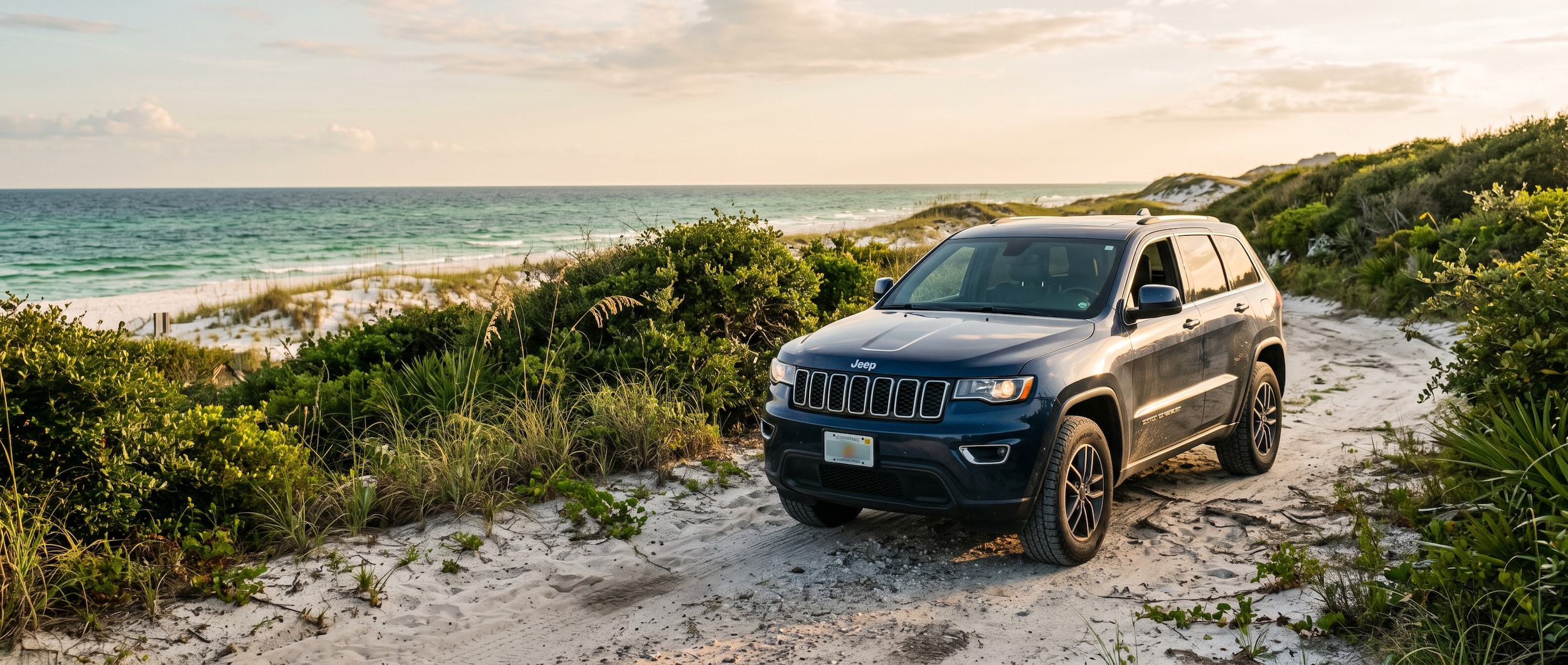
You already know the Grand Cherokee is the right call. Three-row option, real 4x4 when you need it for beach access roads, enough cargo room for a week of soccer gear or a Pier Park beach haul. The question isn't *whether* to buy one. It's *which year* to buy. And that answer matters more here than in most markets.
Gulf Coast ownership is harder on a vehicle than Panama City Beach is on a beach umbrella. Salt air travels up to 20 miles inland from the Gulf, and Bay County logs an average of 75 thunderstorm days per year, per the National Weather Service. We don't mean that as a complaint. Treat it as a used-SUV inspection checklist instead.
Browse our current Grand Cherokee inventory, then use this guide and you'll know exactly which model year belongs on your shortlist.
The short version
- Sweet-spot years: 2019-2021 (late WK2 generation, refined V6 platform, verified reliability) and 2023-2024 (WL generation, post-first-year bugs worked out)
- Years to approach with caution: 2011-2014 (TIPM electrical failures, documented by NHTSA), 2022 (first-year WL, multiple recall campaigns in the first 18 months)
- 4xe alert: The 2022-2024 Grand Cherokee 4xe plug-in hybrid carries a documented NHTSA fire-risk recall. Verify recall completion on any 4xe VIN before you buy.
- Pentastar V6 durability: The 3.6L engine has proven serviceable past 150,000 miles with documented maintenance history.
- Gulf Coast inspection must-do: Check the undercarriage for salt corrosion and electrical connector seals on any WK2 with beach or coastal road exposure.
Which Years Are the Sweet Spot for a Used Grand Cherokee?
Two windows stand out for used buyers, and both earn the spot for the same reason. By the time these cars rolled off the line, the generation had already sorted out its early problems, so you're buying proven refinement instead of gambling on a first attempt. The late WK2 and the settled WL are where we'd steer Bay County families first.
Late WK2: 2019-2021. Jeep built the WK2 platform from 2011 through the 2021 model year. By 2019, that platform had been refined for nearly a decade. The early TIPM electrical problems were long gone. The 3.6L Pentastar V6, which Jeep lists at 293 horsepower and 257 lb-ft of torque, had built up a real-world reliability track record by then. NHTSA complaint data puts the 2019 model year at 336 complaints. Set that against the 2014 model year's 3,333 complaints (per NHTSA records), and the trend is obvious. The 2020 model year shows only 207 complaints in the same database. A documented-maintenance 2019-2021 V6 with under 100,000 miles is, in our experience, one of the more sensible used-SUV values you'll find in this segment right now.
There's a genuine tradeoff here, and we're not going to bury it. The WK2 cabin feels older than a 2022-and-up WL. The infotainment lags the newer platform by a visible margin. If your family's long-drive entertainment runs through the screen, that gap matters.
WL Generation 2023-2024. Jeep redesigned the Grand Cherokee entirely for 2022, introducing what Jeep calls the WL platform, with a two-tier dashboard, a 10.1-inch Uconnect 5 touchscreen, and significantly improved interior materials. The 2023 and 2024 model years, though, are where we'd point used buyers rather than the 2022. The reason is specific and documented, and it leads straight into the next section.
| Model Year Range | Generation | Platform | Key Powertrain | Sweet Spot? |
|---|---|---|---|---|
| 2011-2014 | 4th Gen (WK2) | WK2 | 3.6L V6 / 5.7L V8 | No (TIPM recall history) |
| 2015-2018 | 4th Gen (WK2) | WK2 | 3.6L V6 / 5.7L V8 | Moderate (verify electrical) |
| 2019-2021 | 4th Gen (WK2) Late | WK2 | 3.6L V6 / 5.7L V8 | Yes (verified sweet spot) |
| 2022 | 5th Gen (WL) Year 1 | WL | 3.6L V6 / 5.7L V8 / 4xe | Caution (first-year recall cluster) |
| 2023-2024 | 5th Gen (WL) | WL | 3.6L V6 / 5.7L V8 / 4xe | Yes (post-bug WL) |
See our pre-owned Grand Cherokee listings to check which years are available on our lot right now.
Which Years Should You Watch Out For?
A few model years deserve genuine caution, and it comes down to documented recalls rather than vague reputation, because a bad year you know about is manageable while a bad year you find out about later gets expensive fast. We'd rather flag them plainly than let a surprise land in your driveway.
They're all in the public NHTSA database, sorted by campaign. You can pull any of them by VIN.
2011-2014: The TIPM problem. The Totally Integrated Power Module (TIPM) in these years had a documented fuel pump relay failure that could cause the engine to stall without warning. NHTSA formally recalled 2011-2013 models under campaign 14V530. NHTSA data shows the 2014 model year carried the highest single-year recall campaign count in the Grand Cherokee's history, at 18 separate campaigns. None of these are unsalvageable, but before you hand over a check you'll want a confirmed recall-completion paper trail and a current-condition electrical inspection.
2022 WL (first model year): A recall cluster, not a conspiracy. First model years of redesigned platforms almost always carry more early campaigns than their successors, and the 2022 Grand Cherokee didn't break the trend. NHTSA documented incorrectly installed rear coil springs that could detach while driving (NHTSA campaign 23V413000). A rearview camera display failure traced to an overheating display transistor. An improperly secured front seat side airbag connector that could prevent airbag deployment (covered by NHTSA campaign 24V897000 across 2022-2024 models). A separate investigation into post-remedy coil spring detachments (NHTSA query 25005) was still open as of late 2025. None of this makes a 2022 unfixable, but every 2022 needs a verified recall completion check by VIN at nhtsa.gov before it's in your driveway.
2022-2024 Grand Cherokee 4xe: The fire risk recall is the non-negotiable item. NHTSA documented a fire risk in more than 35,000 model year 2022-2024 Grand Cherokee plug-in hybrid electric vehicles (4xe). The recall covers a high-voltage battery pack that may fail internally and cause a fire while parked or while driving. NHTSA advised owners to park outside away from structures until it's remedied. A separate NHTSA recall covering 91,787 Grand Cherokee 4xe SUVs from 2022-2026 documented a software error causing complete loss of drive power.
Gulf Coast check: Any used Grand Cherokee that spent time near Panama City Beach, Mexico Beach, or St. Andrews Bay carries a higher-than-average salt exposure load. Bay County's salt air concentrations run highest from March through October. On any WK2 example, have a technician inspect the undercarriage, electrical connector seals, and brake hardware for corrosion before you buy. We're happy to walk you through what that inspection covers at our service bay.
Schedule a pre-purchase inspection at Bay Chrysler Dodge Jeep Ram before you commit to any used example you're serious about.
How the 3.6L Pentastar V6 Holds Up on the Gulf Coast
The 3.6L Pentastar V6 sits under most of the used Grand Cherokees on a Bay County shopping list, and the short version is reassuring with one caveat, because the engine itself is proven and the salt-belt hardware around it is what actually decides the deal. The V6 has proven serviceable past 150,000 miles with a real maintenance history behind it. The Pentastar has powered the Grand Cherokee since the 2011 model year, and it's still running right through the current 2026 lineup.
So which matters more on a Gulf Coast example, mileage or maintenance? Maintenance wins, and it isn't close. Salt air and humidity speed up wear on electrical connectors, brake hardware, and undercarriage components faster than the spec sheet assumes. The engine itself holds up, but the supporting systems around it may not, if maintenance was deferred or the truck saw regular beach-road exposure without periodic undercarriage rinsing (the same rinse-down a boat trailer gets after a launch). A 90,000-mile 2019 from a meticulous owner beats a 60,000-mile 2019 from someone who never washed the undercarriage.
The Pentastar V6 Grand Cherokee has proven serviceable past 150,000 miles with documented maintenance. On the Gulf Coast, salt exposure means the maintenance history matters as much as the odometer, so don't shop on mileage alone.
The 5.7L HEMI V8 was available in 2019-2021 WK2 models and in WL models through 2025. Jeep discontinued the V8 option beginning with the 2026 model year. Find a used V8 with verified history and you've got a capable engine, though you should expect higher fuel costs. The EPA rates the V6 WK2 at around 19 city / 26 highway, which is serviceable for the Highway 98 runs and Panama City Beach weekend trips a Bay County family actually racks up.
Get an Offer on Your Current Vehicle
Which Year Fits Which Buyer?
Budget and cabin expectations pull in different directions, and the right year depends on which one you're willing to bend. A 2019 WK2 and a 2023 WL are both good buys for very different families, so match the year to how you drive and what you want out of the interior. Here's our read on who belongs where.
The value-first family (2019-2021 WK2). You want a proven platform, real 4x4 for the occasional Eglin-area trail run or soft-sand access road, and a seat count that handles the kids without drama. The 2019-2021 range delivers all of that on a platform with a decade of engineering refinement behind it. The cabin isn't cutting-edge, and you won't get the dual-screen dash of the WL. But the mechanical foundation is as solid as this nameplate gets in used form, and the documented reliability data backs it up.
The modern-cabin family (2023-2024 WL). You want the Uconnect 5 screen, the quieter ride, and the improved interior materials of the WL generation, so skip 2022. The 2023 and 2024 model years have the first-year recall cluster behind them and share the same redesigned platform. If it's a 4xe plug-in hybrid, verify the battery fire and power-loss recalls are completed by VIN before you go further. A straight V6 or V8 2023-2024 is a clean pick.
The family with a garage and beach-road access (any year, but do the inspection). No matter which year you land on, the Gulf Coast maintenance picture doesn't change. Plan on an annual undercarriage rinse, more frequent brake hardware checks, and electrical connector inspections on higher-mileage WK2 examples. The Grand Cherokee is built for capable terrain, and Bay County's salt air is capable terrain of its own. Plan accordingly.
Looking at a Jeep Wrangler instead? We've got used Wrangler inventory alongside the Grand Cherokee if you want to compare platforms before you decide.
Frequently Asked Questions
What is the most reliable used Jeep Grand Cherokee year to buy?
The 2019-2021 model years are the most refined version of the WK2 platform, which Jeep built and improved from 2011 through 2021. NHTSA complaint data shows the 2020 model year at 207 complaints and the 2019 at 336, against 3,333 for the 2014 model year. The 3.6L Pentastar V6 in these years has a documented track record of service past 150,000 miles with proper maintenance. If you want the newer WL interior and platform, 2023 and 2024 are your picks, and they've already got the first-year bugs sorted.
Should I avoid the 2022 Jeep Grand Cherokee as a used buy?
Yes, with a caveat. The 2022 model year was the first year of the WL redesign, and it picked up multiple NHTSA recall campaigns, including incorrectly installed rear coil springs (NHTSA campaign 23V413000), an improperly secured seat side airbag connector (campaign 24V897000), and rearview camera failures. None of those are fatal if all recalls are documented as completed. Still, you'll want a full VIN-level recall verification on every 2022 Grand Cherokee at nhtsa.gov before purchase. If that paperwork is clean and the vehicle has a service history, it can still be a viable buy. If the recall completion is missing, walk away and look at a 2023.
Is the Grand Cherokee 4xe a good used buy for a Bay County family?
It depends entirely on the recall status. NHTSA documented a fire risk in 2022-2024 Grand Cherokee 4xe plug-in hybrids due to a high-voltage battery pack failure, advising owners to park outside away from structures until remedied. A separate recall covered 91,787 vehicles from 2022-2026 for a software error causing loss of drive power. If both recalls are verified as completed on the specific VIN, the 4xe can be a capable choice. If either recall is open, it's a hard no, particularly for families in Bay County who park in attached garages or carports near the Gulf.
Categories:
Social