





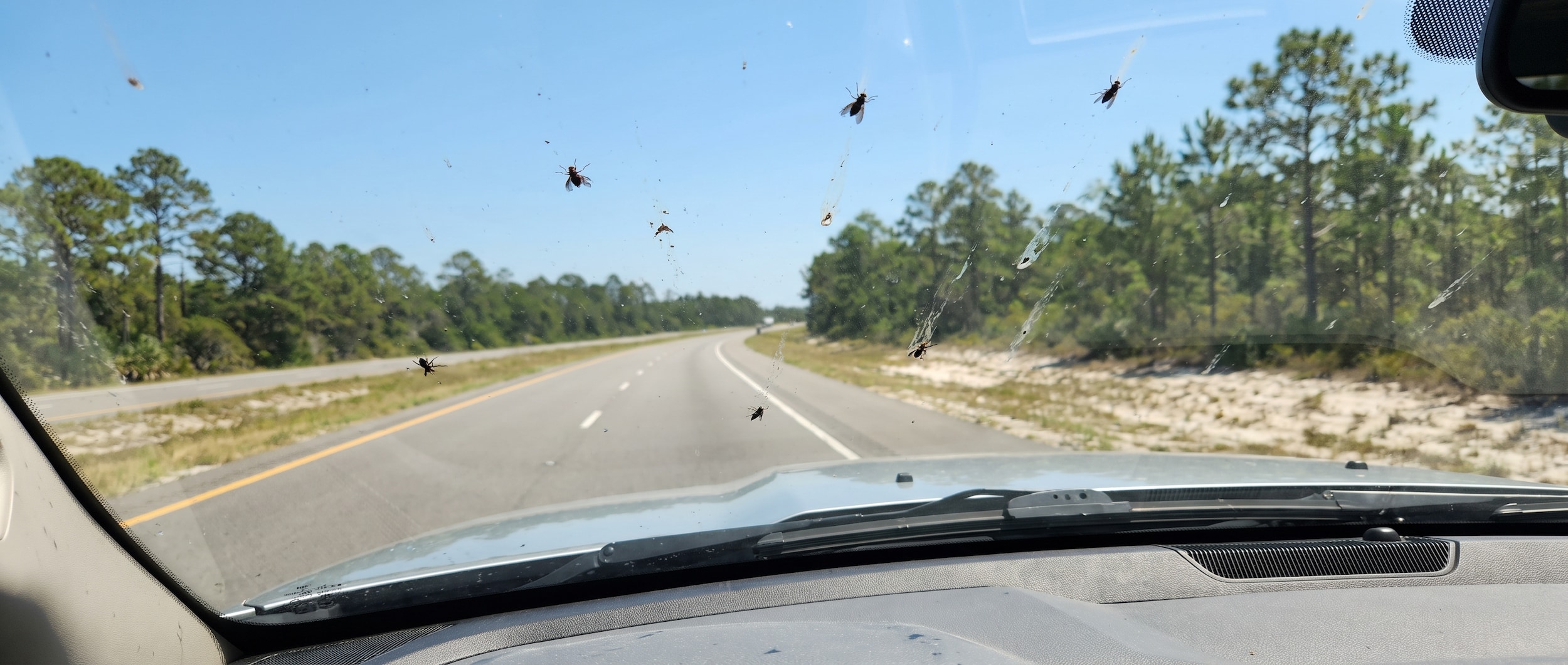
Walk into any auto parts store in Panama City and you'll find a wall of washer fluids. Blue jugs, orange jugs, green jugs, summer formulas, all-season formulas, de-icer blends rated to -35 degrees F. Half that shelf exists for climates that Florida Panhandle drivers will never actually need. The question worth asking isn't which fluid is "best" in some universal sense. The one that matters is which handles what actually hits your windshield here (love bugs twice a year and afternoon thunderstorms seemingly every other day from May through September).
Get that match wrong and you're either paying for freeze protection down to -25 degrees F that Panama City's weather will never test, or you're smearing acidic bug bodies across your glass with an underpowered formula that just spreads the mess. Our service team sees both come through the drive.
The short version
- Bug-wash formula (Prestone Bug Wash): best for drivers who want maximum bug-clearing power during love bug season and are fine switching fluids seasonally
- All-season 2-in-1 (Rain-X 2-in-1 All-Season): best for drivers who want one jug year-round, strong bug removal, AND water beading that actively helps during heavy rain
- Rain-X Bug Remover: best for drivers who want Rain-X's hydrophobic water-beading technology at a bug-season price point, with the understanding it shares the same +32 degrees F freeze floor as Prestone Bug Wash
- Skip the plain winter de-icer fluid entirely: high methanol blends for deep freezes are simply unnecessary for Gulf Coast Florida driving
- Critical detail for all three: none of these replace worn wiper blades. A ragged rubber edge turns any good fluid into a smear
How Do These Three Fluids Actually Compare?
Compared head to head, these three fluids sort out along three axes that matter for a Panhandle driver, and only two of those axes will ever get much of a workout this far south, since our winters rarely test a freeze floor the way a northern state would. Bug-clearing muscle, rain-beading ability, and how each handles Florida's mild "cold" snaps are the differences worth weighing (we're talking 40-degree mornings in January, not Minnesota).
| Formula | Bug Clearing | Water Beading | Freeze Floor | Best Florida Match |
|---|---|---|---|---|
| Prestone Bug Wash | Excellent (stronger detergent concentration) | Yes (hydrophobic layer after each wash) | +32 degrees F | Spring/fall love bug seasons; store a backup jug |
| Rain-X 2-in-1 All-Season | Very Good | Yes (Rain-X hydrophobic polymer, every cycle) | -25 degrees F | Year-round single-jug solution; afternoon rain driving |
| Rain-X Bug Remover | Good | Yes (Rain-X hydrophobic polymer) | +32 degrees F | Love bug season with added Rain-X wet-weather benefit |
The freeze floor deserves a quick flag. Prestone Bug Wash and Rain-X Bug Remover both protect only to +32 degrees F, which is fine for the vast majority of Panhandle winters. On the rare January or February morning when Bay County does dip near or below freezing, your reservoir won't protect the pump with those formulas. The Rain-X 2-in-1 handles that edge case easily, no swapping required. It's a minor but real tradeoff to know going in.
Schedule a Service Appointment
What Makes Love Bugs So Hard on Windshields?
Love bugs punish a windshield in two ways at once, and visibility is actually the smaller of the two problems, since their body fluid is acidic enough to work on paint and clear coat while it also cakes the glass in a film that standard fluid struggles to clear in one pass. They swarm twice a year here (late April into May, then again from late August into September). According to pest research on the species, that acidity can begin etching paint and clear coat within hours of baking in direct Florida sun.
On the windshield, a standard blue summer fluid often doesn't have the detergent concentration to dissolve the protein-based residue in one or two wiper passes. You hit the spray lever, the wipers smear a half-dissolved film across the glass, and suddenly your visibility is worse than before you tried.
A bug-wash formula is built for exactly that problem. Prestone Bug Wash uses a stronger detergent concentration designed to break down organic residue fast. Rain-X's bug formulas combine that cleaning power with their water-repellent polymer chemistry so every wash also reinforces the glass's hydrophobic surface. If you're driving US-98 during a September swarm, that combination matters.
Browsing new vehicles with larger glass areas (panoramic roofs, full-width windshields) means more surface area for bug accumulation and a stronger case for staying stocked with the right fluid.
During love bug season (late April-May and late August-September in Florida), bug body fluid can begin etching paint within hours in direct sun. Washing the vehicle and the windshield the same day you drive through a swarm is genuinely protective, not just cosmetic.
| Pros | Cons |
|---|---|
| Bug-wash formulas clear protein-based insect residue that standard fluid smears | Bug-wash-only formulas freeze at +32 degrees F (adequate for most Panhandle winters, not all) |
| Rain-X 2-in-1 deposits hydrophobic polymer with every use for wet-weather benefit | Rain-X 2-in-1 costs slightly more per gallon than single-purpose fluids |
| Water beading in afternoon thunderstorms lets rain sheet off at highway speed | Water beading can feel slightly oily on a dry windshield to some drivers |
| Prestone Bug Wash is widely available and pre-mixed, no dilution needed | High-methanol de-icer blends (designed for -35 degrees F) are unnecessary here and waste money |
Does Water Beading Actually Help in a Florida Downpour?
Yes, water beading earns its place in Florida rain, though the benefit runs bigger in light-to-moderate rain than in a true downpour, where your wipers end up doing most of the work no matter what fluid sits in the reservoir. The hydrophobic polymer that Rain-X deposits with each wash causes rainwater to bead and roll off rather than sheet across the glass.
At highway speeds on I-10 or US-98, that effect is most noticeable in light-to-moderate rain (water clears the glass between wiper strokes instead of sitting on it). In a genuine Gulf Coast downpour at lower speeds, wipers are doing most of the work either way.
Gradual buildup: The polymer builds up gradually over repeated washes. A single fill will not coat the glass all at once.
The payoff for Florida shows up in that 10-minute transition storm. The sky opens up, you hit the spray lever to clear accumulated road grime right before the rain starts, and the hydrophobic layer you've been building wash-by-wash helps the rain water sheet off quick.
A Jeep Grand Cherokee with a tall windshield and big side glass accumulates road film fast on humid Panhandle days. Keeping the reservoir topped with a fluid that works double-duty (cleaning and reinforcing the glass surface) makes a tangible difference in those conditions.
One limit is worth being straight about. Water beading from washer fluid is not a substitute for a dedicated ceramic or Rain-X spray-on glass treatment. It helps, but only so far.
Which Formula Fits Your Driving Life?
Picking among the three comes down to how much of your driving lands in bug season versus how much freeze insurance you want to carry for the odd cold snap, and here is how we would sort it for drivers around here:
- You drive primarily during love bug season and want maximum bug-clearing muscle: Prestone Bug Wash. It's the strongest detergent formula for organic residue and is pre-mixed, so there's no guesswork. Stock an extra jug during spring and fall swarm windows.
- You want one jug that handles everything without thinking about it: Rain-X 2-in-1 All-Season. Bug removal, water beading with every wash, and freeze protection to -25 degrees F. That last spec means you won't stress on a rare cold January morning in Bay County.
- You want Rain-X's hydrophobic water beading at a slightly lower cost and you don't mind the same +32 degrees F freeze floor as the Prestone Bug Wash: Rain-X Bug Remover. Good choice for drivers who prioritize wet-weather visibility and deal with heavy insect activity.
- What to avoid: cheap blue generic fluid designed for cold climates. It typically has little to no bug-dissolving detergent, and plain tap water is worse. It can damage the washer pump over time and leaves streaks that no wiper blade can fix.
All three formulas share one requirement. They work better with clean, undamaged wiper blades. If your blades are streaking, the fluid formula isn't going to fix that. A blade inspection takes two minutes. The Ram 1500 owners who come in for truck service often find the blade condition is what's causing the smear, not the fluid.
Frequently Asked Questions
Can I mix different windshield washer fluids in my reservoir?
You can top off with a different formula without draining the reservoir first. The fluids are water-based and won't react dangerously. The practical effect is that you'll dilute the bug-clearing or water-beading properties of whichever formula was in there. If you want the full benefit of Rain-X's hydrophobic treatment, for example, the cleaner the switch-over the faster you'll build up the polymer layer on the glass. If you're mid-season and just need more fluid, topping off is fine. A full drain and refill is a good idea when you're intentionally switching formulas at the start of love bug season.
Is plain water or dish soap okay in a pinch?
Skip both. Plain water won't dissolve bug protein or road grime effectively, and it leaves mineral deposits on the glass from Florida's water supply. Dish soap is worse: it can degrade the rubber seals in the washer pump and nozzles over time, and it almost always leaves a soapy film that streaks badly at highway speed. The difference between a proper bug-wash formula and improvised alternatives is visible the first time you spray. Keep a spare gallon in the truck bed or cargo area (they're lightweight and easy to stow) so you're never reaching for something that damages the system.
Categories:
Social