




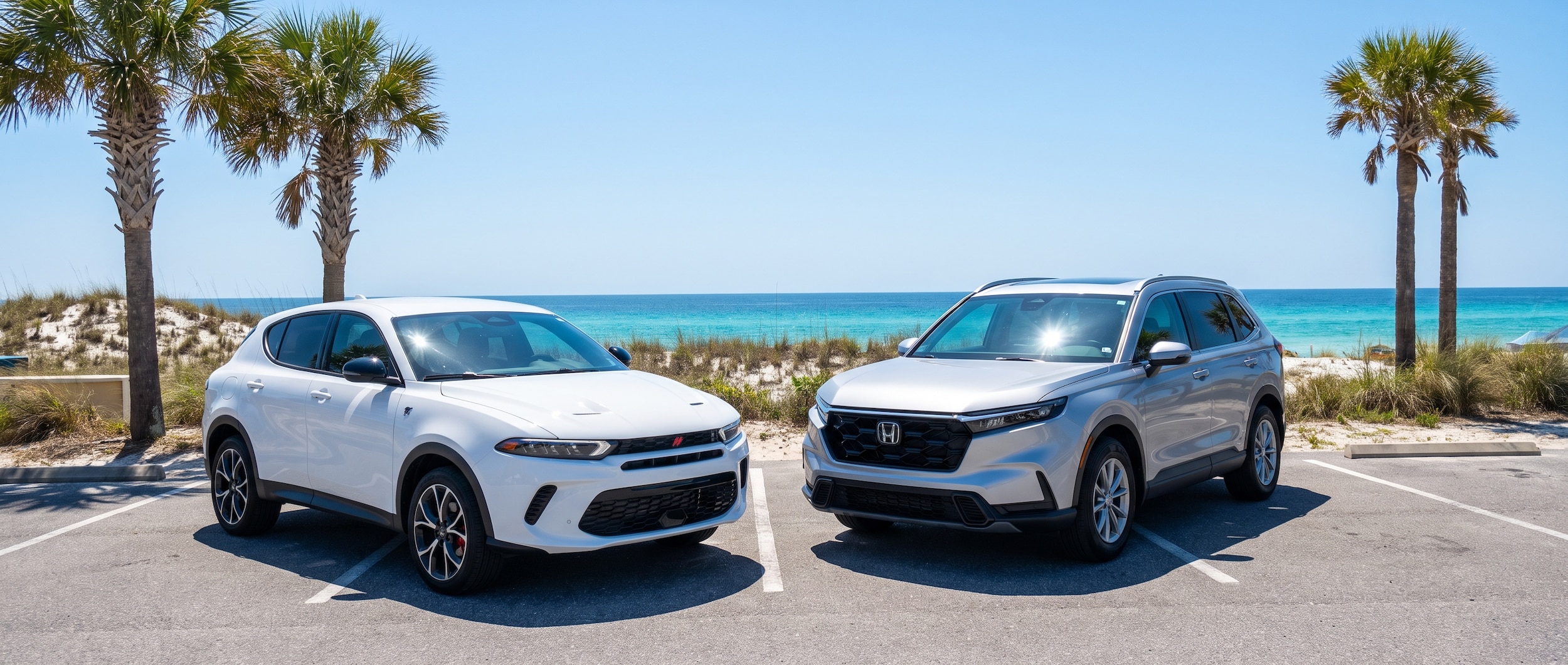
The short answer is an easy one. The Dodge Hornet is gone. Dodge confirmed in January 2026 that Hornet production has ended permanently after the 2025 model year, killed by import tariffs on its Italian-built platform. Plenty of 2025 Hornets (and some carry-over 2024 units) are still sitting on lots across the country, including here in the Panhandle, so it's still a real purchase decision. But you need to know you're buying a discontinued model. The 2026 Honda CR-V, meanwhile, is fully current and actively updated.
We'll treat this the way it actually plays out on our lot, with the Hornet as a remaining-stock opportunity and the CR-V as the living, current alternative. We're zeroing in on the PHEV version of the Hornet (the R/T) and the CR-V Hybrid, because that's where the comparison gets interesting for Florida Panhandle drivers.
How Far Will Each One Actually Go Here?
Both electrified powertrains do well in the Panhandle, though for different reasons, and the flat coastal geography is a big part of why. Neither hybrid system has to fight grades on the roads from Lynn Haven to Panama City Beach, and the short stop-and-go runs on US-98 and Thomas Drive in summer are exactly the kind of driving where hybrid and PHEV powertrains recover energy best.
Here's how the two stack up on range, efficiency, and charging:
| Category | Dodge Hornet R/T (2025 PHEV) | Honda CR-V Hybrid (2026 AWD) |
|---|---|---|
| Powertrain | 1.3L turbo + rear electric motor | 2.0L Atkinson + dual electric motors |
| System horsepower | 288 hp combined | 204 hp combined |
| EV-only range | EPA-rated 32 miles | None (full hybrid, not PHEV) |
| Fuel economy (hybrid mode) | EPA-rated ~29 mpg combined | EPA-rated 37 mpg combined (AWD) |
| MPGe (electrified) | EPA-rated 77 MPGe | N/A (not a plug-in) |
| Cargo space (behind rear seats) | 22.9 cu ft | 36.3 cu ft (hybrid trims) |
| Drivetrain | AWD standard | AWD available |
| Production status | Discontinued (2025 was final year) | Current (2026 MY, active) |
The Hornet R/T wins the raw performance number. Its 288 horsepower and 383 lb-ft of torque make it genuinely quick for this segment, and the PowerShot feature delivers an extra 30 horsepower for 15-second bursts, which drops the 0-60 time to 5.6 seconds. The CR-V Hybrid is quicker than it looks when you're merging day to day, but it isn't trying to be sporty. It's trying to be efficient. And it is. Very.
Where Do You Charge Locally?
For a Panama City buyer, the two vehicles split here in a way that actually matters, and it comes down to whether you want to plug in at all. The Hornet R/T is a plug-in hybrid. You can charge it, or you can also never plug it in and just run it as a conventional hybrid for as long as you own it, no charger needed. That flexibility is real, and it matters here.
See Current New Vehicle Offers
The Florida Panhandle's Level 2 public charging network is growing, but it's still thin compared to the I-4 corridor. For a PHEV, that isn't the liability it'd be for a full EV. The Hornet R/T's EPA-rated 32 miles of electric-only range covers a round trip from Panama City Beach to Pier Park and back without touching the gas engine, assuming a full overnight charge at home. If you don't charge it, the car still runs fine. It won't strand you. And that's the practical advantage of a PHEV in a market where charging still hasn't caught up.
The CR-V Hybrid needs no charger at all. It regenerates as you drive, captures braking energy on the Thomas Drive crawl, and returns better numbers than the gas version without asking anything of you. For buyers who want efficiency and no new daily habit, that's a fair argument.
- Decide whether you want plug-in capability or a no-charger hybrid
- Confirm any remaining Hornet 2025 inventory actually exists in your region before driving to see it
- Test the Hornet cargo area with your typical beach or weekly load before committing
- Check parts availability timeline for a discontinued Italian-built platform
Considering the Discontinued Status: A Practical Guide
Buying any discontinued model is a different decision than buying a current one, and we'll be straight with you about both the upside and the catch. The Hornet shares its mechanical platform with the Alfa Romeo Tonale, which remains in production in Italy, so parts supply should hold up for years. Dodge has committed publicly to continued customer support, service, and parts availability for existing Hornet owners.
So the parts side looks reasonable for now. The Tonale connection is the reason.
Still, the service picture matters on the Gulf Coast. Florida's salt air and beach parking are hard on any vehicle over time, and for a platform that won't see new model-year iterations, you want to be comfortable with the long-term service path. The schedule a service appointment page is where our team can walk through what routine Hornet service looks like at our shop.
The CR-V doesn't carry that uncertainty. Honda's compact SUV is one of the highest-volume vehicles on American roads, its 2026 version is supported and updated, and service intervals are well established. For a family vehicle someone plans to keep eight to ten years, that counts for more than a sports-car 0-60 number.
Plan It This Way
If you're drawn to the Hornet R/T for its performance, the PHEV novelty, and the aggressive remaining-inventory pricing on the last of the stock, that's a defensible choice, provided you go in knowing you're buying a closed chapter rather than a car with a future. Verify the specific unit's condition with care, because what you see is what exists.
If you want a compact SUV that'll stay supported, keep getting updates, and run efficiently through Panama City's long, hot, AC-dependent summers, the 2026 CR-V Hybrid is the practical pick. The flat Gulf Coast geography plays to its regenerative braking strengths, and 37 combined mpg in a vehicle with 36.3 cubic feet of cargo space is a pairing the Hornet R/T never offered.
Our team at Bay Chrysler Dodge Jeep Ram can help you check which Hornet units remain and compare them, side by side, against what we've got in the compact SUV segment. Come drive both before the Hornet supply is gone for good.
Frequently Asked Questions
Is the Dodge Hornet still available to buy in 2026?
Yes, but only as remaining new-car inventory from 2025 (and some 2024 carry-over units). Dodge confirmed in January 2026 that Hornet production has ended permanently after the 2025 model year. Once dealers sell through what they've got, there won't be any new Hornets to order.
What is the Honda CR-V Hybrid's fuel economy for 2026?
The EPA rates the 2026 Honda CR-V Hybrid at 37 mpg combined in AWD trim. Those numbers hold up well in stop-and-go coastal traffic, where the hybrid system recaptures energy during frequent slowdowns.
Is it risky to buy a Dodge Hornet now that it is discontinued?
The main risks are parts availability over the very long term and the absence of future model-year updates. Dodge has publicly committed to continued parts supply and service support for current Hornet owners. The Hornet also shares its mechanical platform with the Alfa Romeo Tonale, which is still in production, and that helps parts continuity.