




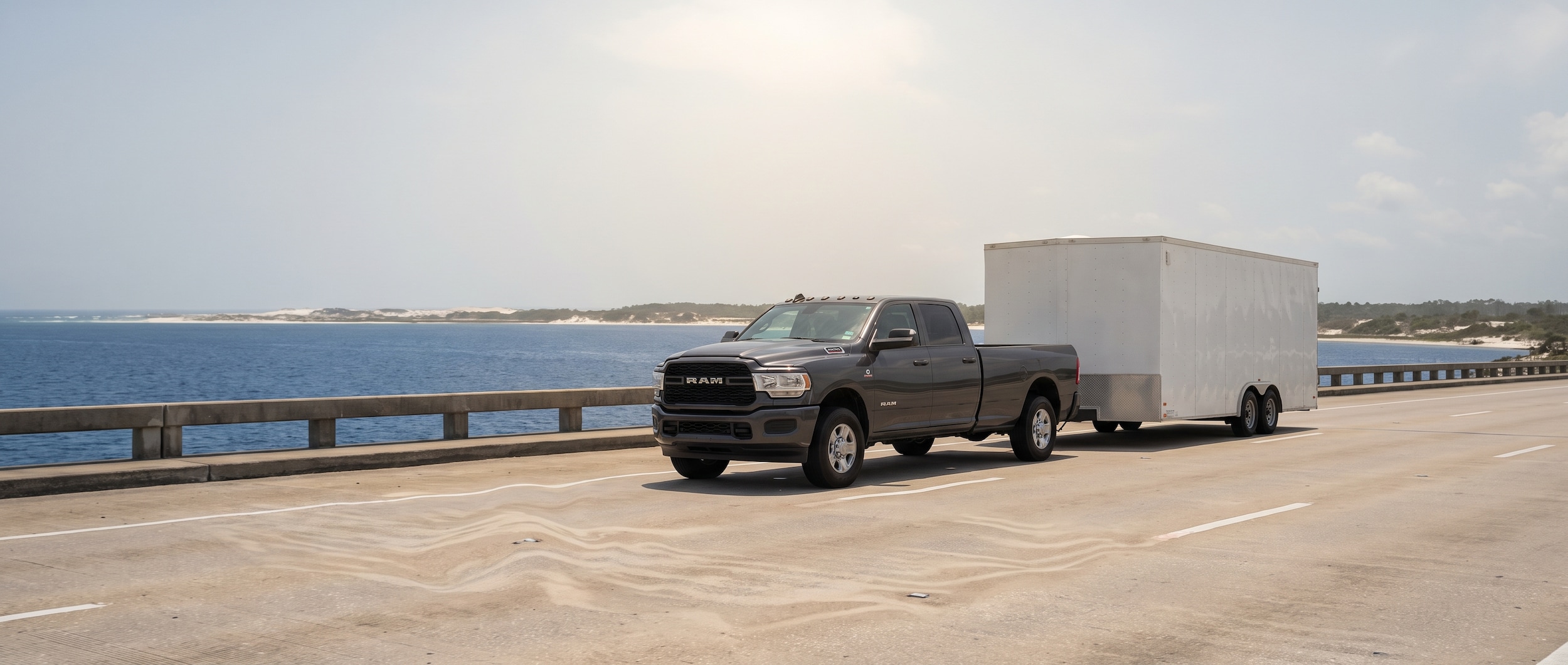
A lot of Ram 2500 owners in the Panama City area believe that because we don't have mountain passes, summer towing is easy on the brakes. The flatness is real. The safety assumption is not.
Gulf Coast heat combined with stop-and-go beach traffic, repeated bridge approach braking, and the Panhandle's notoriously high summer humidity creates a brake fade environment that's different from the mountains but just as unforgiving. The physics don't care about elevation change. Heat is heat, and humid air accelerates the one thing that makes Florida towing genuinely dangerous: moisture saturation in your brake fluid.
- The myth: Flat roads mean no brake heat buildup when towing in Florida summer.
- Reality #1: Stop-and-go traffic on US-98 and repeated bridge approaches generate significant friction brake heat even on flat terrain. The weight doesn't stop being heavy because the road is level.
- Reality #2: Panama City's July humidity (average 74%) accelerates moisture absorption in brake fluid, lowering its boiling point and raising fade risk.
- Reality #3: DOT 3 brake fluid with absorbed moisture can boil at as low as 284 degrees F. A threshold friction brakes can reach under sustained towing load in summer stop-and-go.
- Reality #4: The 2026 Ram 2500 Cummins diesel's Automatic Smart Exhaust Brake is specifically designed to reduce this friction brake load. It works in Florida, not just in the Rockies.
- What to do: Flush brake fluid before peak tow season, use Tow/Haul mode on every pull, and understand your specific truck's rated capacity, not the class maximum.
Check out the 2026 Ram 2500 at Bay Chrysler Dodge Jeep Ram and see which configurations are currently in stock.
Is the "Flat Florida Roads" Towing Safety Myth Actually True?
No, it isn't, and the brake fluid science tells you exactly why it falls apart.
| The Common Claim | What's Actually True | Source |
|---|---|---|
| "Flat terrain means no brake heat when towing" | Repeated braking in stop-and-go traffic generates friction heat regardless of grade; a loaded 15,000-lb rig braking for a traffic light produces the same heat as braking on a mild descent | Physics of friction braking |
| "Brake fade is a mountain problem" | Brake fade results from heat overcoming the brake fluid's boiling point. A condition reachable in sustained summer stop-and-go towing | U.S. Department of Transportation brake fluid standards |
| "My brake fluid is fine until it looks bad" | Glycol-based DOT brake fluid is hygroscopic. It absorbs moisture from ambient air continuously, lowering its boiling point over time even when the brakes feel normal | DOT brake fluid classification standards |
| "DOT 3 fluid is fine for truck towing" | DOT 3 wet boiling point (after moisture absorption) is approximately 284 degrees F. A temperature reachable under sustained summer towing load. DOT 4 wet boiling point is approximately 311 degrees F | DOT brake fluid minimum standards |
| "The Ram 2500 exhaust brake is only useful in hills" | The Automatic Smart Exhaust Brake on Cummins diesel 2026 Ram 2500 models uses engine backpressure to slow the rig continuously, actively reducing heat load on friction brakes in any sustained towing situation | Ram trucks manufacturer specification |
| "Panama City's summer heat isn't that extreme" | July heat index in Panama City averages 102 degrees F, with daily highs around 88 degrees F and humidity averaging 74%. Conditions that accelerate brake fluid moisture absorption and thermal stress on braking components | Weather data for Panama City, FL |
What's worth understanding at a molecular level is how the fluid works, because it changes how you should prep the truck before a pull. Brake fluid is hygroscopic. It actively pulls moisture from the air around it, not just when you open the reservoir cap, but through microscopic permeation in the system over time. In Panama City's July air, that process moves faster than it does in a dry climate. As moisture content in the fluid rises, the boiling point drops. The U.S. DOT establishes minimum wet boiling points precisely because of this: DOT 3 at approximately 284 degrees F, DOT 4 at approximately 311 degrees F. Under sustained summer towing load, a truck's friction brake temps can approach and exceed those thresholds.
Nobody's saying you'll lose your brakes on US-98. What we do see, when trucks come in after a summer of heavy pulling, is brake fluid that tests well outside safe moisture content. The drivers had no idea, because the pedal felt normal right up until it didn't.
What the Heat Actually Does to a Loaded Ram 2500's Brake System
On a July afternoon tow from Panama City to Destin with 14,000 pounds behind you, a 6% grade isn't your problem. The Hathaway Bridge approach is. So is the signal light on Front Beach Road with 40,000 tourists stacked ahead of you, and the construction zone on US-98 where traffic backs up for a quarter mile. Each of those events asks your brakes to scrub momentum from a fully loaded rig in high ambient heat.
Schedule a pre-towing service check with our team before your first big summer pull.
The mechanical chain matters here. When friction brakes engage under load, rotors and pads generate heat. That heat transfers into the brake caliper, and the caliper transfers it into the brake fluid in the lines. If fluid temperature reaches or exceeds its wet boiling point, it vaporizes. Vapor compresses under pedal pressure where liquid does not. That compression gap is what produces a spongy or fading pedal. In a worst case, the pedal goes deep with little response.
Florida's summer adds two compounding factors you won't find in a temperate climate. First, ambient temperature is already high (heat index regularly topping 100 degrees F in July), so the system starts the day with less thermal margin than it'd have in October. Second, sustained high humidity accelerates moisture saturation in glycol-based brake fluid. The combination means a Florida truck doing serious summer towing is working with a reduced buffer that most drivers never stop to quantify.
The diesel Cummins exhaust brake changes this equation in a meaningful way. The Automatic Smart Exhaust Brake on the 2026 Ram 2500 uses the 6.7L Cummins turbo diesel's variable geometry turbocharger to generate backpressure, which slows the truck through engine retardation rather than friction. It actively reduces how much work the friction brakes have to do on any sustained tow, flat roads included. The system offers two modes: Full mode (maximum engine braking, engaged the moment you lift off the accelerator) and Smart mode (automatically adjusts braking force to maintain a consistent speed). On a summer tow through beach traffic, Smart mode protects your pads and fluid by handling a portion of the deceleration before the friction system ever touches.
The Ram 3500 uses the same system for even heavier payloads if your work demands a step up.
So What Should You Actually Do Before Your Next Summer Tow?
Four things, in priority order.
1. Check Your Actual Rated Capacity, Not the Class Maximum
Ram lists the 2026 Ram 2500 at up to 20,000 lbs towing capacity when properly equipped with the 6.7L Cummins High-Output diesel. The 6.4L HEMI V8 reaches up to 17,750 lbs in certain configurations. Your specific truck's rating lives on the driver-door sticker, and the class maximum is not your truck's number. Tongue weight (typically 10 to 15 percent of trailer gross weight for conventional hitch setups) eats into payload capacity alongside passengers, fuel, and gear. Know what your door sticker says before you hitch up.
2. Address the Brake Fluid Before Peak Season
If the fluid hasn't been replaced in the last two years or is approaching that mark, flush it before summer towing starts. In a coastal high-humidity market like the Panhandle, that interval matters more than it does in a dry inland climate. Ask your service tech to test moisture content directly. It's a quick test and gives you an actual number rather than a calendar guess.
3. Use Tow/Haul Mode on Every Pull, Not Just Heavy Ones
Tow/Haul mode adjusts shift points and activates engine braking during deceleration on the 2026 Ram 2500's TorqueFlite transmission. It reduces how often the friction brakes engage under load. This isn't a suggestion for extreme towing only. It's the correct operating mode any time a trailer is hitched, including on flat Florida roads. Diesel owners should additionally engage the exhaust brake (Smart mode is appropriate for most Florida highway and arterial towing).
4. Verify Your Trailer Brake Controller Is Set Correctly
Florida requires trailer brakes on trailers with a gross weight above 3,000 lbs. With a controller gain set too low, the trailer isn't contributing to deceleration, so all the stopping work falls on the truck's friction brakes. A quick manual test applies the controller slide at low speed without touching the truck's brake pedal, and it tells you immediately whether the system is engaging. Our service team can verify wiring, calibration, and function as part of a pre-tow inspection.
Schedule a Pre-Tow Service Inspection
Explore financing options if you're considering a move from a half-ton to a Ram 2500 HD platform for your towing needs.
Frequently Asked Questions
Does the Ram 2500 exhaust brake work on flat Florida roads?
Yes. The Automatic Smart Exhaust Brake on the 2026 Ram 2500 with the 6.7L Cummins turbo diesel uses engine backpressure to reduce vehicle speed through engine retardation, a function that applies any time you're decelerating with a heavy trailer, regardless of grade. On flat roads in summer stop-and-go traffic, it reduces heat load on the friction brake system, which is where Florida towing risk actually lives.
How often should I flush brake fluid if I tow regularly in a coastal Florida climate?
Per DOT brake fluid standards, glycol-based brake fluid is hygroscopic and absorbs moisture from ambient air over time, which lowers its boiling point. In high-humidity coastal environments like the Gulf Coast Panhandle, moisture saturation can occur faster than in dry climates. As a general guideline, fluid should be tested and often replaced on a roughly two-year cycle for regular towing use. A moisture test gives you the actual condition of your specific fluid rather than a calendar estimate.