




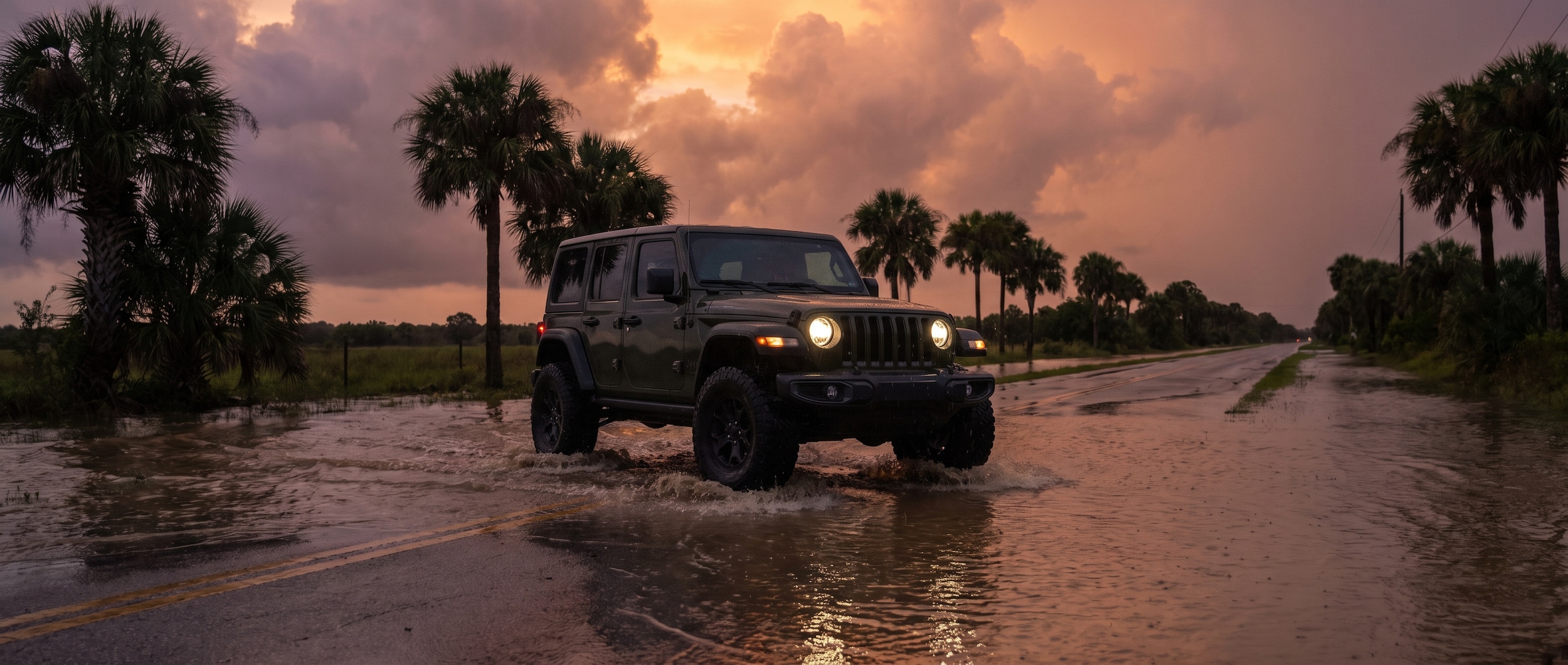
Sunny at noon and knee-deep by 3 p.m. is a normal Bay County summer day. The primary cause of flooding here is rainfall from frequent and sometimes intensely stormy weather, and in summer those storms don't politely announce themselves 24 hours out. The National Weather Service has documented flash flooding hitting Panama City Beach streets including Hutchinson Boulevard and Front Beach Road from a single afternoon storm system. Additional rainfall of 4 to 7 inches is possible in a matter of hours, with locally higher amounts that may cause flash flooding especially in urban and poor-drainage areas. Your vehicle sitting in a low-lying parking lot during one of those bursts isn't protected by luck. The protection comes from decisions you made before the sky turned green.
The right vehicle, parked and driven correctly, handles Bay County's pop-up flooding without drama. Even a capable vehicle has real limits, and the gap between drives through it fine and total loss can come down to inches.
See the 2026 Jeep Wrangler on our lot if you want to start from the vehicle that was literally engineered for water crossings.
Why Does Bay County Get So Much Flash Flooding?
Bay County carries real structural flood risk that goes well beyond hurricanes. Bay County is highly prone to flood hazards associated with hurricanes, tropical storms, and rainfall with high intensity or duration. The flat coastal terrain doesn't drain quickly. Storm systems stall. And summer sea-breeze collisions (the kind that build into afternoon thunderstorms with almost no warning) can dump several inches of rain before a Flood Watch even gets issued. These storms can produce very heavy rainfall in a short amount of time, increasing the risk of dangerous and potentially life-threatening flash flooding.
On the road, that pattern is easy to spot. Front Beach Road and Thomas Drive in Panama City Beach have both appeared in National Weather Service flood records from single storm events. Flash flooding occurred in Panama City Beach from one July storm system, with flooding documented on Hutchinson Boulevard and parts of Front Beach Road and Thomas Drive. Low-lying intersections, underpasses, and parking lots along the coastal strip are the first places water goes. If that's where your vehicle sits when the storm hits, the vehicle's characteristics matter a lot.
What Makes a Vehicle Actually Suited to Bay County Storm Conditions?
| Local Condition | The Feature That Handles It | Why It Matters Here |
|---|---|---|
| Standing water on flat coastal roads (6-18 inches) | High ground clearance | Keeps intake, electrical connectors, and cabin floor above water. 2026 Jeep Wrangler: up to 12.9 inches. Ram 1500 RHO: 11.8 inches. A standard sedan averages 4-6 inches. |
| Flooded creek crossings and drainage outflows | Water-fording depth rating | Jeep rates the 2026 Wrangler at up to 35 inches of fording depth (Trail Rated tested). That number matters when a drainage ditch backs up across a road. |
| Saltwater coastal flooding | Corrosion-resistant undercoating and sealed electrical connections | Salt accelerates corrosion on exposed metal. Trail-rated builds include sealed electronics and skid plates. |
| Pop-up storms with no warning | 4WD traction and stability control | Wet roads with debris require confident traction management. A 4WD system with multiple terrain modes keeps you moving safely when a wet road turns slick. |
| Sudden evacuation on debris-covered roads | Sidewall-tough all-terrain tires | Standard passenger tires are more vulnerable to puncture from storm debris. AT tires on the Wrangler and Ram 1500 Rebel/RHO are rated for rough surface puncture resistance. |
Browse the Ram 1500 lineup here and explore the Grand Cherokee if you're looking for a family-hauler with genuine water clearance.
Here's a fair caveat. Ground clearance protects a moving vehicle. It does not protect a parked vehicle from rising water. If you leave a Wrangler in a low spot and a storm drops six inches of rain while you're at work, it's going to get wet. Clearance buys you time and mobility. It doesn't replace a good parking decision.
- Identify two alternate parking spots at higher elevation on your regular route (a concrete parking garage level 2 or higher is ideal)
- Save the Bay County Emergency Operations Center alert channel in your phone before you need it
- Check tire pressure monthly. Properly inflated tires evacuate water from the contact patch faster and reduce hydroplaning risk on flooded pavement.
- Fold your mirrors in if a storm parks directly overhead while you're away from the vehicle
Driving Into Standing Water: The Number That Changes Everything
Per Ready.gov, just one foot of moving water can sweep your vehicle away, and that single fact should reshape how you read every flooded intersection in Panama City. Read that again slowly. Twelve inches. A flooded intersection reads like a harmless puddle from the driver's seat. What's actually there may be moving drainage water with real force behind it. The depth is never obvious from the driver's seat. Curb heights, road markings, and the bottoms of stop signs are rough reference points. If the water is above the curb, stop.
The Jeep Wrangler's 35-inch fording depth (verified by Jeep's own Trail Rated testing program) is genuinely impressive. Jeep engineered the 2026 Wrangler with 12.9 inches of ground clearance and up to 35 inches of water-fording capability. The number holds up in a controlled, known-depth crossing at low speed. The calculation changes entirely when the water is moving, the road surface underneath is invisible, and storm debris has shifted the depth unpredictably. Our team's advice stays consistent. Even in the Wrangler, if you don't know what's under the water, don't drive into it. The spec protects you in conditions you can assess. It doesn't override the fundamental physics of moving floodwater.
Schedule a post-storm vehicle inspection here if your vehicle has been through standing water and you want a professional set of eyes on it before you rack up more miles.
Schedule a Post-Storm Inspection
Before the Storm: Five Things to Do Right Now
The best vehicle protection in Bay County happens before the storm, not during it. When a storm system threatens your area, securing your vehicle and planning a safe route can't wait until it arrives.
1. Know your parking risk. If your regular parking spot sits near a drainage ditch, a low-lying road, or a coastal basin, it's a flood candidate during heavy rain. Identify your risk before July becomes August.
2. Keep a full tank. Fueling up even when you don't plan to evacuate is smart. After a major storm, supply issues, power outages, and station damage can make gas difficult to find.
3. Photograph your vehicle before storm season peaks. Date-stamped photos of the exterior, interior, and engine bay give you documentation that's actually useful for an insurance claim. Do it now, not after the fact.
4. Check door and window seals. Worn seals let water into the cabin faster. If your interior gets damp in a normal rainstorm, that's a flood vulnerability worth taking seriously.
5. Move to higher ground early. Relocate your vehicle to higher ground if water hasn't reached you and it's safe to drive. The window between heavy rain starting and streets flooding in Bay County can be under an hour.