




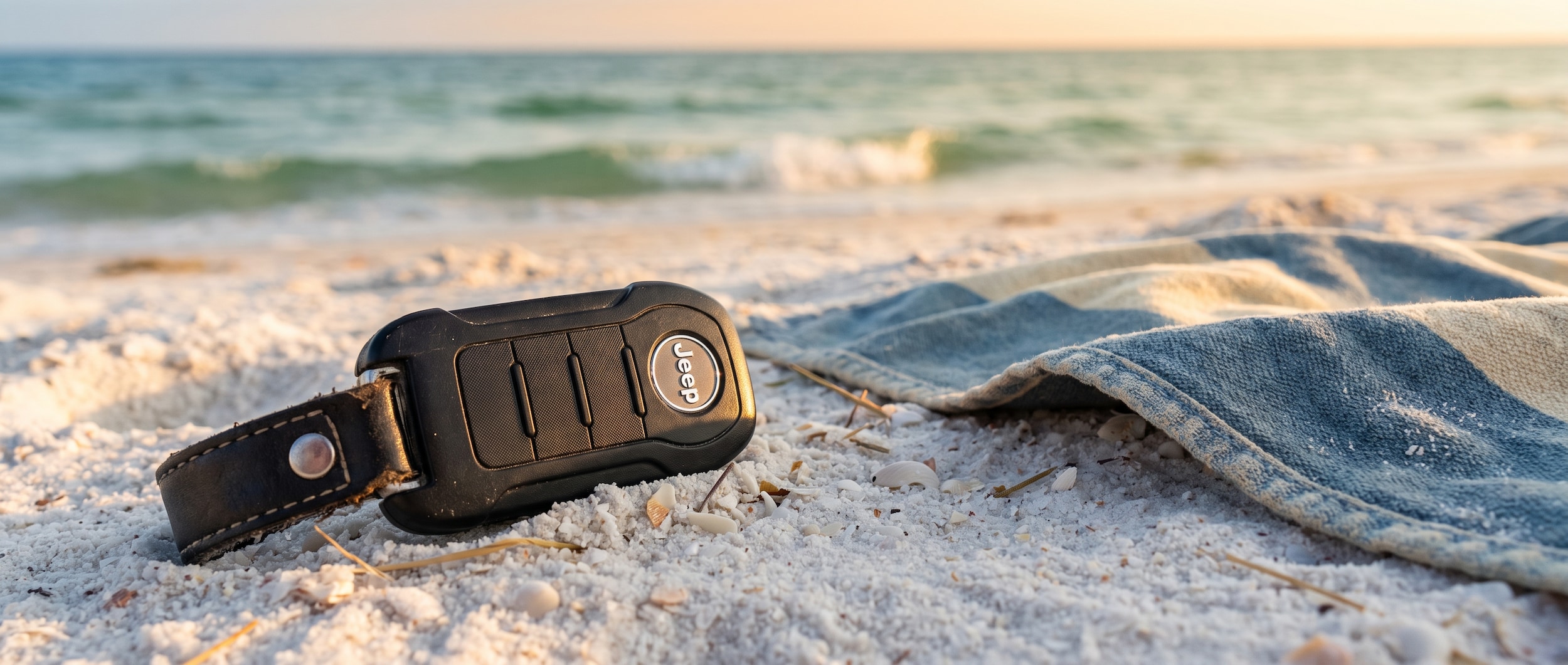
Salt did the real damage here. The water was just how it got inside.
The bottom line up front is simple. A key fob that got dunked in Gulf water or buried under a sandy beach bag has two separate problems working against it. Mix up the fix for one with the fix for the other, and you can end up needing a full replacement when a ten-minute cleanup would've done the job. Our service team at Bay Chrysler Dodge Jeep Ram sees this pattern every summer in Panama City Beach, and the fix depends on which threat you're facing.
What's Actually Going On Inside Your Fob?
| Symptom | Likely Cause | What's Happening Inside | What to Do |
|---|---|---|---|
| Buttons feel mushy or won't click | Sand intrusion | Fine Gulf quartz sand packed behind the rubber button pad, blocking contact | Open the fob, remove the pad, clean with compressed air and dry brush |
| Fob works today, fails next week | Salt corrosion | Chloride ions attacking copper traces on the circuit board even after visible drying | Rinse board with distilled water, follow with 90%+ isopropyl alcohol |
| "Key Not Detected" on the dash | Battery failure or damaged RF circuit | Salt or moisture has disrupted battery contact or the transmitter | Replace CR2032 battery; use backup push-to-start method |
| Buttons partially work (lock yes, unlock no) | Contaminated contact pads | Carbon conductive pads on the rubber buttons have a salt film | Clean pad and board contacts with isopropyl alcohol swab |
| Fob totally dead, no LED flash | Shorted circuit board | Water bridged two traces while battery was still in | Bring it to us. Board may be recoverable; programming will still be needed. |
Salt Is the Slow Killer, and That's the Part Nobody Warns You About
Saltwater is the slow killer because it feels bone-dry within an hour under the Gulf sun, and yet the dissolved salt it leaves behind keeps attacking the copper traces inside your fob for days, long after the case looks and feels completely dry to the touch. Salt dissolves in water, so it travels into every tight space it can reach. When the water evaporates, the chloride ions stay put and keep working on the board. It's an electrochemical reaction, and it won't stop on its own just because the fob looks dry.
Jeep Wrangler owners and Ram 1500 drivers who park near the access points along Panama City Beach often report the same thing. The fob worked fine on the drive home, then failed two or three days later. The surface fools you. Salt runs on a delayed timeline. The corrosion has already started.
The only way to stop it is to remove the dissolved salt with distilled water (not tap water, which carries its own minerals) and then clean the board with 90% or higher isopropyl alcohol. Alcohol displaces residual moisture, dissolves salt deposits, and evaporates without leaving a film. A cotton swab and a little patience are all you'll need for the board itself. The battery contacts need the same treatment. If you spot white or greenish powder on the metal contacts, that's active corrosion. The terminals are already insulating.
Sand Is the Immediate Threat (and the Easier One to Fix)
Sand is the more immediate threat and the easier one to fix, because it jams the buttons by purely mechanical means without any water involved, and a mechanical jam is something you can usually clear yourself in under fifteen minutes. Our Gulf Coast quartz is fine-grained and light, and it works its way into the gaps around the fob buttons without any water at all. If your buttons feel gritty, mushy, or won't click cleanly, sand has packed itself between the rubber button pad and the gold contact points on the circuit board. The problem is mechanical. So is the fix.
Getting inside the fob is the first step. The split seam around the edge of most Chrysler, Dodge, Jeep, and Ram fobs has a small pry notch, and a plastic trim tool or the edge of a coin works without scratching the case. Once open:
- Lift the rubber button pad out and set it aside. Don't stretch it.
- Use a can of compressed air to blow out loose sand from the board and the case.
- Brush the gold contact points on the circuit board with a dry, soft-bristled toothbrush.
- Wipe both the board contacts and the underside of the rubber button pad with a cotton swab lightly dampened with 90%+ isopropyl alcohol.
- Let everything dry completely before reassembly. Five minutes in a warm (not hot) spot is enough for alcohol; it evaporates fast.
- Snap the case back together and test each button individually.
Done right, this clears a sand-jammed fob in under fifteen minutes. Skip the rice. Uncooked rice is a poor desiccant next to silica gel packets, and it leaves starch dust that creates a brand-new problem inside the case.
When DIY Isn't Enough: The Right Time to See Our Service Team
Jeep Grand Cherokee fobs run more complex transponder setups, so they're recoverable after salt or sand damage up to a point, but once the transponder chip itself shorts out, no amount of cleaning or fresh batteries will bring the fob back to life on its own. If you've cleaned the board and replaced the CR2032 battery and the fob still won't communicate with the vehicle, the transponder chip may have shorted. That isn't a battery problem. It's a programming problem.
There's one thing worth knowing before you ever get stranded. If your Jeep or Ram has a push-button start and the fob battery is dead or the fob is too damaged to transmit, you can hold the nose of the fob (the end opposite the emergency key blade) directly against the ENGINE START/STOP button and push. The vehicle reads the passive transponder chip inside the fob, which doesn't need battery power. The method is a backup, it's in the owner's manual, and it works. It'll get you home. It won't substitute for a working fob long-term.
Bring it to us when:
- The LED inside the fob doesn't flash on any button press (even after a fresh battery)
- You cleaned the board and the symptom came back within a day
- The vehicle dash says "Key Not Detected" with a brand-new battery installed
- The emergency key blade turns the lock but push-to-start still fails
- The case is cracked and won't seal correctly anymore
Why does a cracked case matter so much? Because the rubber seals on a fob depend on the case halves pressing firmly together, and once that seal breaks, every future beach trip drives more humidity and salt straight onto the board. A new shell costs almost nothing. A new programmed key fob costs considerably more.
- [ ] Remove battery immediately after any salt or submersion exposure
- [ ] Rinse circuit board with distilled water if saltwater was involved, then follow with 90%+ isopropyl alcohol
- [ ] Use compressed air and a dry brush to clear sand from button channels
- [ ] Clean gold board contacts and rubber pad underside with isopropyl alcohol swab
- [ ] Dry fully before reassembling (silica gel packets work well; skip rice)
- [ ] Replace the CR2032 battery as a precaution after any significant exposure
- [ ] Check the case seam for cracks; a broken seal means the next beach trip repeats the problem
- [ ] If push-to-start fails: hold fob nose against the start button and push (passive transponder backup)
- [ ] If LED won't flash after cleaning and a new battery, schedule a service visit for diagnostics
Frequently Asked Questions
Can a key fob that got soaked in Gulf saltwater actually be saved?
Yes, and often it comes back if you move fast. Speed and the right cleaning sequence make the difference. Remove the battery right away to prevent the board from shorting, rinse the circuit board with distilled water to lift dissolved salt, then clean it with 90% or higher isopropyl alcohol, and let it dry completely before reinstalling a fresh CR2032 battery. The fob's rubber seals offer some protection against brief splashes, but full submersion in saltwater long enough to work past those seals usually means salt has reached the board. If the LED flashes when you press a button after cleaning and reassembly, the board survived. If it doesn't flash at all, bring it to our service team for diagnostics before you pay for a replacement.
How do I know if it's a sand problem or a salt problem?
Sand tends to give itself away right off the bat. Buttons feel gritty, won't click cleanly, or stick after you press them. Salt damage tends to surface later, anywhere from hours to a few days after the beach visit, because corrosion is a chemical process that keeps running after the fob looks dry. A fob that worked fine on the drive home but started throwing "Key Not Detected" warnings two days later is almost certainly a salt situation. Check the battery contacts for white or greenish powdery residue. That white film is corroded metal, and it confirms salt reached the inside.