





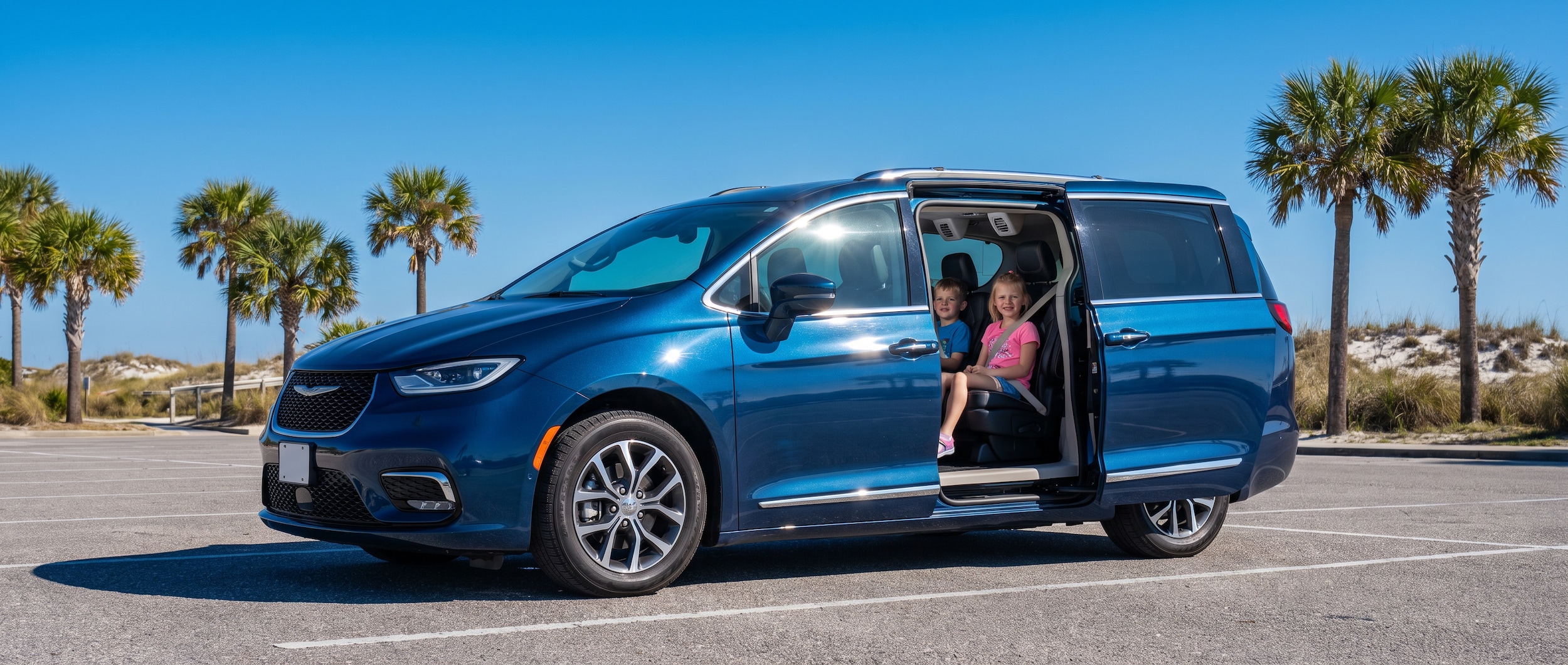
Cracking the windows barely helps, and parking in the shade doesn't do much either. Both facts catch a lot of parents off guard. On a typical Panama City July afternoon (where AccuWeather shows highs running 88 to 93 degrees and the heat index pushing past 102 degrees), a car's interior can jump roughly 20 degrees in the first ten minutes alone, per NHTSA. The numbers don't leave room to argue.
The good news is the 2026 Chrysler Pacifica was built with this exact problem in mind. But a few of its most useful features go completely unused by families who buy into the summer-heat myths. Let's fix that right now.
The short version
- Cracking windows does NOT meaningfully slow interior heat buildup (NHTSA confirms this directly).
- A car's interior can reach over 115 degrees Fahrenheit when the outside temperature is just 70 degrees Fahrenheit, making Gulf Coast July temperatures genuinely dangerous without running AC.
- The 2026 Pacifica's tri-zone automatic climate control covers all three rows with independent rear controls; it is NOT just a front-seat feature.
- Remote start on the Pacifica activates climate control automatically in temperatures above 80 degrees Fahrenheit. It pre-cools the entire cabin before anyone climbs in.
- The Rear Seat Reminder system displays a dashboard alert every time you park, so forgetting a sleeping child becomes far less likely.
Is "Just Crack the Windows" Actually Safe in a Florida Summer?
No, and the data behind that answer leaves very little wiggle room for a quick stop, because a sealed cabin traps radiant heat far faster than a cracked window can vent it, in full sun or under a shady live oak alike. NHTSA states plainly that rolling windows down or parking in the shade does little to change the interior temperature of a vehicle. What does change it, and fast, is running the air conditioning. An outside temperature in the mid-60s can push a vehicle's inside temperature above 110 degrees Fahrenheit, and the inside temperature can rise almost 20 degrees Fahrenheit within the first 10 minutes.
Now run that math on a Panama City July. AccuWeather's July 2026 forecast for Panama City, FL shows daily high temperatures ranging from 88 to 93 degrees, with an average high of 91 degrees.
Every summer brings the same scene. A parent pulls the kids from the Pacifica, leaves one napping in back with a window cracked, and heads inside for just a minute. The instinct is understandable. But a cracked window buys you nothing.
| The Myth | What's Actually True | Source |
|---|---|---|
| Cracking windows keeps the cabin cool enough | Does little to change interior temperature | NHTSA |
| Parking in the shade makes it safe | Shade does not prevent dangerous heat buildup | NHTSA |
| A light-colored van runs meaningfully cooler inside | Interior temperature difference is minimal | Kids and Cars safety research |
| "Just a minute" is fine on a hot day | Interior temps can rise 20 degrees in the first 10 minutes | NHTSA |
| The Pacifica's AC only cools the front | Tri-zone climate control covers all three rows independently | Chrysler |
| Remote start just warms up the engine | Remote start activates climate control above 80 degrees F | Pacifica owner's manual |
A child's body temperature rises three to five times faster than an adult's, per NHTSA. Heatstroke begins when the core body temperature reaches about 104 degrees, and per NHTSA, death occurs at a core body temperature of 107 or above. The window-cracking habit survives because nothing bad has happened yet. Surviving so far isn't the same as being safe.
What the Pacifica's Climate System Actually Does for the Back Seat
Plenty of families shopping the 2026 Pacifica zero in on cargo room and sliding doors, and that's a fair place to start, but the climate system is what actually carries the back seat through a Panhandle summer, especially in the second and third rows. Skipping past it on the test drive is a genuine missed opportunity.
The 2026 Pacifica doesn't ask the back seat to survive on whatever drifts back from the front vents. Chrysler specs the tri-zone automatic climate control to cover all three rows, with rear passengers able to control their own zone independently from the panel between the second-row seats. The rear climate control activates through the Uconnect touchscreen, offers a "Rear Auto" mode for automatic temperature management, and includes a "Lock Rear" function that keeps rear climate access with the front passengers when you'd rather have full control.
Does setting the rear zone actually matter, or is it a nice-to-have? On a 91-degree July afternoon driving home from routine service, it matters, because a zone left on Auto is quietly managing temperature in rows two and three while you're focused on the road. Leave it switched off from last week's cooler drive, and your kids in back ride along while only the front chills down.
Set the rear zone to Auto before every summer drive. The Pacifica's tri-zone system actively cools rows two and three (but only if it's turned on).
A detail worth flagging often slips past families. Per the Pacifica owner's manual, when remote start is activated, the climate control and vented seats (if equipped) are also activated in temperatures above 80 degrees Fahrenheit. So if you remote-start from inside a store, the AC's running across the whole cabin by the time you buckle the kids in. In a Gulf Coast July, that's more than a convenience. Call it a meaningful safety buffer.
Cabin pre-cool tip: The remote start pre-cool only works if you left the system on Auto the last time you drove. Switch the AC off manually, or set the rear zone to off before parking, and remote start won't override that setting. A 10-second check before you climb out keeps the system working on your side.
So What Should You Actually Do Before You Leave the Van?
Build a repeatable routine and trust it over your memory here, because on a busy July errand run the back-seat features only protect a child when you turn them on the same way, every single time you park. Intentions and willpower fade on a hot afternoon. A routine holds steady.
The 2026 Pacifica includes a Rear Seat Reminder built into the instrument cluster. The system automatically engages when a rear door is opened and closed before the vehicle starts, monitors your trip, and reminds you to check the back seats when you park. The reminder works off door activity. If a rear door was opened before your trip, the van reminds you to check the back when you shut the engine off. There's no radar involved, just a straightforward logic layer that catches the most common mistake.
Use this practical checklist for any Pacifica family running errands through a Gulf Coast summer:
- Before every trip: Confirm the rear climate zone is set to Auto. Takes five seconds.
- Remote start from outside: Key fob range on the Pacifica extends to approximately 328 feet. Use it. The cabin will be pre-cooled before the first child buckles in.
- Lock Rear mode on long drives: Use the front controls to manage rear temperature so small kids cannot accidentally switch the zone off mid-trip.
- Activate Rear Seat Reminder: Settings > Safety and Driving Assistance on the Uconnect 5 touchscreen. Confirm it's on. It's easy to overlook during initial setup.
- Put something in the back seat: Place your bag, phone, or keys back there as a physical reminder. Per NHTSA, over 50% of pediatric vehicular heatstroke deaths result from a parent or caregiver forgetting a child in a car.
One honest tradeoff is worth naming. The Pacifica's Rear Seat Reminder uses door-logic, not radar or breath sensors. The system doesn't scan for movement. If you load a child through the front door or forget to re-enable the feature after a settings change, the reminder won't fire. Treat it as a strong layer, not a complete substitute for checking the back seat yourself every single time. No technology is.
Panama City's average relative humidity in July sits at 74%, per weather records. High humidity stacked on 90-plus-degree heat is what shoves the heat index above 102 degrees, and that combination is why a parked cabin turns dangerous within minutes. Using these features on purpose, every trip, is what keeps the cabin safe this summer.
Frequently Asked Questions
Does cracking the windows keep the back seat safe for a quick stop?
No. Per NHTSA, rolling windows down does little to change a vehicle's interior temperature. On a Panama City summer day with a heat index above 100 degrees, interior temperatures can climb dangerously fast whether windows are cracked or the van's parked in shade. The only effective approach is running the air conditioning, using remote start to pre-cool before boarding, and never leaving children unattended in a parked vehicle for any amount of time.
Does the 2026 Chrysler Pacifica's remote start cool the back seat, or only the front?
When remote start is activated at temperatures above 80 degrees Fahrenheit, the climate control system engages across the cabin. The Pacifica's tri-zone automatic climate control covers all three rows, so the rear zones cool along with the front (provided the rear climate setting was left in Auto or On during the previous drive). If the rear zone was manually switched off before parking, remote start won't override that. The practical fix: always leave the rear zone in Auto before you exit the van.
Can the Rear Seat Reminder detect a sleeping child if a door wasn't opened?
The Rear Seat Reminder uses door-logic (door-open activity), not radar or motion sensors. If a child was loaded through the front door or the feature was accidentally disabled, the reminder won't alert you. Manual checks every time remain the safest layer. The reminder is a strong backup, not a substitute for your own verification.
Categories:
Social