




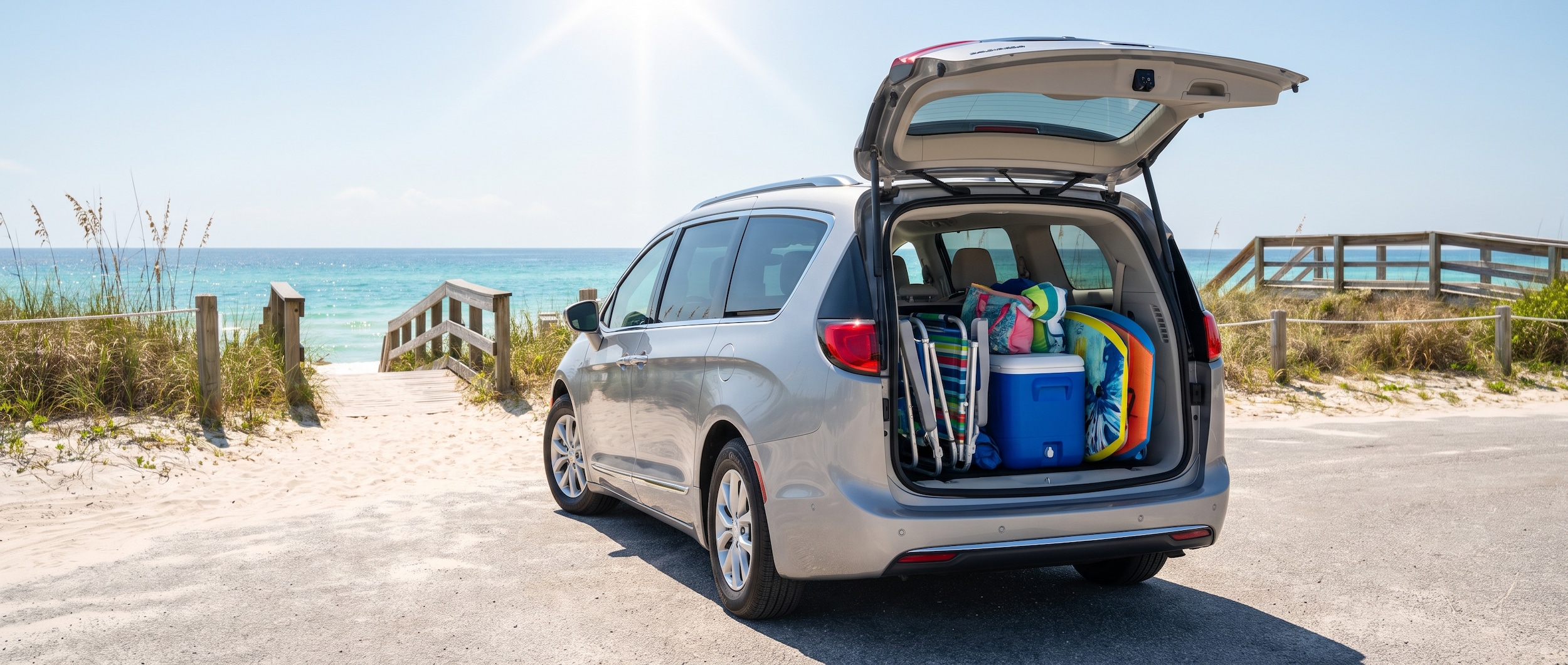
For most Panama City families loading up for a US-98 run to St. Andrews State Park or a longer haul down Scenic Highway 30A, the 2026 Chrysler Pacifica wins on the road-trip scorecard. It carries more cargo, seats kids more comfortably in the third row, and handles Gulf Coast summer heat better than a three-row SUV -- unless you need to tow a boat trailer or want off-road access, where the SUV earns its keep.
Does the Pacifica actually give you more room than a three-row SUV?
Space is the whole game on a family road trip, so let's start there with real numbers. The 2026 Chrysler Pacifica lists a maximum cargo volume of 140.5 cubic feet when both rear rows fold flat into the floor -- that is Chrysler's figure from the official specs page. The three-row Jeep Grand Cherokee L tops out at 84.6 cubic feet with both rows down, per Jeep's own design page.
That 56-cubic-foot gap matters the moment you start loading beach chairs, a wheeled cooler, boogie boards, and six people's luggage for an overnight at Panama City Beach. Run those numbers against your packing list and the SUV runs short; the minivan does not.
| Decision Factor | 2026 Chrysler Pacifica | 2026 Jeep Grand Cherokee L |
|---|---|---|
| Max cargo (all rows down) | 140.5 cu ft | 84.6 cu ft |
| Cargo behind 3rd row | 32.3 cu ft | 17.2 cu ft |
| Standard seating | 7 (8 available) | 7 |
| 3rd-row legroom | 36.5 inches | 30.3 inches |
| FWD highway fuel economy (EPA) | 28 mpg | Lower (AWD standard on upper trims) |
| Stow-flat floor without lifting | Yes (Stow 'n Go) | No |
| Towing with optional equipment | Up to 3,600 lbs | Up to 6,200 lbs |
| Trail/off-road capability | Everyday road use | Available 4WD for off-pavement access |
The Pacifica's Stow 'n Go system is a genuine differentiator here: on Select and Limited gas trims, both the second and third rows fold flush into dedicated floor compartments -- no wrestling seats out of the vehicle, no stacking them in the garage while you load for the trip. On a July morning when your driveway is already 90 degrees, that matters.
The Grand Cherokee L's third row measures only 30.3 inches of legroom -- tight for anyone past middle school -- while the Pacifica's third row stretches to 36.5 inches, enough that teenagers can ride to St. Andrews State Park without a revolt before you hit the parking lot.
What makes the Panhandle drive itself harder on passengers -- and does the Pacifica handle it?
US-98 between Panama City and Destin is one of the most stop-and-go stretches of road in Northwest Florida during July. Traffic backs up at every beach access point, resort entrance, and drawbridge along the coast. That is the context where interior comfort and climate control stop being features and start being trip quality.
The Chrysler Pacifica comes standard with tri-zone climate control, which lets the driver, second-row passengers, and third-row passengers set independent temperatures. In a full seven-passenger load heading down Scenic Highway 30A on a summer afternoon, that means the adults up front can run cooler air while the kids in back dial up a little warmth -- or more realistically, everyone gets what they need without a negotiation at every stop.
The EPA rates the 2026 Pacifica FWD at 19 city and 28 highway mpg. Combined, that is 22 mpg. Stop-and-go stretches on US-98 will pull that city number down for any vehicle, but the Pacifica's front-wheel-drive powertrain avoids the mechanical drag of AWD hardware that most full-size three-row SUVs carry. More practically: a van-shaped vehicle moving a family of seven at highway speed is working more efficiently than a tall SUV with the same load, and the Pacifica's sliding side doors let kids exit and board at every beach stop without swinging into neighboring cars in a packed parking lot -- a real advantage at the St. Andrews State Park parking area in peak summer.
When does the SUV actually win this comparison?
Honest answer: the Grand Cherokee L wins two specific scenarios, and they are worth naming.
If you tow -- a boat to the bay, a PWC trailer, or a camper for a trip to a Panhandle campground -- the Grand Cherokee L's tow rating reaches 6,200 pounds when properly equipped, per Jeep's specs. The Pacifica's optional Trailer Tow Group caps at 3,600 pounds. For a small fishing boat or a pair of jet skis, the Pacifica covers it. For a larger cabin cruiser, the Grand Cherokee L is the right tool.
Second scenario: if your road trip leaves the pavement. The Grand Cherokee L offers available 4WD systems and meaningful ground clearance for unpaved areas, boat ramps, or the kind of primitive access road that leads to a quiet beach section. The Pacifica is built for roads, not trails.
For everything else on the typical Panama City family itinerary -- hauling gear along US-98, parking at Pier Park, loading seven people plus luggage, keeping the third row comfortable -- the Pacifica does it better.
Frequently Asked Questions
Does the Chrysler Pacifica have enough cargo space for a week-long Florida road trip?
Yes. Chrysler lists the 2026 Pacifica's maximum interior cargo volume at 140.5 cubic feet with both rear rows folded into the floor. That is enough room for a family of five or six with full luggage, a large cooler, beach chairs, and gear -- more than any three-row SUV in the same passenger-count range. For context, the Jeep Grand Cherokee L maxes out at 84.6 cubic feet with both rows down.
Is the Pacifica's third row usable for older kids on a long drive?
More so than most SUVs. The 2026 Pacifica's third row provides 36.5 inches of legroom, compared to 30.3 inches in the Grand Cherokee L's third row. For children and younger teens, the Pacifica's third row is genuinely comfortable on a multi-hour drive. Adults will find it acceptable for shorter legs of a trip; it is not first-class seating, but it is meaningfully roomier than a typical three-row SUV's rearmost bench.
Can the Chrysler Pacifica tow a boat trailer to the bay?
With the available Trailer Tow Group on Limited and Pinnacle trims, the 2026 Chrysler Pacifica is rated to tow up to 3,600 pounds. That covers a small center-console fishing boat, a pair of PWC, or a light camper trailer. If you regularly pull a larger rig -- a cabin cruiser or a full camper -- the Jeep Grand Cherokee L, rated up to 6,200 pounds when properly equipped, is the better match for that job.