





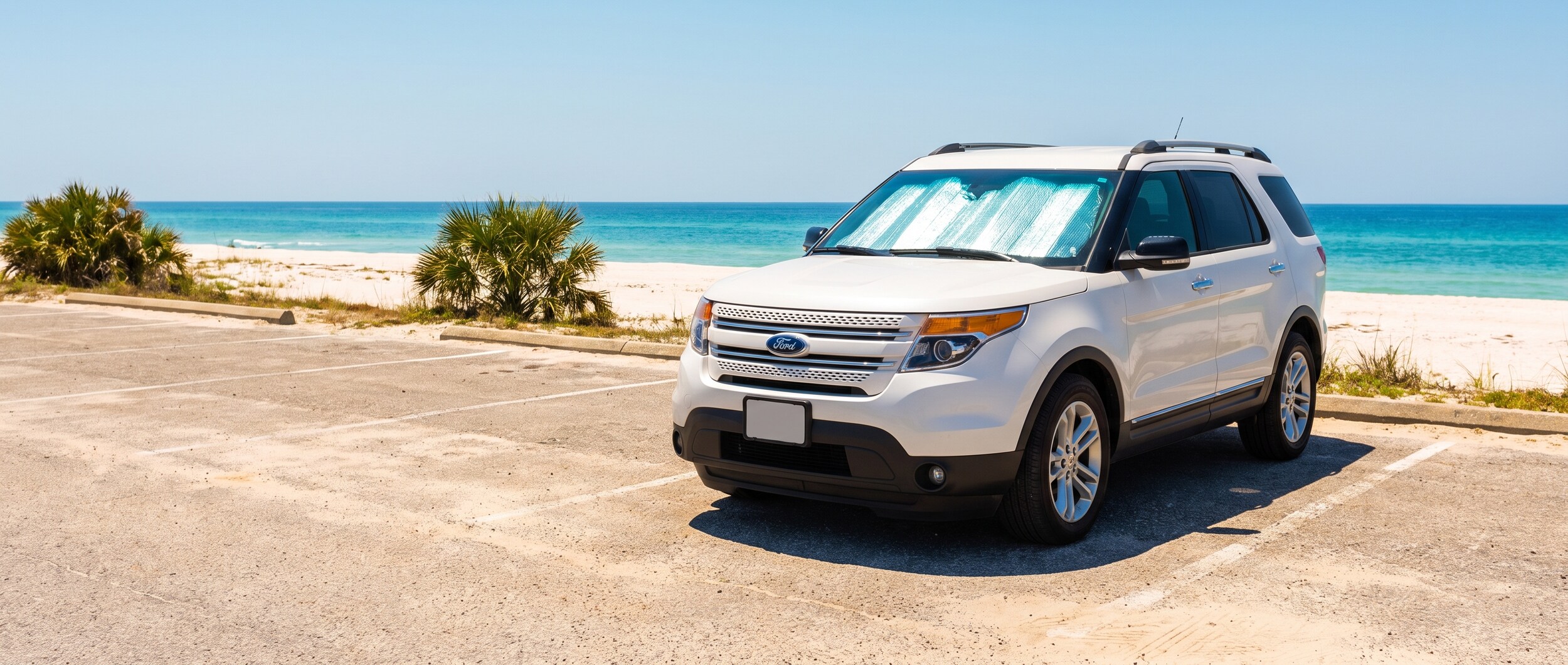
Panama City Beach packs its parking lots hard from June through August, and nearly every public lot near the water sits on open asphalt with zero tree cover. You walk back to your vehicle after two hours on the sand and hit a wall of air hot enough to damage a dashboard and burn bare skin. Here is the plan to prevent that -- and to get moving again fast when it does happen.
The short version: park by 9 a.m. or after 5 p.m., point the nose away from the afternoon sun, put a reflective shade up every single time you leave, and crack the windows a half-inch if the lot is reasonably secure. Those four moves alone shave off most of the worst heat before you even reach for the AC dial.
The Jeep Grand Cherokee lineup available at Bay Chrysler Dodge Jeep Ram includes remote start on trims from the Limited level up -- which means you can fire up the AC from across the parking lot before you ever touch the door handle. That matters on a PCB afternoon.
Where Do You Park, and When Does It Actually Fill Up?
Arrive after 10 a.m. on a summer weekend near Front Beach Road and your realistic options shrink fast. The three city-managed paid lots along Front Beach Road, Henley Drive, and Thomas Drive fill first. The free Bay County lots scattered through Sunnyside and Laguna Beach fill shortly after. St. Andrews State Park has interior spots with partial tree shade, but the park stops admitting vehicles entirely once it reaches capacity on busy summer days.
Timing is the biggest lever you have -- and earlier arrival also means your vehicle spends fewer peak-sun hours on asphalt.
| Arrive by | Where to park | Shade available | Fit note | Key heat tip |
|---|---|---|---|---|
| Before 9 a.m. | City paid lots (Front Beach Rd, Henley Dr, Thomas Dr) | None -- open asphalt | Handles full-size trucks and SUVs | Nose toward east; shade kit on immediately |
| 9 to 10 a.m. | St. Andrews State Park interior lots | Partial tree cover | Entry fee required; reaches capacity on peak days | Seek shaded spots -- tree cover cuts cabin temps meaningfully |
| 9 to 10 a.m. | Rick Seltzer Park lot (Thomas Drive area) | Minimal | Less crowded; free | Use full window shade kit; no structural shade |
| After 10 a.m. | Side streets in Sunnyside or Laguna Beach | Variable -- some tree-lined streets | Limited space; watch posted no-parking signs | Look for any east- or north-facing building shadow |
| After 5 p.m. | City paid lots re-open space as crowd thins | None | Asphalt radiates stored heat even after the sun drops | Fan the cabin before driving; run AC on max for first mile |
Locals who live near the water consistently report heading out before 10 a.m. to secure a spot during summer. If you are towing or driving a full-size crew cab, add time to find an end spot or pull-through -- the rows near Russell-Fields Pier get tight.
The Maneuvering and Fit Play for Larger Vehicles
Parking a crew-cab truck or a three-row SUV near Front Beach Road takes a different approach than a compact car. The paid lots at Henley Drive and the Thomas Drive lot across from Ripley's Believe It or Not tend to have wider lanes and occasional pull-through or end positions suited to longer vehicles. Street parking in Laguna Beach and Sunnyside runs through narrower residential layouts.
Beyond fit, orientation drives heat. Research from the Florida Solar Energy Center found that a reflective windshield shade reduces interior cabin temperature by 15 to 20 degrees Fahrenheit. Pair the shade with rear-to-sun orientation -- point the vehicle's rear toward the southwest, where the Florida summer afternoon sun tracks -- and the windshield faces away from the worst solar load. At PCB's June heat index of roughly 99 degrees Fahrenheit, a shaded and oriented cabin returns closer to bearable than one that absorbed five hours of direct glass exposure.
The Jeep Wrangler's removable doors and fold-down windshield let you vent the cabin almost entirely when parked in a secure lot, flushing heat faster than any shade panel alone. If you drive a Chrysler Pacifica, open both power sliding doors the moment you return -- that cross-breeze clears the hottest trapped air in seconds before you seal up and run the AC.
Parking orientation tip: Pull in nose-first to a spot that faces east or north when you have a choice. The afternoon sun tracks toward the southwest in the Gulf Coast summer sky, so a north- or east-facing windshield collects far less solar load during the peak heat hours between noon and 4 p.m.
Lot etiquette reminder: Pay at the kiosk before you leave the city-managed lots -- enforcement is active and consistent during summer. Do not park in condo or hotel lots without authorization; towing is enforced aggressively at peak season. If your truck or van extends into a lane, find an end spot rather than a mid-row position.
A Stanford University study found that interior cabin temperature averages 40 degrees Fahrenheit above ambient on sunny days -- at PCB's average June high of 87 degrees Fahrenheit, an unprotected parked cabin can reach 127 degrees or more.
Your Go-Enjoy-It Checklist for Every Beach Day
Run through this every time you park. It takes about 90 seconds and turns a miserable return into a manageable one.
Before you walk to the beach:
- Deploy the windshield shade -- reflective side facing the interior, not the glass. Add side-window shades if you have child seats or dark leather that absorbs heat aggressively.
- Crack each window a half-inch -- enough hot air escapes, not enough to invite theft or catch a rain shower. Vent guards let you do this safely in lots that see afternoon thunderstorms.
- Point the rear toward the sun -- if you have a pull-through or a corner spot, use it so the rear glass faces the southwest and the windshield faces away from direct afternoon exposure.
- Flip metal seatbelt buckles face-down -- buckles sitting in direct sun reach burn-level temperatures; flipping them costs nothing and matters when kids climb in first.
- Drape a light-colored towel over the steering wheel and dark seat surfaces -- light colors absorb less heat than bare dark vinyl or leather.
- Stow valuables out of sight before you leave home, not in the parking lot -- moving bags to the trunk in a busy summer lot is an advertisement.
When you come back:
- Fan the cabin before you climb in -- roll down the passenger window fully, then open and close the driver door five or six times. Each swing pumps superheated air out and pulls in outside air, dropping interior temps by roughly 10 degrees in under a minute.
- Aim vents at the ceiling -- cold air sinks, so point the center vents upward on high for the first mile. The cool stream cascades down rather than blasting the driver while passengers stay in the heat.
- Use remote start if your vehicle has it -- Grand Cherokee models from Limited trim upward include a remote start system; trigger it two to three minutes before you reach the vehicle and step into a pre-cooled cabin instead of an oven.
- Plan an AC service before peak summer stretches on -- a clogged cabin air filter cuts airflow and makes the system work harder to reach target temperature. Weak vent output in July is a symptom worth addressing now rather than in August.
Schedule Your AC Service at Bay Chrysler Dodge Jeep Ram
Parking near PCB in summer is a logistics problem with a solution. Know your lot options, arrive early, stay oriented, and use the tools your vehicle already has. Then walk to the water and stop thinking about the parking lot.
If you are shopping for a vehicle that handles the Gulf Coast summer routine -- from the open-air capability of a Ram 1500 hauling gear to the family space of a seven-passenger SUV -- stop by and see what is on the lot right now.
Categories:
Social