





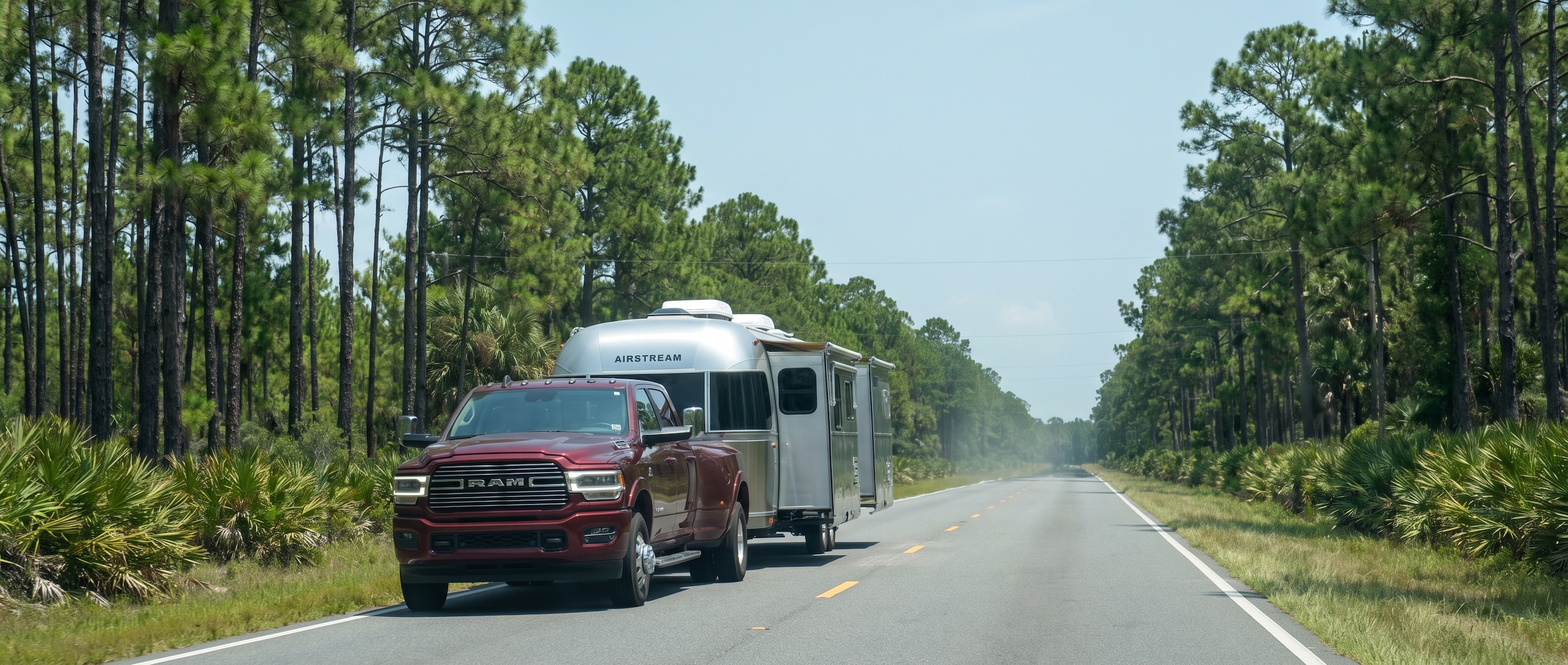
Your Ram Heavy Duty can handle the camper. The question is whether you checked the numbers before you loaded the coolers, filled the water tank, and put four people in the cab -- because that is where most towing problems start. Run through this list before you leave the driveway and the drive from Panama City down to St. Andrews State Park or along U.S. 98 stays exactly what it should be: a weekend trip, not a roadside lesson in weight limits.
What Goes on the Checklist?
The twelve items below are the ones that separate a smooth Gulf Coast towing run from one that ends on the shoulder. Each item carries a note on why it matters specifically in a Bay County summer -- heat, humidity, heavy traffic, and campground access roads that reward a prepared driver.
| Checklist Item | Why It Matters for a Bay County Summer Tow |
|---|---|
| Confirm your tow rating for your exact configuration | Ratings shift by engine, cab, bed, and axle. Ram rates the Ram 2500 with the High-Output 6.7L Cummins at up to 20,000 lbs when properly equipped, and with the 6.4L HEMI V8 at up to 17,750 lbs when properly equipped |
| Weigh the trailer fully loaded | Dry weight is a starting point. Fill the water tank, load the food and gear, and your trailer may weigh 10-20% more than the spec sheet |
| Calculate tongue weight | Target 10-15% of the trailer's gross weight for a conventional hitch setup. Too little and the trailer sways; too much and rear steering gets vague |
| Read the door-sticker payload number | Tongue weight plus passengers plus bed cargo all count toward it. This is your real ceiling, not the spec-sheet maximum |
| Confirm brake controller is active and tested | Required in Florida for trailers with brakes. Do a manual override test at low speed before the trip |
| Inspect hitch ball, coupler, and safety chains | Look for wear, cracking, or corrosion. A worn hitch ball is not a gray area |
| Check trailer tire pressure and lug torque | Trailer tires can lose significant pressure sitting for weeks. Hot pavement and low pressure are a blowout combination |
| Test all trailer lights | Brake, turn, and running lights -- have someone stand behind the trailer while you work the pedals |
| Verify mirrors cover full trailer width | If you cannot see both rear corners of the trailer from the driver seat, the mirror setup needs adjustment before you drive |
| Check DEF level if Cummins-equipped | A low-DEF warning during a heavy pull on a hot afternoon is an avoidable delay |
| Inspect engine coolant and transmission fluid levels | Sustained towing at 90-plus degrees stresses both. Check at home, not at a rest stop |
| Know your campground's rig-length limit | St. Andrews State Park in Bay County accommodates RVs up to 45 feet with water and electric hookups, but site width is limited and pull-throughs are few -- knowing your rig dimensions before you arrive prevents a messy backing situation at check-in |
The Numbers Behind the Key Items
Most towing articles list the max rating and move on. Two numbers bite Bay County campers more than any other.
Payload is the ceiling you are actually working with. Ram lists a maximum gas payload of 4,420 lbs for the 2025 Ram 2500 equipped with the 6.4L HEMI V8. That sounds like plenty of headroom. In practice, tongue weight from a loaded 10,000-lb travel trailer runs around 1,000 lbs, and two adults plus a weekend's worth of provisions adds several hundred more -- leaving less margin than owners expect on higher-trim configurations where options and features add curb weight. The payload number on your driver's door jamb is the one to plan against; the spec-sheet maximum is a starting point for comparing trucks, not a guarantee for your exact build.
The Cummins diesel changes the feel on a summer pull. Ram's High-Output 6.7L Cummins Turbo Diesel, now standard across the 2025 Ram 2500 and Ram 3500 diesel lineup, produces 430 horsepower and 1,075 lb-ft of torque, paired with a new TorqueFlite HD eight-speed automatic transmission. On a Florida Panhandle summer run -- flat-to-rolling terrain, afternoon heat, stop-and-go around Panama City Beach, and the occasional bridge approach -- that torque makes a real difference. The 6.4L HEMI gas engine handles travel trailers under roughly 12,000 lbs without strain. The Cummins is the right engine when you are consistently pulling above 14,000 lbs, running a fifth-wheel, or doing this run more than a few times a season.
Tongue weight and weight distribution. For a conventional hitch on a loaded travel trailer, keep tongue weight at 10-15% of the trailer's gross weight. If the tongue weight on your setup runs above 500 lbs on a lighter truck, a weight-distribution hitch levels the rear suspension and brings steering feel back to normal. Ram's own towing documentation places the maximum tongue weight for a Class V receiver hitch at 1,800 lbs -- a number to stay well under, not approach.
Tip: The campground loops at St. Andrews State Park sit in the pine woods near Grand Lagoon. Sites accommodate various rig sizes but access lanes are narrow compared to a commercial RV park. Run a backing practice session in an empty parking lot before the trip -- even an experienced tower benefits from refreshing the feel of their specific trailer on that specific truck.
See Current Ram Heavy Duty Offers
Schedule a pre-trip service check to have a technician confirm your hitch setup, brake controller wiring, and fluid levels before the trip -- especially if you have not towed with this truck before.
Print-and-Go Recap Before You Leave
Everything above distilled to a two-minute check the night before departure.
Evening before the trip:
- Trailer gross weight (loaded) is within your truck's rated capacity for your actual configuration
- Tongue weight is 10-15% of loaded trailer weight
- Tongue weight plus cab occupants plus bed gear is under your door-sticker payload number
- Trailer tires are at the correct pressure and lugs are torqued
- Hitch ball, coupler, safety chains, and breakaway cable inspected
- All trailer lights confirmed working with the truck running
- DEF level and engine coolant checked
- Campground site dimensions and loop access confirmed from your reservation
Morning of departure:
- Adjust side mirrors to full trailer width
- Shift the transmission into tow/haul mode
- Test the trailer brake controller manually at slow speed before reaching traffic
Explore financing options if you are considering a Ram Heavy Duty upgrade before your next big trip -- moving from a half-ton to an HD platform makes the math on larger campers a lot more straightforward.
Next step: Pull your trailer's weight documents and your truck's door-sticker payload number, and work through the checklist above item by item. If either number is missing or unclear, that is the first call to make before you hitch up.
Categories:
Social