




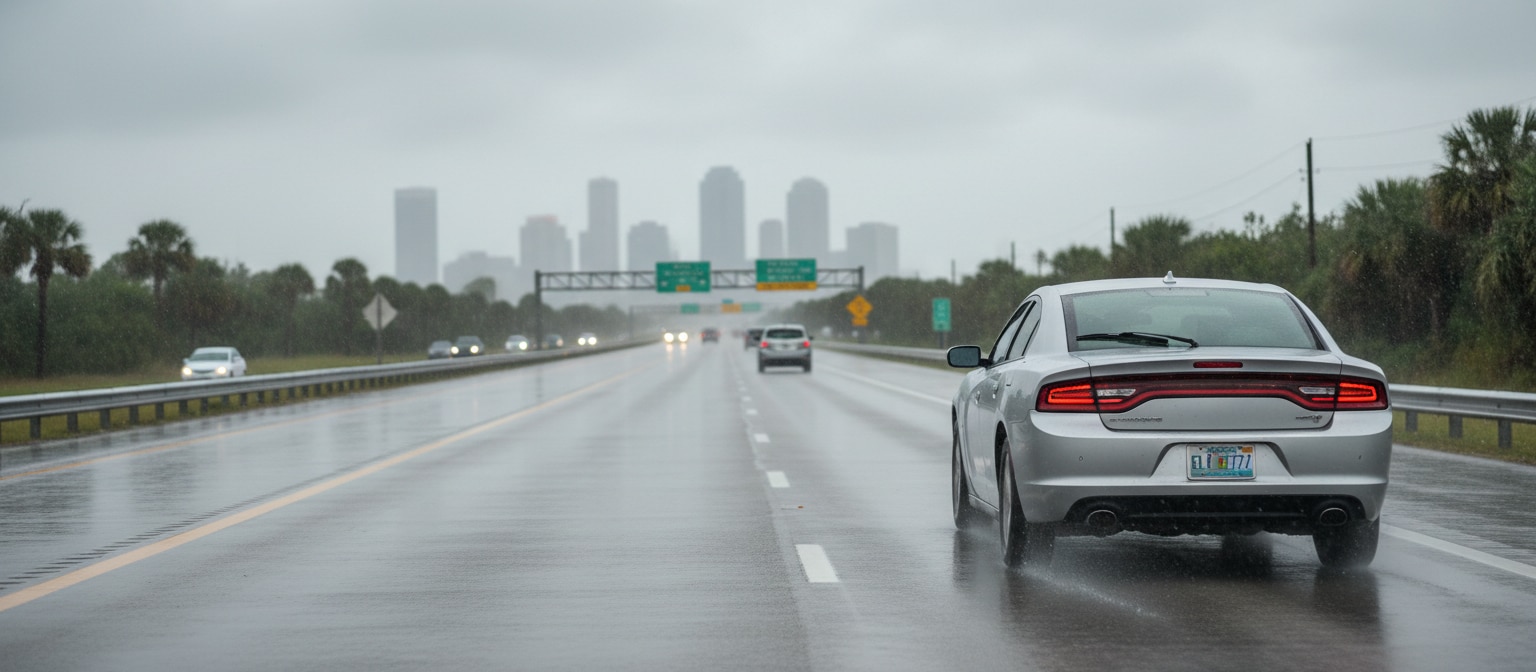
Your Dodge Charger® loses up to 30% of its tire traction the moment rain hits FL-77 - a fact that catches many Birmingham, AL drivers off guard during Alabama's frequent afternoon thunderstorms. Understanding how to maximize your Charger's safety systems while navigating wet conditions can mean the difference between a confident commute and a white-knuckle drive through Hoover or Bessemer.
Understanding Your Charger's Wet Weather Performance
The physics of wet road driving change dramatically when water creates a barrier between your tires and the pavement - and your Charger's weight distribution plays a crucial role in how it handles these conditions. With its rear-wheel-drive configuration and powerful engine options, the Charger requires specific techniques to maintain control when FL-77's surface becomes slick.
Modern Chargers come equipped with electronic stability control and traction management systems that actively monitor wheel slip hundreds of times per second. These systems work behind the scenes, applying individual wheel braking and reducing engine power when sensors detect a loss of grip.
Understanding your specific Charger trim's features makes a significant difference. R/T and Scat Pack models include performance-tuned stability programs that allow more wheel slip before intervening, while GT models prioritize maximum stability for everyday driving conditions.
The transition between different road surfaces becomes especially important during rain. Where FL-77 meets I-65 near the Birmingham-Shuttlesworth International Airport, the change in pavement texture can catch drivers unprepared.
Essential Pre-Drive Safety Checks
Before heading out on wet roads, five critical inspection points deserve your attention - and skipping even one significantly increases your risk. Start with your tires, as they're your only contact with the road surface.
- Check tread depth using the penny test (Lincoln's head should be partially covered)
- Verify proper inflation according to the door jamb sticker
- Inspect for uneven wear patterns
- Look for cuts, bulges, or embedded objects
- Ensure all four tires match in brand and tread pattern
Windshield wipers often get overlooked until you desperately need them. Quality wipers should clear water in one pass without streaking or skipping. Replace them every 6-12 months, or sooner if you notice deterioration.
Your Charger's lighting system becomes crucial in heavy rain. Walk around your vehicle checking:
- Headlights (low and high beams)
- Taillights and brake lights
- Turn signals front and rear
- Fog lights if equipped
- License plate lights
Brake responsiveness changes in wet conditions. Test your brakes gently before entering traffic, listening for unusual sounds and feeling for vibrations through the pedal.
Mastering Wet Road Driving Techniques
The moment rain begins falling, your driving style must adapt - aggressive inputs that work fine on dry pavement become dangerous on wet surfaces. Smooth, gradual movements keep your Charger planted and predictable.
Speed reduction isn't just cautious advice; it's physics. Water can't be compressed, so your tires must push it aside to reach pavement. Higher speeds make this increasingly difficult, leading to hydroplaning where your tires ride on top of the water.
Following distance requires dramatic adjustment in rain. The three-second rule for dry conditions should expand to six seconds or more. This gives you time to react and space to stop without relying on maximum braking.
Steering inputs need particular attention in rear-wheel-drive vehicles like the Charger. Quick direction changes can cause the rear end to step out, especially when accelerating. Make steering adjustments gradually, and avoid sudden movements.
Birmingham's hilly terrain around Red Mountain adds another challenge. Descending wet grades requires engine braking rather than riding the brake pedal. Shift to a lower gear using your Charger's manual shift mode to control speed without overheating your brakes.
Navigating FL-77's Specific Challenges
FL-77 presents unique hazards during rain that local drivers know to anticipate - but visitors often discover the hard way. The stretch passing Vulcan Park and Museum features several low spots where water accumulates quickly during downpours.
Construction zones along FL-77 create additional risks with:
- Uneven pavement transitions
- Temporary lane markings that become invisible when wet
- Narrow lanes with no shoulders
- Metal plates that become extremely slick
- Loose gravel that mixes with water creating muddy conditions
The interchange areas where FL-77 meets US-31 see frequent accidents during rain due to the combination of merging traffic and changing elevations. Maintain steady speed through these zones rather than accelerating or braking mid-turn.
Standing water tends to collect in the right lanes where road crown drainage fails. During heavy rain, consider using the center or left lanes where water runs off more effectively. However, avoid the leftmost lane unless passing, as faster traffic may not adjust speed appropriately for conditions.
Railroad Crossings near the Birmingham Rail Park become particularly treacherous when wet. The metal rails offer almost no traction, so cross them at a perpendicular angle when possible and avoid any acceleration or braking while on the rails.
Emergency Handling and Recovery
Even experienced drivers occasionally encounter hydroplaning - that stomach-dropping moment when steering input produces no response. Your natural instinct to brake hard or jerk the wheel will worsen the situation.
- Ease off the accelerator immediately
- Keep steering wheel pointed where you want to go
- Avoid braking unless you have anti-lock brakes
- Wait for tires to regain contact
- Gently correct your path once control returns
If your Charger begins sliding, remember that front-wheel slides (understeer) and rear-wheel slides (oversteer) require different responses. For understeer, reduce throttle and wait for front grip to return. For oversteer, steer into the slide while gradually reducing power.
Brake fade can occur during extended wet weather driving, especially descending from areas like Shades Mountain. If your brake pedal feels soft or requires more pressure, find a safe place to stop and let them cool for several minutes.
Should you need to pull over, choose your stopping location carefully. Soft shoulders along FL-77 can become muddy traps in heavy rain. Look for paved areas like the parking lots near Sloss Furnaces or established rest areas.
Technology Features That Enhance Wet Weather Safety
Your Charger includes several electronic assistants designed specifically for challenging conditions - understanding how to use them effectively maximizes your safety. The Electronic Stability Control (ESC) system continuously compares your intended path with the vehicle's actual direction.
Rain-sensing wipers, available on many Charger trims, automatically adjust speed based on moisture detection. However, don't rely on them entirely - manually override when conditions change rapidly.
The Charger's available all-wheel-drive system (on GT models) provides significant advantages in wet conditions:
- Automatic torque distribution between front and rear wheels
- Enhanced straight-line stability
- Better initial acceleration from stops
- Improved confidence in turns
Forward Collision Warning with Automatic Emergency Braking becomes even more valuable in rain where stopping distances increase. The system accounts for wet conditions when calculating intervention points.
For those with the Technology Group package, the rain brake support feature periodically applies light brake pressure to keep rotors dry and ready for maximum stopping power.
Common Questions About Dodge Charger Safety Tips for Wet Roads on FL-77 in Birmingham, AL
How much should I reduce my speed on FL-77 during heavy rain?
Reduce your speed by at least 10-15 mph below the posted limit during heavy rain on FL-77. When visibility drops below 1/4 mile or standing water is present, consider reducing speed by 20 mph or more to maintain safe control of your Charger.
Does the Dodge Charger's weight help or hurt in wet conditions?
The Charger's 4,000+ pound curb weight provides better stability and hydroplaning resistance compared to lighter vehicles. However, this weight also increases stopping distances on wet roads, so maintain larger following distances and brake earlier than you would in dry conditions.
Should I use cruise control on wet Birmingham roads?
Avoid using cruise control in moderate to heavy rain or when roads are visibly wet. If hydroplaning occurs while cruise control is engaged, the system may try to accelerate to maintain speed, worsening the loss of control.
What tire pressure should I run for wet weather driving in Birmingham, AL?
Maintain the manufacturer-recommended tire pressure found on your Charger's door jamb sticker, typically 32-35 PSI. Neither over-inflating nor under-inflating improves wet traction - proper inflation provides the optimal contact patch for water evacuation.
Are all-season tires adequate for Birmingham's wet roads?
Quality all-season tires with at least 5/32" tread depth provide adequate wet traction for Birmingham's climate. However, performance summer tires on R/T and Scat Pack models lose significant grip below 45°F and in wet conditions, making all-seasons a safer choice year-round.
How do I know when my Charger is starting to hydroplane on FL-77?
Watch for the traction control light flashing, steering that feels unusually light or unresponsive, and engine RPM increases without corresponding acceleration. These signs indicate your tires have lost contact with the pavement and are riding on water.
Your Safe Journey Starts Here
Mastering wet weather driving in your Dodge Charger transforms FL-77 from an intimidating challenge into a manageable commute, even during Birmingham's heaviest downpours. By combining your vehicle's advanced safety technology with proven defensive driving techniques, you'll navigate confidently whether heading to work downtown or exploring the scenic routes around Oak Mountain State Park.
Remember that your Charger's safety systems work best when properly maintained and when you drive within their designed parameters. Regular service ensures these systems function when you need them most.
The team at Bay Chrysler Dodge Jeep Ram understands the unique driving challenges Birmingham residents face and can help ensure your Charger is properly equipped and maintained for our local conditions. Stop by to check out our new inventory of Chargers with the latest safety features, or schedule service to prepare your current vehicle for the rainy season ahead.