





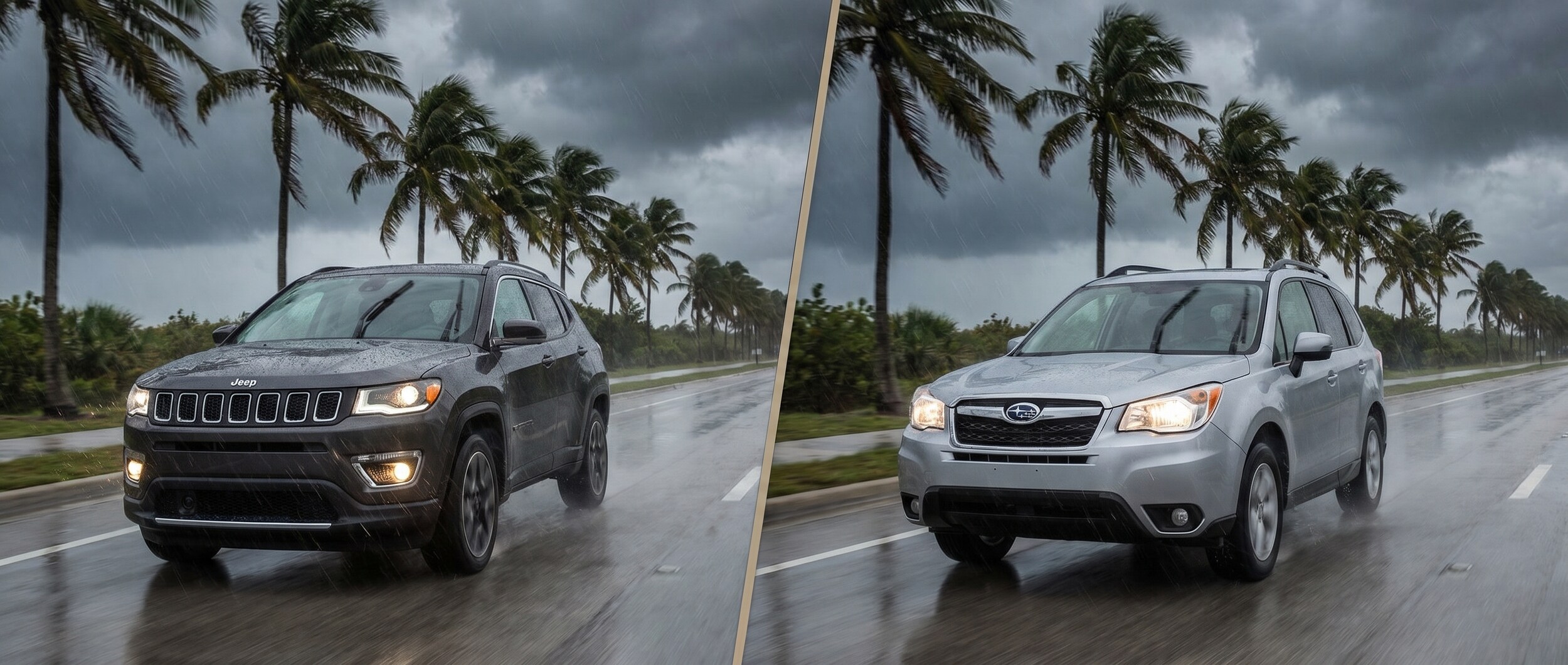
Panama City, FL gets hit with 59 inches of rain annually - that's 20% more precipitation than the national average, with most arriving during intense summer thunderstorms that can drop visibility to near zero in seconds. For Bay County drivers navigating everything from flash floods on Highway 98 to standing water near St. Andrews Bay, choosing between the Jeep® Compass™ and Subaru Forester means understanding how each SUV handles our unique weather challenges. This comparison breaks down real-world performance differences, traction systems, and safety features that matter when those afternoon storms roll in from the Gulf.
Understanding Bay County's Unique Weather Driving Challenges
Bay County's weather throws curveballs that test any vehicle's capabilities - from microbursts that dump 3 inches of rain in 30 minutes to coastal fog that blankets Highway 77 during morning commutes.
The combination of high humidity, sudden downpours, and salt air creates specific challenges:
- Flash flooding hotspots: Low-lying areas near Lynn Haven and Callaway can accumulate 6-8 inches of standing water within minutes
- Reduced visibility zones: Fog combines with rain near Tyndall Air Force Base, cutting visibility to under 50 feet
- Hydroplaning risks: Fresh rain on oil-slicked roads after dry spells creates dangerous conditions on major corridors
- Wind gusts: Thunderstorms regularly produce 40-50 mph gusts that push high-profile vehicles around
Local meteorological data shows July through September as peak concern months, with afternoon storms developing rapidly between 2 PM and 6 PM - right during rush hour. Drivers heading from Panama City Beach back toward Southport know how quickly conditions deteriorate when storms blow in from the Gulf.
Did you know? The National Weather Service reports that Bay County experiences an average of 75 thunderstorm days per year, making it one of the most storm-active regions in the continental United States.
Traction and Stability Systems: Compass vs. Forester
Both SUVs approach wet-weather traction differently, with distinct advantages depending on your typical driving routes around Panama City.
Jeep Compass Traction Features
The Compass employs Jeep's Selec-Terrain® Traction Management System with five distinct modes:
| Mode | Best Used For | Key Benefits |
|---|---|---|
| Auto | Daily commuting on Highway 231 | System automatically adjusts to conditions |
| Snow | Rare cold snaps with icy bridges | Optimizes throttle and transmission response |
| Sand | Beach access roads near Camp Helen | Maximizes momentum in loose surfaces |
| Mud | Unpaved areas after heavy rain | Aggressive traction control calibration |
| Rock | Not typically needed locally | Low-speed precision control |
The Compass Trailhawk® trim adds these weather-fighting features:
- Active Drive Low with 20:1 crawl ratio
- Skid plates protecting underbody components
- 8.5 inches of ground clearance (compared to Forester's 8.7 inches)
- Hill descent control for steep grades near Deer Point Lake
Subaru Forester All-Wheel Drive System
Subaru's Symmetrical All-Wheel Drive operates differently, sending power continuously to all four wheels through a center differential. The system includes:
- X-MODE with hill descent control
- 8.7 inches of ground clearance
- Active torque vectoring
- Vehicle Dynamics Control
The Forester's approach prioritizes predictable handling in all conditions rather than specialized terrain modes.
Safety Features That Matter in Florida Storms
When visibility drops and roads flood, advanced safety systems become critical. Here's how each SUV protects occupants during severe weather.
Weather-Specific Safety Technologies
Jeep Compass Safety Suite:
- Automatic emergency braking with pedestrian detection
- LaneSense® lane departure warning with lane keep assist
- Full-speed forward collision warning
- Adaptive cruise control with stop and go
- Blind spot monitoring (crucial when spray reduces mirror visibility)
Subaru Forester EyeSight® System:
- Pre-collision braking system
- Adaptive cruise control
- Lane departure and sway warning
- Lane keep assist
- Lead vehicle start alert
Both vehicles earned strong ratings from the Insurance Institute for Highway Safety (IIHS), though the Forester received their TOP SAFETY PICK award for 2024.
Pro tip: During heavy rain, disable lane keep assist on either vehicle - the systems can struggle to detect lane markings through standing water, causing unnecessary steering interventions.
Real-World Performance Comparison for Local Conditions
Testing these SUVs on Bay County roads reveals practical differences that specifications don't capture.
Acceleration and Passing Power
The Compass offers two engine options that affect rain performance:
- 2.0L Tigershark® (158 hp): Adequate for normal conditions but requires planning for highway merges
- 2.4L MultiAir® 2 (180 hp): Available in upper trims, provides confident acceleration
The Forester's single 2.5L BOXER® engine delivers 182 horsepower consistently across all trims. The horizontally opposed engine design lowers the center of gravity, enhancing stability during crosswind situations common on the Hathaway Bridge.
Visibility Differences
Strengths:
Compass:
- Commanding seating position
- Large windshield area
- Available LED lighting package
- Rain-sensing wipers standard on upper trims
Forester:
- Exceptional glass area with minimal blind spots
- Standard LED headlights across all trims
- Larger rear window aids backing in poor visibility
- Heated windshield wiper de-icers (rarely needed locally)
Considerations:
Compass:
- A-pillar design creates moderate blind spots
- Rear visibility affected by spare tire on some trims
Forester:
- Lower hood line may reduce forward visibility for shorter drivers
- Rear spoiler can accumulate rain, affecting rear camera
Interior Protection and Comfort During Weather Events
Spending time stuck in traffic during storms tests interior quality and comfort features.
Water Resistance and Cabin Sealing
The Compass, particularly in Trailhawk trim, features:
- All-weather floor mats standard
- Rubberized cargo area
- Water-resistant seat materials available
- Drain plugs in floor (Trailhawk only)
The Forester emphasizes:
- StarTex® water-repellent upholstery
- Deep door pockets for wet items
- Rear seat waterproof covers available as accessories
- Larger cargo area for emergency supplies
Climate Control Performance
Both vehicles offer dual-zone automatic climate control, but implementation differs:
Compass advantages:
- More powerful air conditioning for humid conditions
- Heated steering wheel available
- Remote start standard on many trims
Forester advantages:
- Heated front and rear seats standard on upper trims
- Larger defrost vents
- More intuitive control layout
Maintenance Considerations for Coastal Environments
Salt air from the Gulf accelerates corrosion, making maintenance intervals critical for long-term reliability.
Recommended Service Intervals
| Service Item | Compass | Forester |
|---|---|---|
| Oil Changes | 7,500 miles* | 6,000 miles |
| Tire Rotation | 7,500 miles | 6,000 miles |
| Brake Fluid | 2 years | 3 years |
| Coolant Flush | 10 years/150k | 11 years/137k |
| Transmission | 120,000 miles | 30,000-60,000 |
*Severe conditions may require 4,000-mile intervals
Living near salt water means additional maintenance:
- Underbody washing after beach trips
- More frequent brake inspections
- Annual corrosion inspections
- Wax applications every 3-4 months
Check out our pre-owned inventory for well-maintained examples of both models that have proven themselves in local conditions.
Common Questions About Rainy Weather Driving in Panama City, FL
How deep of water can the Jeep Compass safely drive through in Bay County floods?
The Jeep Compass can safely ford up to 19 inches of water when properly equipped, though drivers should avoid any standing water over 6 inches on public roads. The Trailhawk trim offers the best water fording capability with additional skid plates and sealed electrical connections, but remember that Bay County ordinances prohibit driving through barricaded flooded roads regardless of vehicle capability.
Does the Subaru Forester's all-wheel drive system work better than the Compass in Panama City Beach sand?
The Subaru Forester's full-time AWD provides consistent traction on sandy beach access roads, but the Jeep Compass with Selec-Terrain's Sand mode actually performs better in deep sand conditions. The Compass can modulate wheel spin more effectively for momentum, while the Forester's system may struggle without a dedicated sand mode, especially on softer surfaces near St. Andrews State Park.
Which SUV handles better on Highway 77 during afternoon thunderstorms?
The Subaru Forester's lower center of gravity provides more stable handling on Highway 77 during gusty thunderstorms, reducing the unsettled feeling from crosswinds. However, the Jeep Compass offers superior water dispersal from its tires and more aggressive stability control intervention, making both vehicles competent choices for this busy corridor during severe weather.
How often should I replace tires on these vehicles given Panama City, FL's weather?
Replace tires every 40,000-45,000 miles on both vehicles when driving primarily in Bay County's wet conditions, about 20% sooner than in drier climates. The constant heat, UV exposure, and frequent wet roads accelerate tread wear, and maintaining proper tread depth is crucial for preventing hydroplaning on rain-slicked roads like Thomas Drive or Front Beach Road.
Are there specific Jeep Compass or Forester features that help with fog driving near Tyndall Air Force Base?
The Jeep Compass Limited and above includes fog lamps and automatic high-beam assist that help navigate dense fog near Tyndall Air Force Base. The Subaru Forester's EyeSight system actually performs better in fog, maintaining adaptive cruise control functionality in conditions that disable the Compass's system, though both vehicles require careful speed reduction in limited visibility.
Which vehicle is better for evacuating Panama City during hurricane season?
The Jeep Compass edges ahead for hurricane evacuation with its available factory-installed trailer hitch, greater fuel range on a single tank, and more rugged construction for debris-strewn roads. The Forester offers superior cargo space for supplies and better fuel economy during stop-and-go evacuation traffic, making either vehicle suitable depending on your specific evacuation needs and family size.
Making Your Decision for Bay County Driving
Choosing between the Jeep Compass and Subaru Forester for Panama City's challenging weather comes down to your specific driving patterns and priorities. The Compass shines with its specialized terrain management and rugged capability - ideal if you frequently travel unpaved roads near Pine Log State Forest or need maximum ground clearance for flood-prone areas. The Forester excels with predictable all-weather handling and superior visibility, making it the practical choice for families primarily navigating paved roads from Lynn Haven to Panama City Beach. Both vehicles have proven themselves capable of handling our 75 annual thunderstorm days, but your decision should align with where and how you drive most often. The team at Bay Chrysler Dodge Jeep Ram understands these local challenges firsthand and can help you test drive both options during various weather conditions to make the most informed choice for your Bay County lifestyle.
Categories:
Social