




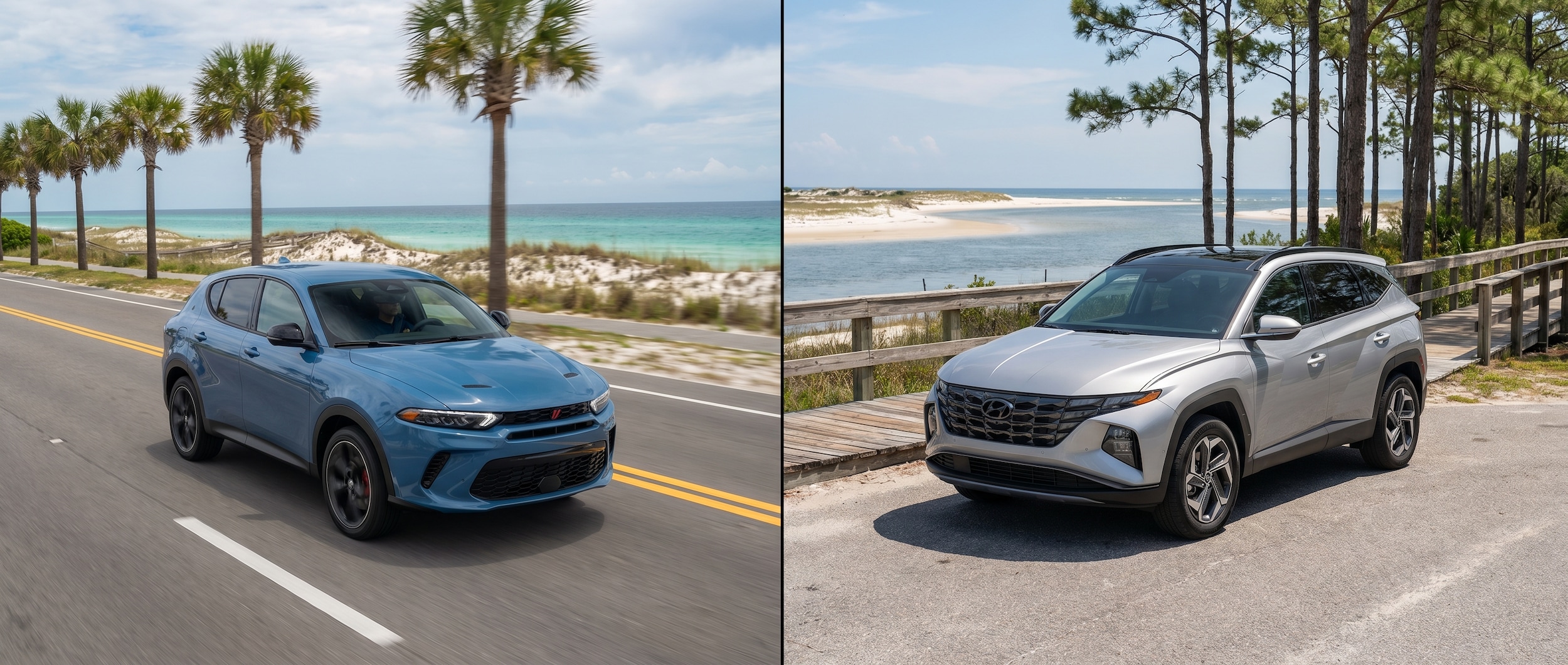
The Dodge® Hornet brings 288 horsepower and cutting-edge technology to Panama City, FL streets, while the Hyundai Tucson counters with spacious comfort and proven reliability. Both compact SUVs promise modern tech and safety features, but they deliver these benefits through vastly different approaches. For drivers navigating from Panama City Beach to Lynn Haven or commuting along Highway 98, understanding these differences means finding the perfect match for your daily needs and weekend adventures.
Breaking Down the Technology Battle
The Hornet's 12.3-inch digital cluster puts customizable performance data right in your line of sight - a feature typically reserved for vehicles costing thousands more. This isn't just about flashy screens. The Hornet's Uconnect 5 system processes voice commands faster than you can finish saying "navigate to Pier Park," while the standard wireless Apple CarPlay and Android Auto mean your phone stays in your pocket.
The Tucson takes a different approach with its dual 12.3-inch curved display that seamlessly blends the instrument cluster with the infotainment screen. Where the Hornet emphasizes performance metrics and driver engagement, the Tucson focuses on creating a calm, connected environment. Its Blue Link system offers remote start capabilities that prove invaluable during those humid Panama City summers.
Here's how the tech features stack up for daily use:
Hornet Tech Advantages:- Faster processor speeds for zero lag
- Performance-focused displays with G-force meter
- Standard wireless smartphone integration
- Customizable drive mode displays
- Larger combined screen real estate
- Ambient mood lighting system
- Digital key smartphone app
- Voice-activated climate control
Safety Ratings and Real-World Protection
Your family's safety on roads from Callaway to Parker deserves serious consideration. The 2024 Hornet earned a Top Safety Pick award from IIHS, scoring "Good" ratings in all crashworthiness categories. This achievement comes from Dodge's strategic use of ultra-high-strength steel in critical areas, creating a protective cage around passengers.
| Safety Feature | Dodge Hornet | Hyundai Tucson |
|---|---|---|
| IIHS Overall Rating | Top Safety Pick | Top Safety Pick |
| Forward Collision Warning | Standard | Standard |
| Blind Spot Monitoring | Standard | Standard |
| Adaptive Cruise Control | Available | Standard |
| Lane Keep Assist | Standard | Standard |
| Parking Sensors | Rear Standard | Front & Rear Standard |
The Tucson matches the Hornet's Top Safety Pick status while adding a few extra conveniences. Its Highway Driving Assist essentially handles highway cruising for you, maintaining speed and lane position during those long drives to Destin. The Hornet counters with its Traffic Sign Recognition system that displays current speed limits directly in your gauge cluster - particularly helpful when speed limits change frequently along scenic Highway 30A.
Both vehicles include comprehensive airbag systems, but the Hornet adds driver knee airbags as standard equipment. For families frequently traveling with car seats, both offer LATCH anchor points in outboard rear positions, though the Tucson's wider rear doors make installation noticeably easier.
Understanding the Value Equation for Bay County Drivers
Value extends beyond the sticker price when you're investing in a vehicle that needs to handle everything from beach trips to daily commutes. The Hornet delivers its value through performance efficiency - its turbocharged engine produces significantly more power while achieving similar fuel economy to the Tucson's larger engine.
Hornet Ownership Benefits:- 32 mpg highway despite 288 horsepower
- Compact size perfect for downtown Panama City parking
- Lower insurance costs in the compact SUV segment
- Standard all-wheel drive for weather confidence
- More rear seat space for growing families
- Larger cargo area for beach gear
- Established service network
- Proven long-term reliability record
The Hornet's PowerShot feature might seem like a gimmick until you're merging onto Highway 77 with a boat in tow. That instant power boost provides confidence when you need it most. Meanwhile, the Tucson's extra cargo space proves its worth every weekend at St. Andrews State Park, swallowing coolers, beach chairs, and fishing gear with room to spare.
Performance Differences That Matter Daily
Raw numbers tell only part of the performance story. The Hornet's 2.0-liter turbocharged four-cylinder generates 288 horsepower and 295 lb-ft of torque, reaching 60 mph in just 6.5 seconds. The Tucson's 2.5-liter naturally aspirated engine produces 191 horsepower, taking about 8.8 seconds for the same sprint.
But here's what those numbers mean for Panama City drivers:
The Hornet's turbocharged power delivery transforms highway merging from anxious to effortless. When you're joining Highway 98 traffic from a standstill, that instant torque surge provides a safety margin you'll appreciate daily. The standard all-wheel drive system also redistributes power within milliseconds when afternoon thunderstorms slick the roads.
The Tucson prioritizes smooth, predictable power delivery over outright performance. Its traditional engine might lack the Hornet's punch, but it delivers consistent response whether you're creeping through school zones or cruising to Mexico Beach. This predictability, combined with its softer suspension tuning, creates a more relaxed driving experience.
Interior Space and Comfort Analysis
Compact SUV dimensions require smart packaging, and each vehicle prioritizes differently. The Tucson offers 108 cubic feet of passenger space compared to the Hornet's 97 cubic feet, with most of that advantage appearing in the rear seats.
| Interior Dimensions | Dodge Hornet | Hyundai Tucson |
|---|---|---|
| Front Headroom | 39.0 inches | 39.6 inches |
| Rear Legroom | 36.9 inches | 41.3 inches |
| Cargo Space (seats up) | 27.0 cu ft | 38.7 cu ft |
| Cargo Space (seats down) | 57.0 cu ft | 74.8 cu ft |
For daily commutes between Lynn Haven and Tyndall Air Force Base, either vehicle provides adequate comfort. The Hornet's sport seats offer better lateral support during spirited driving, while the Tucson's chairs prioritize all-day comfort. Both feature premium available leather that handles Florida's heat and humidity well.
The Tucson's cargo advantage becomes apparent during Costco runs or when packing for a week at the beach. However, the Hornet's cargo area includes clever storage solutions like underfloor compartments and grocery bag hooks that maximize its smaller space.
Technology Integration in Daily Life
Living with modern vehicle technology means more than impressive spec sheets. The Hornet's Uconnect 5 system learns your preferences over time, automatically suggesting navigation to frequent destinations when you start the vehicle. Its Performance Pages display real-time data like G-forces and acceleration times - features that transform mundane commutes into engaging drives.
The Tucson's Blue Link system excels at remote functions you'll use constantly. Start the vehicle from inside Publix to cool the interior before loading groceries. Check fuel levels from your couch before that early morning fishing trip. These conveniences might seem minor until they become part of your routine.
Daily Tech Features You'll Actually Use:Hornet Advantages:
- Wireless charging pad keeps phones powered
- Configurable gauge displays for preferred info
- One-touch performance mode activation
- Built-in navigation with traffic updates
Tucson Advantages:
- Quiet mode for sleeping passengers
- Smart park assist for tight spaces
- Digital key sharing with family
- Natural voice commands for most functions
Making the Panama City Choice
Choosing between the Hornet and Tucson ultimately depends on your priorities and lifestyle around Bay County. The Hornet rewards drivers who value performance and engagement, delivering genuine driving excitement whether you're navigating downtown Panama City or exploring backroads toward Marianna.
The Tucson serves families who prioritize space and convenience features, offering a refined experience that handles everything from school pickup lines to vacation road trips with equal composure. Its proven reliability and comprehensive warranty provide peace of mind for long-term ownership.
Consider how you'll use your vehicle most days. If your typical week includes mostly solo commutes with weekend adventure trips, the Hornet's performance and efficiency make compelling arguments. Browse our new inventory to explore available Hornet models and configurations.
For families regularly hauling sports equipment to Frank Brown Park or needing maximum cargo space for Sam's Club runs, the Tucson's practicality might prove more valuable than the Hornet's performance advantages.
Common Questions About Dodge Hornet vs. Hyundai Tucson in Panama City, FL
Which vehicle handles better in Panama City Beach's sandy conditions?
The Dodge Hornet's standard all-wheel drive system provides superior traction in sandy or wet conditions compared to front-wheel drive Tucson models. Both vehicles offer enough ground clearance for beach access roads, but the Hornet's torque-vectoring AWD actively sends power to wheels with the most grip, proving especially helpful when leaving beach parking areas.
How do the warranties compare for Bay County drivers?
Dodge covers the Hornet with a 3-year/36,000-mile basic warranty and 5-year/60,000-mile powertrain coverage. Hyundai offers 5-year/60,000-mile comprehensive coverage and 10-year/100,000-mile powertrain protection, providing longer coverage that many Panama City buyers find reassuring for long-term ownership confidence.
Which SUV offers better fuel economy for Highway 98 commutes?
Despite producing nearly 100 more horsepower, the Hornet achieves 32 mpg highway compared to the Tucson's 33 mpg highway rating. For typical Panama City commutes mixing city and highway driving, real-world fuel economy proves nearly identical, with driving style affecting consumption more than the one-mpg rating difference.
Does the Dodge Hornet require premium fuel in Florida's climate?
The Hornet runs on regular 87-octane fuel, though Dodge recommends premium for maximum performance output. Panama City's hot, humid climate doesn't require premium fuel for daily driving, but using 91-octane or higher unleashes the full 288 horsepower when you want maximum acceleration for highway merging.
How do technology updates work for each brand?
Both vehicles receive over-the-air updates for infotainment features, but Dodge's Uconnect 5 system allows more extensive updates including performance parameters and vehicle settings. Bay Chrysler Dodge Jeep Ram provides complimentary update assistance, ensuring your Hornet's technology stays current throughout ownership.
Which vehicle fits better in Panama City Marina parking spaces?
The Hornet's compact 179-inch length makes it 8 inches shorter than the Tucson, providing noticeable advantages in tight marina lots and downtown Panama City parallel parking situations. This smaller footprint, combined with the Hornet's tighter turning radius, simplifies navigation in crowded beach parking areas during peak tourist season.
Your Next Step Toward the Perfect SUV
The choice between the Dodge Hornet's turbocharged performance and the Hyundai Tucson's spacious practicality reflects your personal priorities for Panama City driving. Each delivers modern technology and proven safety in different packages designed for different drivers.
Take time to experience both vehicles in real-world conditions - from stop-and-go traffic on 23rd Street to highway cruising toward Destin. Pay attention to how each vehicle's technology enhances your daily routine and which comfort features matter most for your typical passengers.
The team at Bay Chrysler Dodge Jeep Ram understands Bay County driving conditions and can demonstrate how the Hornet's features perform in local situations. Whether you're drawn to its PowerShot performance or comprehensive safety technology, experiencing these features firsthand makes the decision clearer.