




November catches a lot of Panama City drivers off guard. The mornings are genuinely cooler now, with lows running in the low-to-mid 50s and occasional dips toward the upper 40s, and that's the moment a battery weakened by months of Gulf Coast summer heat finally shows what it's been hiding. Here's the honest truth. Heat is what kills Florida batteries, and the cool morning is just the reveal.
What does that mean for you? A battery that sailed through summer isn't necessarily a healthy battery. Heat speeds up the internal chemical reactions that break down electrolyte fluid, a process called sulfation, and a battery that should have lasted five years in a cooler state can be down to functional capacity after just three years on the Panhandle. So when that first 50-degree morning hits and the engine cranks slowly, the battery didn't fail because of the cold. It failed because it was already compromised.
Choosing the right replacement battery, and knowing when to test the one you have, is what this guide covers.
- Florida heat (not cold) is the primary battery killer here: Gulf Coast conditions can shorten battery life from 5 years down to roughly 3 years.
- Consumer Reports recommends a professional load test annually once a battery hits 2 years old in warm climates.
- AGM (Absorbent Glass Mat) batteries handle Gulf Coast heat and humidity significantly better than standard flooded batteries.
- For trucks and large SUVs, look for 650 to 800 CCA or more; for passenger cars and smaller SUVs, 450 to 600 CCA covers most situations.
- The right CTA after a cool-morning slow crank: schedule a service check before the battery makes the decision for you.
Schedule a service check at Bay Chrysler Dodge Jeep Ram
What Actually Matters When Choosing a Battery for the Gulf Coast?
The spec that dominates battery marketing is Cold Cranking Amps (CCA), and it's measured at 0 degrees Fahrenheit, which is about 50 degrees colder than the coldest morning Panama City typically sees. CCA still matters here. It reflects overall starting power, but for Gulf Coast drivers, it isn't the most critical number on the label.
What matters more in our climate is heat tolerance, which breaks down into these four variables.
| Factor | What It Measures | Why It Matters Here | The Tradeoff |
|---|---|---|---|
| Battery type (AGM vs. flooded) | Sealed vs. open electrolyte design | AGM resists evaporation and sulfation in sustained heat | AGM carries a higher upfront cost |
| Reserve Capacity (RC) | Minutes the battery can sustain load at 25 amps before dropping to 10.5V | Protects against AC and accessory drain during Gulf Coast summers | Higher RC batteries are physically larger; confirm fitment |
| CCA rating | Amps deliverable at 0 degrees Fahrenheit for 30 seconds above 7.2V | Reflects overall starting power, still relevant for November mornings | Over-specing CCA without matching RC buys little in a warm climate |
| Age | Years in service | Heat accelerates degradation; a 3-year-old Florida battery is comparable to a 5-year-old northern battery | No amount of brand or type overcomes a depleted battery |
Battery Type Is the Real Decision on the Gulf Coast
For most Panama City drivers, the choice between a standard flooded battery and an AGM battery is the most consequential call you'll make. Standard flooded (also called wet-cell) batteries have an open electrolyte design that lets heat evaporate the internal fluid faster. That evaporation exposes the internal lead plates, which corrodes them and reduces capacity. AGM batteries are fully sealed. The electrolyte gets absorbed into glass mat separators, so there's no fluid to boil off.
That sealed design is why AAA and Consumer Reports specifically flag AGM as the better fit for hot-climate and high-electrical-demand vehicles. And here's where it gets relevant to what we see at the shop. Newer Ram trucks, Jeep Wranglers, Jeep Grand Cherokees, and Chrysler Pacificas increasingly leave the factory with AGM batteries, precisely because their electrical loads (stop-start systems, trailer-brake controllers, powered tailgates, multiple screens) demand it. If your vehicle came with an AGM and you swap in a standard flooded battery to save upfront, you're stepping backwards in both heat tolerance and charge-cycle capability.
Browse the Jeep Grand Cherokee lineup See current Jeep Wrangler inventory
AGM batteries do cost more, and they're not magic. Consumer Reports notes that sustained extreme heat affects AGM just like flooded, though AGM performs better overall in their testing. A well-sized AGM kept clean and load-tested on schedule will outlast a flooded battery in this climate by a meaningful margin. But a neglected AGM installed and forgotten isn't a fix.
| AGM Battery | Standard Flooded Battery | |
|---|---|---|
| Pros | Sealed against evaporation; better heat tolerance; handles deep-cycle demands; lower maintenance; pairs well with high-electrical-load vehicles | Lower upfront cost; widely available; easier to source in a pinch |
| Cons | Higher upfront cost; must be charged with an AGM-compatible charger; overkill for a simple, low-accessory vehicle | Open design loses fluid to evaporation faster in heat; more susceptible to sulfation; shorter lifespan in Gulf Coast conditions |
Match the Battery to How You Actually Drive
Fitment is the last piece, and this is where drivers sometimes undo good decisions by grabbing whatever is in stock without checking three things: group size (physical dimensions and terminal placement), minimum CCA for the vehicle's engine displacement, and whether the vehicle's charging system expects a specific battery type.
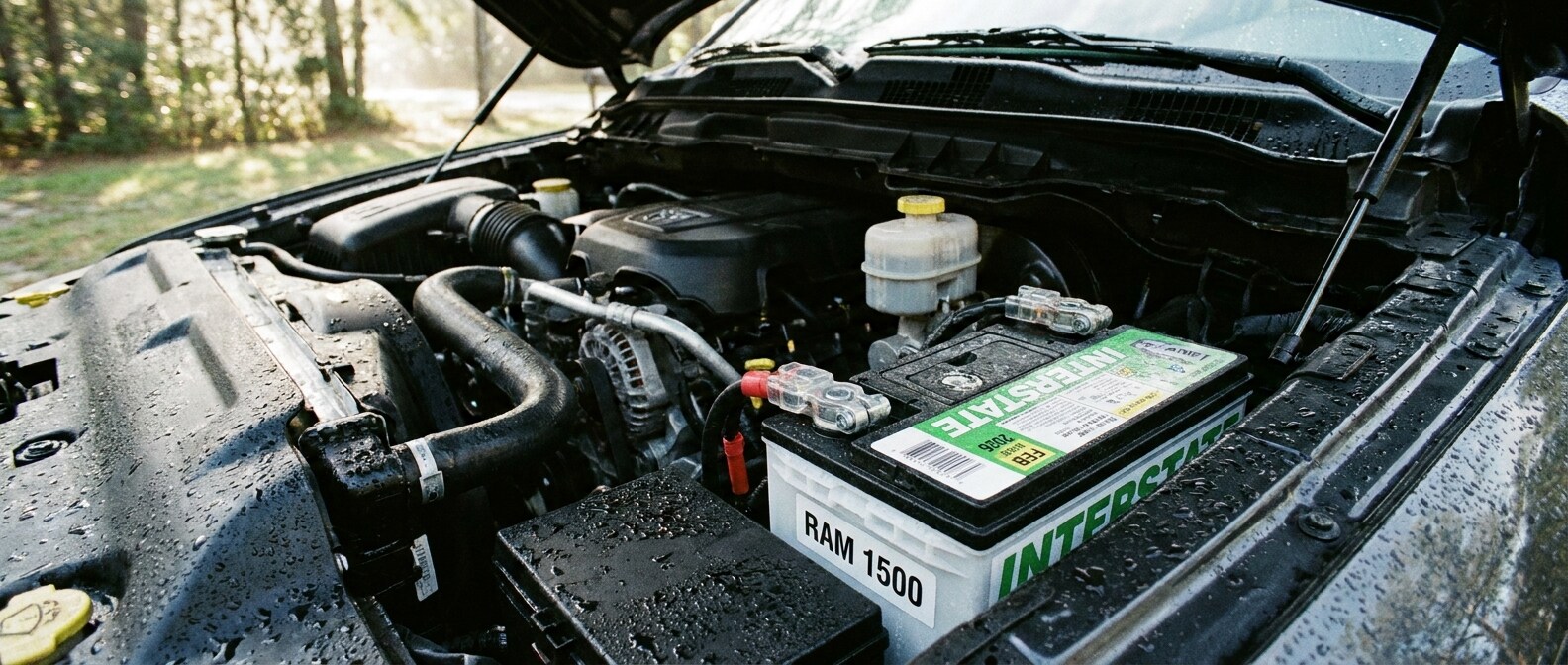
If you drive a passenger car or a smaller SUV, a battery in the 450 to 600 CCA range covers starting demands under our conditions. For full-size trucks and larger SUVs, like Ram 1500s, browse Ram 1500 inventory, the engine and accessory load calls for 650 to 800 CCA or more, and AGM is the smart default given the towing, trailer, and work-site electrical demands most of these trucks carry.
Short-trip drivers have an extra factor to watch. On a lot of runs under 15 minutes around Panama City, the alternator doesn't get enough time to fully recharge what the starter pulled. Over weeks and months, that partial cycling degrades the battery faster regardless of type. If that's your pattern, test it twice a year.
So buy to your vehicle's spec, not to a generic size. The service team at Bay Chrysler Dodge Jeep Ram can pull the OEM battery specification for your exact vehicle, run a load test on what you've got, and tell you whether you're shopping for a battery this week or next year.
Frequently Asked Questions
Why does my car struggle to start on a cool Panama City morning if the battery passed inspection in the summer?
Heat damage in batteries is cumulative and often invisible on a surface check. What looks like a healthy battery in August may have lost significant capacity through sulfation, the process where heat causes internal electrolyte fluid to evaporate and lead sulfate crystals to form on the plates. Those crystals reduce the battery's ability to hold and deliver a charge. Consumer Reports recommends a professional load test, not just a voltage check, for any battery older than 2 years in a warm climate. A voltage check can read normal even when capacity is down. November's cooler starts, with lows running into the 50s and occasionally the upper 40s across the Panhandle, are simply the first real demand the battery faces after a long degrading summer. A load test tells you what you're actually working with.
Is a high CCA rating the most important spec to look for in a battery for Panama City?
CCA (Cold Cranking Amps) is the standard benchmark for starting power and it still matters here, but it's specifically measured at 0 degrees Fahrenheit, a temperature Panama City essentially never sees. For Gulf Coast drivers, heat tolerance and Reserve Capacity are at least as important. Reserve Capacity measures how long the battery can sustain a 25-amp load before dropping below usable voltage, which matters for the AC, trailer loads, and accessory demands that dominate Gulf Coast driving. Match the CCA to your vehicle's OEM specification (450 to 600 for most passenger cars and smaller SUVs, 650 and up for full-size trucks), and then focus on battery type. AGM handles the heat and humidity of the Panhandle better than a standard flooded battery. That sealed design prevents electrolyte evaporation, which is the primary way Florida summers destroy batteries ahead of schedule.