




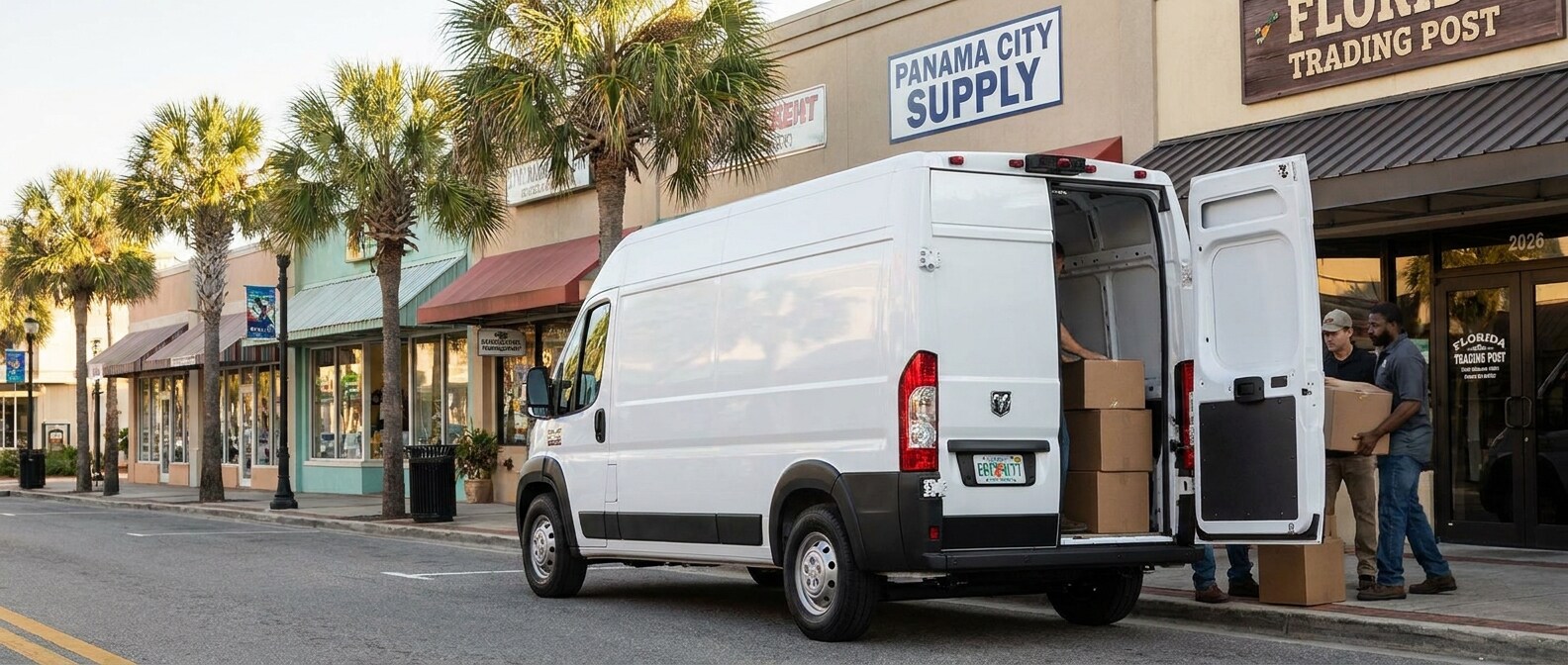
If you run a delivery route in Panama City and you're staring down six weeks of holiday volume, one technical choice sets the 2026 Ram ProMaster apart from every other full-size cargo van on the market. It uses front-wheel drive. The choice is unusual, and it isn't a compromise.
The FWD layout is a deliberate engineering decision that changes where the load floor sits, how wide the cargo box can be, and how tightly the van turns on Harrison Avenue at 7 a.m. when parking is tight and your next stop is two blocks away. Understanding what FWD does inside a commercial van tells you exactly which configuration to pick before the holiday rush locks you into the wrong one.
How Does Front-Wheel Drive Actually Change a Cargo Van?
Front-wheel drive changes a cargo van by moving the engine and the driven axle to the same end, which frees up the entire floor, though it does cost you the option of all-wheel drive that a rear-drive platform can offer. In a rear-wheel-drive commercial van, the driveshaft runs the full length of the vehicle from the front engine to the rear axle. That shaft has to go somewhere, and it runs right through the middle of the floor. You end up with a raised tunnel down the cargo area's centerline. It limits usable floor width, pushes the cargo floor higher off the ground, and forces any shelving or upfit system to work around a hump that can't be eliminated.
The 2026 Ram ProMaster puts the engine and driven axle at the same end of the van. No shaft to the rear, no tunnel.
Ram lists the resulting load floor height at 21 inches from the ground. Measure that against the Ford Transit's 28-inch floor and it sits seven inches lower, three inches lower than the Mercedes Sprinter's 24-inch floor, according to published comparative data. For a driver making 40 stops on a December afternoon in Bay County, those seven inches get felt in the back and the shoulders by stop 20.
The other dividend is a completely flat cargo box, 75 inches wide at the walls. Standard pallet racking drops straight in. Shelving systems mount flush side to side. Drawer units don't need shimming to level out over a driveshaft hump. All of that matters when you're fitting out a van with delivery cubbies, insulated bags, or florist racks in November.
| Spec | 2026 Ram ProMaster | Ford Transit 250 | Mercedes Sprinter 2500 |
|---|---|---|---|
| Drivetrain | FWD only | RWD / AWD available | RWD / 4WD available |
| Load floor height | 21 in. | 28 in. | 24 in. |
| Max cargo width (wall to wall) | 75 in. | ~69 in. | ~71 in. |
| Turning diameter | 36 ft | ~47 ft | ~40 ft |
| Max cargo volume | 524 cu ft | 487 cu ft | 533 cu ft |
| AWD option | No | Yes | Yes |
The trade-off sits right there in the table, since FWD means no AWD, and that part is real. For businesses in the Pacific Northwest or in mountain states, the gap deserves serious weight. Down here in Panama City, our Gulf Coast winters run wet rather than icy. The roads that challenge a delivery van are rain-slick parking lots and tight commercial blocks, and FWD handles those better than a loaded rear-drive van does, because the weight of the engine sits right over the driven wheels.
Which ProMaster Configuration Do You Actually Need for Local Delivery Routes?
The configuration you need comes down to roof height, wheelbase, and model series matched to your route, and the mid-size High Roof covers more local work than the biggest box on the lot does, though a high-cube operation will want the extended wheelbase. Browse our current ProMaster inventory to see what's on the lot, then match the configuration to your actual route. Picking wrong is where Panama City businesses overspend or underspec, and the difference bites hardest during the holiday push when you're running the van hard every day.
The three roof heights drive the decision. Here's how each one plays in a Gulf Coast commercial context.
| Configuration | Interior Cargo Height | Max Cargo Volume | Best For in Panama City |
|---|---|---|---|
| Standard Roof | 66 in. | ~304 cu ft (136-in WB) | Florists, bakeries, small-parcel runs; fits standard parking structures |
| High Roof | 77 in. | Up to 463 cu ft (159-in WB) | Standing-height work inside the van; catering, medical supply, mid-volume retail delivery |
| Super High Roof | 86 in. | Up to 524 cu ft (159-in WB Extended) | Maximum volume; HVAC upfits, furniture delivery, high-cube holiday gift shipments |
Wheelbase adds another dimension. Ram offers the ProMaster in 118-inch, 136-inch, and 159-inch lengths, and on a route threading tight parking on Beach Drive or a busy commercial strip in Lynn Haven, the shorter 118-inch wheelbase keeps that 36-foot turning diameter even handier. Step up to the extended 159-inch and you get 524 cubic feet of cargo volume, though that's a longer vehicle to wrangle in a full holiday lot.
On our lot, the High Roof 2500 on the 136-inch wheelbase hits the balance point for the kind of service routes common around Panama City. It gives you 77 inches of standing height inside, so there's no crouching to organize packages in the cargo area. It carries a payload up to 4,750 pounds when properly equipped, per Ram's published specs. And it still turns tighter than any rear-drive competitor in its class.
Payload planning gets critical once you start adding shelving, because the upfit kit itself weighs something. A full aluminum shelving system for a delivery van can run close to 150 to 200 pounds before you load a single item, and that weight comes straight out of your rated payload. If your route regularly carries heavy goods, start the payload math up front. Do it before you sign off on the upfit.
Key Terms for Any ProMaster Conversation
| Term | What It Means |
|---|---|
| GVWR | Gross Vehicle Weight Rating: the maximum total weight of the loaded van, including the van itself, cargo, and passengers |
| Payload | GVWR minus the van's curb weight; this is how much your cargo, driver, and upfit equipment can total |
| Upfit | Any shelving, partition, rack, or custom equipment added after the van leaves the factory |
| Wheelbase | Distance between the front and rear axles; longer wheelbase = more cargo length, slightly wider turning radius |
What This Means for Your Fleet Decision Before the Holiday Rush
What it means for your fleet decision is that the ProMaster's FWD layout fits a Panama City holiday route well, since our season runs mild and wet, though a business that tows or runs snowbelt miles should weigh that differently. Panama City sits on the Gulf Coast of Florida. The holiday delivery season for a business here doesn't look like it does in Atlanta or Chicago. Financing a fleet van is easier to plan when you know what configuration fits your operation. November through January here means mild temperatures and periodic Gulf rain, not freeze-thaw road damage or snow. It shifts the drivetrain calculus a good bit.
On most local routes, picture a catering company running from a commercial kitchen near St. Andrews Bay out to event venues, or a florist covering Bay County's residential neighborhoods through December. For that kind of work, the ProMaster's FWD layout reads as the right engineering for the conditions. Its 36-foot turning diameter on the short wheelbase keeps you out of three-point turns in tight strip-mall lots. The 21-inch load floor means you're not hoisting boxes up into the van at stop 35.
The van does carry one real constraint our team flags consistently. FWD means the ProMaster doesn't tow as well under load as a rear-drive or AWD competitor would with a trailer behind it. Ram rates maximum towing at 6,910 pounds on the 1500 Cargo Van Standard Roof 118-inch wheelbase. The Ram 3500 Chassis Cab is the better answer if your business needs a van-body conversion with serious towing behind it. For a delivery-focused operation where the work is loading and unloading instead of pulling, the ProMaster's FWD trade-off costs you nothing you'd actually miss.
If you're planning to outfit a van for the first time, talk to us before the upfitter does. The configuration decisions, roof height, wheelbase, and model series, directly affect your payload budget for the life of the van.
Frequently Asked Questions
Does the 2026 Ram ProMaster work well in Florida's rainy winter weather?
Yes. The ProMaster's front-wheel-drive layout places the engine's weight directly over the driven wheels, which improves traction in the wet, rain-slick conditions typical of a Gulf Coast Florida winter. FWD vans tend to handle better than rear-wheel-drive vans on slippery surfaces when loaded, because the driven axle carries most of the vehicle's weight even when the cargo area is full. Ram rates the ProMaster with Crosswind Assist standard, which helps maintain stability on exposed causeways or open stretches of US-98 when Gulf winds pick up. The trade-off is no AWD option, which is a meaningful gap in snowbelt markets but rarely a practical issue for Panama City routes.
How much of the ProMaster's payload is left after adding shelving?
How much is left depends on the shelving system and the van configuration, but it's a question every business owner should answer before finalizing an upfit. Ram rates the 2026 ProMaster Cargo Van at a maximum payload of 4,750 pounds on properly equipped models. A typical aluminum shelving and partition kit for a delivery van adds roughly 150 to 200 pounds of permanent weight to the van before you place a single item inside. That weight counts against your payload rating. Heavier steel shelving systems can add more. The practical step is to get the final upfit kit weight from your installer and subtract it from the payload rating of the specific model series and wheelbase you choose. Those numbers vary between the 1500, 2500, and 3500 series. We walk through this math with customers regularly because it determines whether your operation stays within the van's rated limits under a full holiday load.