




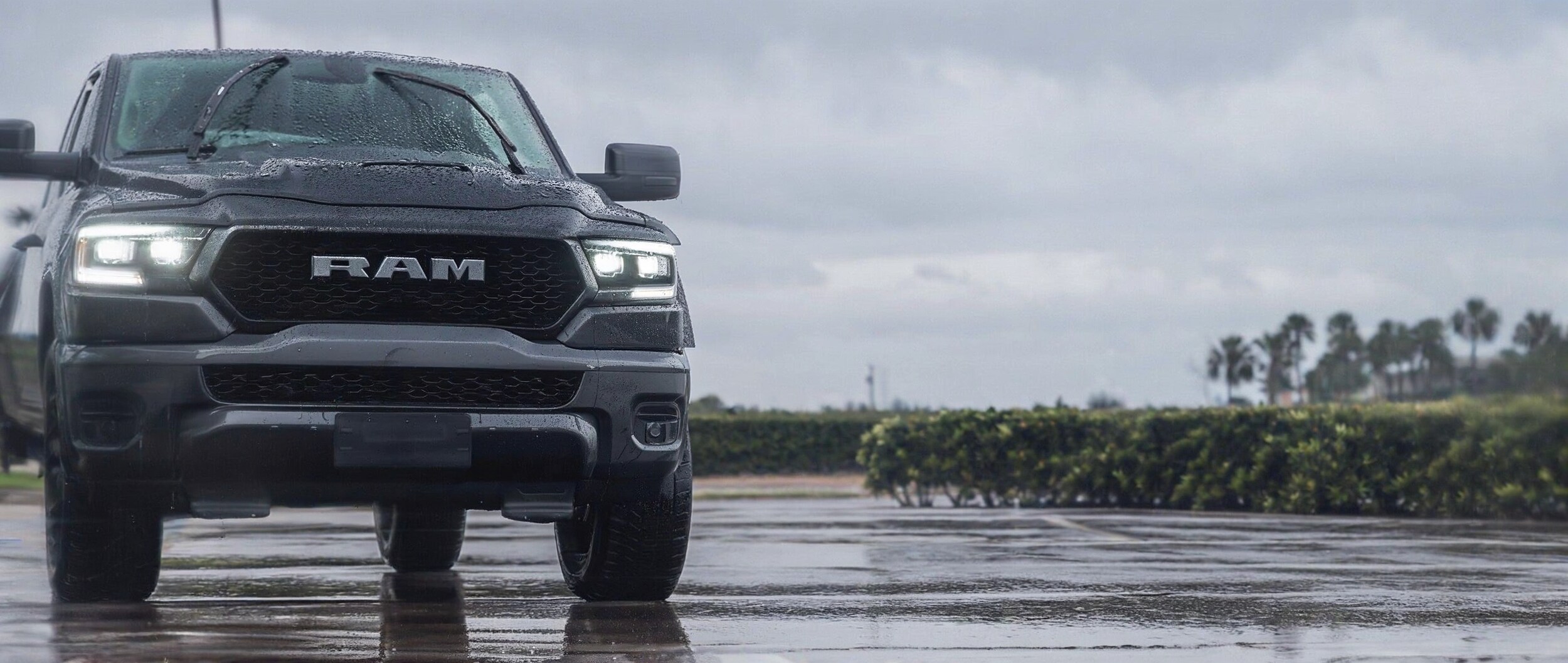
November on the Gulf Coast brings real rain back. We're not talking about the brief summer downpours that clear in twenty minutes. We mean the steady, grey Panhandle squalls that follow a cold front down US-98 at rush hour with no warning. You need blades that actually clear glass by then, and if yours spent the last five months baking under a Florida sun on a hot asphalt lot, they'll let you down right when it counts.
Three blade designs sit on the market. Conventional, beam, and hybrid each handle Panama City's conditions differently. Our service team reaches for a different one depending on the vehicle. We'll walk through why.
- Conventional blades cost the least upfront, though their open metal frame is the part salt air and UV heat eat through fast. Fine for a budget swap. In coastal FL, plan to replace every six months.
- Beam blades are frameless, press evenly across curved glass, and resist heat better than conventional. Best all-around for most Panhandle drivers.
- Hybrid blades wrap a conventional frame inside an aerodynamic shell. Quieter and more resistant to wind lift than a bare conventional, but heavier and pricier than a pure beam.
- The bigger issue. Gulf Coast UV and salt air degrade rubber all summer long. Whatever blade you pick, the six-month replacement interval isn't a suggestion here. Think of it as the realistic window before November rain exposes the damage.
Schedule a service visit with our team if you'd rather have a technician check and swap both front blades plus the rear while they're already under the hood.
How Do Conventional, Beam, and Hybrid Blades Actually Compare?
Across construction, pressure, and Gulf Coast lifespan, the three designs line up in a clear order for our climate, with beam blades generally leading and conventional trailing, though the right pick still depends on your arm type and glass curve. The table below is the honest side-by-side, and these are structural differences, not marketing categories. You feel them the moment you drive into a Panhandle squall at 60 mph.
| Blade Type | Construction | Pressure Distribution | Gulf Coast Lifespan | Wind Lift Resistance | Best For |
|---|---|---|---|---|---|
| Conventional | Open metal frame, rubber insert | Multiple claw points (gaps between) | 4-6 months | Low. Frame catches air | Budget replacement; older arms that won't accept other mounts |
| Beam (frameless) | Single curved steel strip, no frame | Continuous along full blade length | 6-12 months | High. No frame profile | Most modern Jeeps, Rams, and Chrysler vans; curved windshields |
| Hybrid | Conventional frame inside aerodynamic plastic shell | Multi-point (same as conventional underneath) | 6-10 months | Medium. Shell reduces lift | Vehicles that came with a hybrid blade from the factory |
The table can't fully convey a few things. On a conventional blade, the open frame lets Gulf Coast salt particles settle into the hinges, where they act as a fine abrasive every time the blade sweeps the glass. Beam blades have no frame to corrode. TRICO describes the uniform-pressure design as applying force continuously along the full blade length rather than pressing only at each pivot point and relaxing between them. You feel that as a clean, single-pass wipe, where a tired conventional leaves faint banding behind.
Hybrid blades look like beam blades from the outside, but you'll find the frame is still there under the shell. You get better aerodynamics than a bare conventional, plus quieter operation on highway runs. The tradeoff is added weight and a construction that still has frame hinges to corrode over time.
Does Gulf Coast Heat Change Which Blade You Should Pick?
Gulf Coast heat absolutely changes the math, pushing the choice toward a beam blade with a synthetic compound in most conditions, though a flat-glass Jeep or an older arm can still make a conventional the sensible call for your vehicle. The Panama City reality diverges from the generic national advice printed on a wiper-blade box.
Standard wiper rubber (EPDM compound, the material in most conventional and many hybrid blades) has a heat tolerance of roughly 104 degrees Fahrenheit before it starts to harden and lose its edge. Direct Florida sunlight heats windshield glass well past 150 degrees in summer. The rubber doesn't melt. It just gradually stiffens, develops microscopic surface fractures, and stops conforming cleanly to the glass. By the time November rain finally arrives, the blade looks fine from ten feet away, but run it across a wet windshield and you'll see the streaks.
Salt air compounds the problem. Airborne salt particles settle on the glass and on exposed frame hinges, and each sweep of a dry or dusty wiper grinds those crystals across the rubber edge. The wear isn't dramatic, just steady and invisible. Panama City sits squarely in the coastal zone where it runs year-round.
For Gulf Coast drivers, the practical upshot comes down to timing.
- If you're running a conventional blade because it was the cheapest option last spring, the Florida interval for replacement runs six months, well short of the twelve months the national packaging implies.
- Industry guidance on rubber wiper blade replacement in hot, high-UV states like Florida consistently points to the six-month mark as the realistic ceiling.
- Beam blades with a synthetic rubber compound stretch closer to twelve months on the Gulf Coast, but that's still a shorter window than you'd see in a moderate climate.
What does this mean for your specific vehicle? The 2026 Jeep Grand Cherokee came from the factory with curved glass optimized for a beam-style blade, and the continuous-pressure design is what seats properly against that radius. The browse current Grand Cherokee inventory page can show you what's on our lot now, and the Mopar parts counter at our service department carries OEM-spec blades sized exactly to the driver and passenger arms on the Grand Cherokee. Fitment matters more than the construction debate suggests, because the wrong length or connection type produces an unwiped strip at the edge of your vision, and rain pools right there.
The 2026 Jeep Wrangler is a different conversation. Its near-flat windshield, part of the reason owners can fold it down, means the blade doesn't need to conform to a dramatic curve the way a Grand Cherokee blade does. A correctly sized conventional blade fits and works on the Wrangler; a beam blade also works, but the curve-conforming advantage of a beam is less pronounced on flat glass. If you're running a Wrangler on and off the Florida back-country trails west of Panama City, salt mud, sand, and debris are your bigger enemies regardless of blade type. Fresh rubber every six months matters more than which premium construction you're running.
Matching the Right Blade to Your Truck, SUV, or Van
Matching a blade to your vehicle comes down to fitment first and construction second, which means the blade you'll want is the one that matches your arm connector, your blade length, and the glass curvature the manufacturer designed around, even if a fancier construction sits on the shelf beside it.
For Ram truck owners, the 2026 Ram 1500 uses a 24-inch driver-side and 24-inch passenger-side beam-style blade per OEM fitment data. Both sides are the same length on the 2026 1500, which is an easy detail to miss at an auto parts counter when you're in a hurry. The curved windshield on the Ram means a beam blade is the right design choice anyway, and the OEM fitment reinforces it.
The table below maps the common vehicles on our lot to the blade type the manufacturer specced, so you're not guessing at the parts counter.
| Vehicle | Recommended Blade Type | Why It Fits |
|---|---|---|
| 2026 Ram 1500 | Beam (frameless) | Curved glass; OEM-spec driver and passenger both 24 in; beam presses evenly across the radius |
| 2026 Jeep Grand Cherokee | Beam (front); rear separate OEM part | Curved glass; Mopar OEM front blade 68505532AA fits 2021-2026 Grand Cherokee; rear blade sized separately by mirror config |
| 2026 Jeep Wrangler | Conventional or beam (rear OEM: Mopar 68362105AA, fits 2018-2026) | Flatter windshield accepts both; rear blade is a separate part; match arm connector type |
| Chrysler Pacifica | Beam (front); check owner's manual for rear | Curved minivan glass; beam's even pressure is the right fit |
| Ram ProMaster | Conventional (verify by arm type) | Older-style arm fitment on some configurations; check before buying a beam adapter |
One detail gets ignored more than it should, and that's the rear blade. It takes identical UV exposure to the front blades, sits on a near-vertical glass surface that heats up quickly in direct sun, and gets used hard in every rain event. On our service drive, the rear blade is the one that tends to get deferred. Don't skip it.
If you want our technicians to check the blade condition on your Ram, Jeep, Pacifica, or any other vehicle on the lot, the easiest path is a service appointment. We'll check the rubber edge, the arm tension, and the washer fluid level at the same time.
The right blade is the one that fits your vehicle, matches what your glass curvature needs, and hasn't been silently cooked by five months of Panhandle sun. If you bought blades last spring and skipped the fall swap, now's the time, before the next front rolls through.
Frequently Asked Questions
What's the most important factor when buying wipers in Panama City, FL?
Replacement timing matters most. The Gulf Coast combination of UV, heat, and salt air degrades rubber in six months or less on a standard rubber blade, which is shorter than the twelve-month window listed on most national packaging. Blade type (conventional, beam, or hybrid) matters, though not as much as fresh rubber going into November rain season. Buy the right blade for your vehicle's arm connector and glass curve, then replace it on a spring-and-fall schedule rather than waiting for visible failure.
Do beam blades actually fit all Jeep and Ram models?
Not automatically. Beam blades come with adapters for the most common hook-style connectors, but fitment depends on arm type, blade length, and in some cases your vehicle's glass curvature. The 2026 Ram 1500 takes 24-inch blades on both sides with a J-hook connector. The 2026 Jeep Wrangler rear blade is a separate Mopar OEM part (68362105AA) that fits 2018-2026 Wrangler models. The 2026 Jeep Grand Cherokee front blade is similarly model-specific (Mopar 68505532AA, fitting 2021-2026 Grand Cherokee and Grand Cherokee L). Check your owner's manual or ask our service team, the wrong connector won't lock properly, and a loose blade is worse than a worn one.