




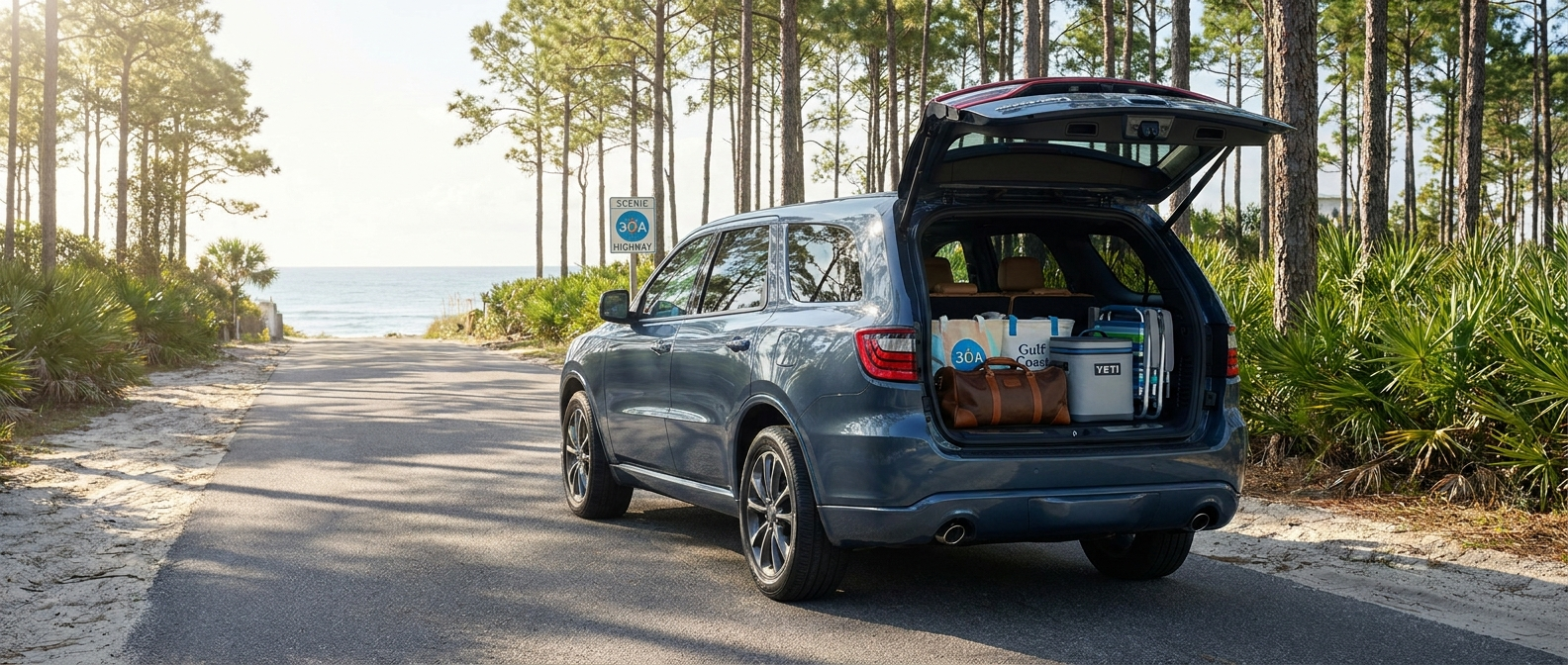
Seven nights. Four (or five, or six) people. Beach chairs, boogie boards, a cooler the size of a small refrigerator, and one stubborn duffel that never fits where you think it will. Pulling out of Panama City for a week-long Panhandle run, you'll find the biggest packing hurdle has little to do with what you bring. What trips families up is which of the Durango's three distinct cargo zones to load it into.
The Dodge Durango is a three-row SUV, and Dodge lists over 50 seating configurations in the 2026 model. Handy, sure. What packing guides skip is that those configurations produce three meaningfully different cargo volumes. All seven seats in place gives you 17.2 cubic feet, folding just the third row flat gets you 43.3 cubic feet, and dropping both the second and third rows opens a full 85.1 cubic feet. The gap between those numbers isn't trivial. You're looking at the difference between "we fit everything" and "dad is strapping a bag to his lap."
Match your gear to the zone, and you roll out clean.
- All seats up (17.2 cu ft): airport-style carry-ons, soft bags, and a small cooler only. Right for 3-4 people with light packing habits.
- Third row folded (43.3 cu ft): four passengers comfortable, full family luggage plus beach gear fits behind the second row. The sweet spot for most Gulf Coast week trips.
- Both rows folded (85.1 cu ft): cargo mode for hauling bulky gear (kayaks, beach tents, a wagon) when you're dropping kids at grandparents and using the back half as a truck bed.
- Roof rack: the available Stow 'N Place Roof Rack holds up to 150 lbs. Use it for gear that can get sandy or wet, not your luggage.
- Load heaviest items low and forward in the cargo area; it keeps handling predictable and protects smaller gear behind it.
What Actually Matters When Loading a Durango for the Week?
Loading a Durango well starts with a single decision about which seat configuration opens the right kind of space for the gear you actually brought, and the answer stays concrete because it follows directly from how the Durango's seats fold and tumble rather than from raw cargo numbers. The space is there. You just have to unlock the right shape of it.
The 2026 Dodge Durango uses a Fold and Tumble second row, which means the second-row seats don't just recline flat. They tip forward and out of the way, creating a flat floor all the way from the liftgate to the back of the front seats. The third row uses a 50/50 split fold, so you can carry five passengers and still open one side for a long item. Those features do real work. They change how you stage gear.
| Configuration | Cargo Volume | Best For | Key Spec | Honest Tradeoff |
|---|---|---|---|---|
| All 3 rows up | 17.2 cu ft | 5-7 passengers, minimal luggage | Tight. Soft bags only | No room for beach chairs or hard coolers |
| Third row folded | 43.3 cu ft | 4-5 passengers, full week of family luggage | Flat floor behind row 2 | Reduces seating from 7 to 5 |
| Both rows folded | 85.1 cu ft | Cargo-only hauls, bulky gear runs | Full SUV bed depth | No rear passengers |
| 50/50 third-row split | Variable | Long items + 5 passengers | One side open for boards/rods | Asymmetric load; pack accordingly |
| Stow 'N Place Roof Rack | 150 lb limit | Sandy/wet gear overspill | Available on select trims | Adds wind noise; check rack weight limit before loading |
Browse the Dodge Durango at Bay Chrysler Dodge Jeep Ram
Match Your Cargo Zone to Your Gear Type
The approach that works for a Gulf Coast week is to treat the Durango's cargo hold as three separate zones (floor-level long storage, mid-height stackable storage, and overhead), where every type of gear belongs in exactly one of them and nothing gets double-stacked across zones that fight each other. Sort it once, and the loading goes fast.
Zone 1. Floor, long items. Beach chairs, a folded beach wagon, bodyboards, fishing rods in a tube case. These go in first, flat against the floor, before anything else touches the cargo area. If you're doing the third-row-folded config, slide them forward past where the third-row seatback used to be. They'll sit flush without crowding row 2.
Zone 2. Stackable cargo. Hard-sided coolers belong here, low and centered, directly behind the second row. Don't put the cooler against the liftgate where it shifts on every braking event. Luggage goes on top of and around the cooler. Roll your clothes instead of folding them (it genuinely compresses packing volume) and use soft duffels rather than hard-shell suitcases for this zone. Hard shells are square, and the Durango's cargo floor tapers at the wheel wells.
Zone 3. In-cabin dead space. The Durango has under-seat storage in the second and third rows, plus door pockets, and a center console. Daily-reach items live here, like snacks, a first-aid kit, charging cables, sunscreen, and the one bag that rides with the kids instead of getting buried. A family of four heading down to St. Andrews State Park for a day on the water doesn't want to unpack six bags to find the reef-safe sunscreen.
See current Dodge Durango inventory
- Pack a collapsible laundry bag in your luggage. Wet bathing suits at the end of each beach day go straight into it, not loose in the cargo hold
- Use a soft-sided cooler for beverages that stays inside the cabin; reserve the hard cooler for food and keep it in zone 2
- Identify one "grab bag" for the whole family: it rides in the second-row footwell and has everything needed for a one-hour stop without opening the liftgate
- Bungee cargo nets across stacked items if you're doing the both-rows-folded configuration; the Durango's cargo area is deep enough that items shift forward on hard braking
Match the Gear to How You Actually Drive
How you load the Durango changes how it drives, and the Panhandle run proves it, because the trip from Panama City toward Destin on US-98, or north toward Florida Caverns State Park near Marianna, mixes stop-and-go coastal traffic with open two-lane highway inside a single afternoon. Both conditions read your load differently.
Dodge specs the 2026 Durango with over 50 seating configurations and up to 85.1 cubic feet of cargo space, but the distribution of that weight matters as much as the volume. Heavy items (a full cooler, bags of gear) belong low in the cargo area and forward, not stacked near the liftgate. Keeping them there drops the center of gravity and gives the Durango predictable handling through the curves on 30A or on the elevated sections of the Mid-Bay Bridge.
One honest limitation is worth flagging. The factory Stow 'N Place Roof Rack is rated at 150 pounds, and that ceiling is real. Dodge lists the available Stow 'N Place Roof Rack as capable of holding up to 150 pounds of cargo. If you're planning to load a rooftop cargo box plus two kayak saddles plus a bag, check your combined weight before you strap anything up. The 150-lb limit applies to the combined load, not each item individually.
Families doing a multi-stop week (say, Panama City Beach for three nights, then a nature day at Falling Waters State Park, then inland) should pack in day-cluster order. The gear you need on day one should be accessible without moving what you need on day five. That sounds obvious, but it isn't, at 5 a.m. in a parking lot, when you're hunting for the beach canopy behind three suitcases.
Pre-trip service check at Bay Chrysler Dodge Jeep Ram
The Durango's cargo geometry rewards a little planning and punishes none at all. Spend 20 minutes with the seat configurations before you start loading. Fold the third row and see what you actually have. That 43.3 cubic feet of flat floor behind the second row holds more than it looks like it will. And if it doesn't, the roof rack handles the rest.
Frequently Asked Questions
How much cargo space does the 2026 Dodge Durango have with the third row folded?
With the third row folded, the 2026 Durango provides 43.3 cubic feet of cargo space behind the second row, which is enough for full family luggage plus beach gear for a four- or five-person trip. That configuration also keeps the second row intact, so four or five passengers ride comfortably.
Can you fit a hard cooler and luggage together in the Durango's cargo area?
Yes, but placement matters. A hard cooler belongs low on the cargo floor, centered and forward, not against the liftgate. Soft duffels stack on top. The 2026 Dodge Durango offers over 50 seating configurations, so if you need more room around the cooler, folding one side of the 50/50 split third row opens a lane for longer or bulkier items without eliminating rear seating entirely.