




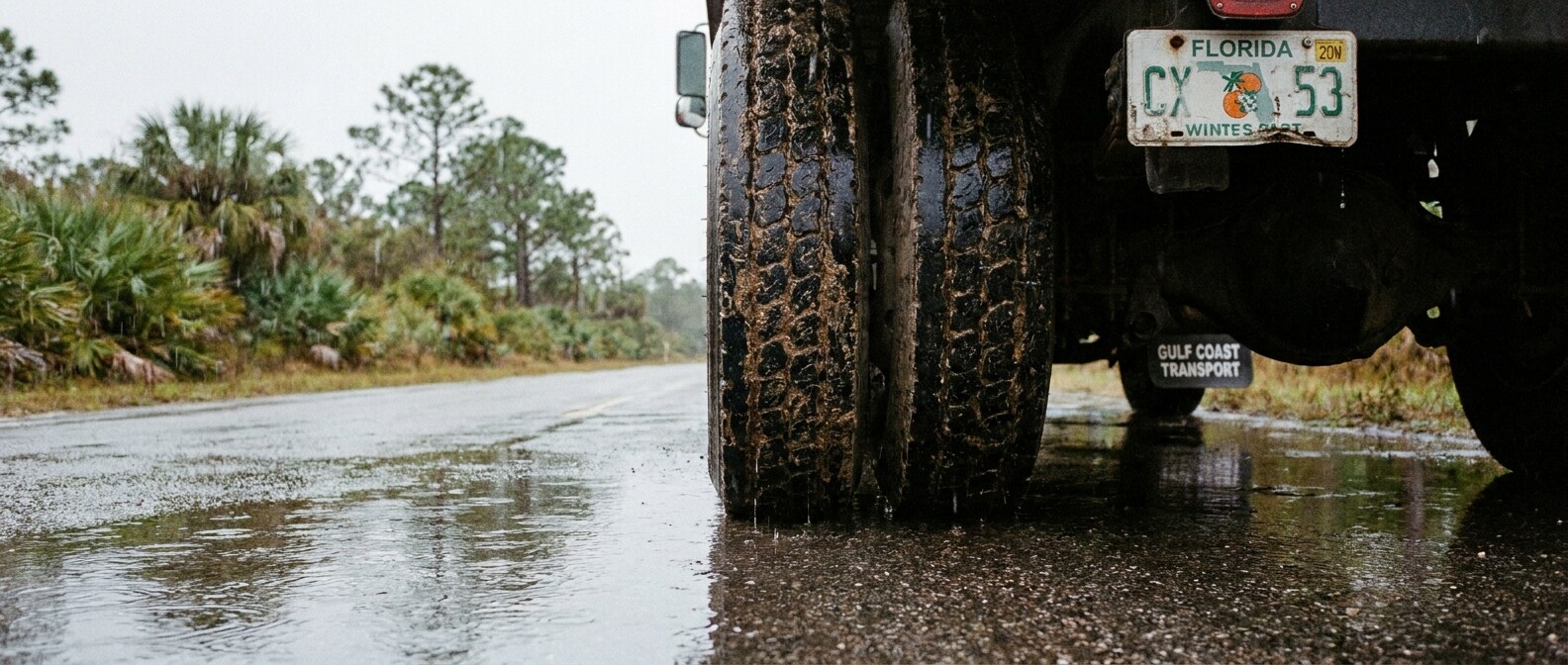
Bay County took on 5 to 8 inches of rain in a single overnight event last Sunday, November 1. Roads near the Panama City Mall, Callaway, and stretches of Highway 231 went under water. By the time morning traffic hit, US-98 at Billings Avenue had a lane closed. None of that came from a tropical storm. It was November. Every winter, Our service team at Bay Chrysler Dodge Jeep Ram sees trucks and SUVs roll in with tires that look fine from the driver's seat and read dangerously thin on a tread gauge.
Bottom line up front, if your tread is at or below 4/32 of an inch, you'll want new tires before the next Gulf Coast rainstorm, not after.
What Goes on the Tire Tread Checklist?
The checklist runs seven quick checks you can do right in your own driveway, covering the penny and quarter coin tests, the tread wear bars, uneven wear, tire pressure, sidewall condition, and the date code, and the whole pass takes about five minutes per vehicle. You don't need a shop to get started.
The Winter Tire Tread Prep Checklist
- [ ] Penny test on all four tires. Press a penny into the tread groove with Lincoln's head pointing down. If you can see the top of his head on any groove, tread is at or below 2/32 of an inch. The DOT's legal minimum is 2/32 of an inch. Stop driving on these in the rain.
- [ ] Quarter test on all four tires. Same method, but grab a quarter with Washington's head pointing down. If you can see the top of his head, tread is at or below 4/32 of an inch. AAA recommends replacing tires at this threshold, before the penny test fails.
- [ ] Check tread wear indicator bars. These small raised bars are molded into the grooves. When a bar sits flush with the surrounding tread, the tire's at 2/32 of an inch. No coin needed.
- [ ] Inspect for uneven wear. Check the inner edge, center, and outer edge of each tire. A tire that passes the penny test at the center can still fail at the shoulder if it's been underinflated or misaligned for a while.
- [ ] Verify tire pressure. The DOT notes that underinflated tires deflect inward, reducing the tread's ability to push water out from under the contact patch. Check the sticker inside your driver's door jamb rather than the number on the sidewall. Check it cold, before the drive, since a few miles on warm pavement nudges the reading up.
- [ ] Inspect sidewalls for cracking. Gulf Coast UV exposure breaks down rubber compounds. A sidewall with visible cracking or bulging can fail on its own, regardless of the tread depth reading.
- [ ] Date code check. Tires older than six years need closer attention even if tread looks acceptable. The DOT date code is a four-digit stamp on the sidewall (week and year of manufacture).
Why These Items Actually Matter in a Panama City Winter
Every item on that list earns its place because Panama City's winter is genuinely wet, wetter than the calendar suggests, and worn tread quietly turns an ordinary rainstorm into a longer stopping distance and a real hydroplaning risk. The numbers back that up.
Panama City isn't a 'rainy summer / dry winter' town, and the rain gauge proves it. December averages 3.78 inches of rain. January and February each average around 4 to 5 inches. The region collects roughly 60 inches of rain a year, nearly 60 percent more than the US average. Think of it as a second wet season rather than a dry one, arriving on roads already proven to hold water.
Tread depth is a drainage problem, not just a friction problem. A Jeep Grand Cherokee or a Jeep Wrangler on all-terrain tires still leans on its tread grooves to channel water away from the contact patch. As tread wears down, those grooves get shallower, and the tire has less volume to evacuate water per second. At highway speed on a wet surface, water pressure under the tire builds and starts lifting the contact patch off the road entirely.
Tire Rack's wet-braking data, tested from 60 miles per hour, makes the point plainly. A new tire with full tread stops in roughly 205 feet on a wet surface. The same tire worn to 4/32 of an inch needs 270 feet. Worn to the legal 2/32 minimum, stopping distance stretches to 400 feet. That's nearly the length of a football field and a third, on a road that was dry when you left home.
AAA's all-season tire testing found that tires worn to 4/32 of an inch required 42 to 44 percent longer wet stopping distance than new tires. On a Ram 1500 carrying a payload, the physics only compounds. More mass means the tire has to work harder to evacuate water and generate friction at the same time.
Coins are crude tools, but they work. A quarter reads deeper than a penny.
So why run the quarter test at all? Because the penny test only catches tires that have already crossed the legal threshold, and by the time Lincoln's head is fully visible, you've been driving through Panama City's December rains on a tire that AAA says should've been replaced thousands of miles ago.
Item / Why It Matters
| Checklist Item | Why It Matters for Panama City Winters |
|---|---|
| Quarter test (4/32") | The real wet-weather decision point; AAA recommends replacing before penny test fails |
| Penny test (2/32") | DOT legal minimum; already compromised in standing water |
| Wear indicator bars | Built-in visual signal at 2/32"; check at every oil change |
| Uneven wear inspection | Edge wear = underinflation or alignment; that edge contacts the road in a turn |
| Tire pressure check | Underinflated tires reduce water-evacuation capacity in the contact patch |
| Sidewall condition | UV and Gulf Coast humidity accelerate rubber degradation; a bulge is a pending failure |
| Date code check | Rubber compounds harden with age regardless of remaining tread depth |
Schedule a Tire and Tread Inspection
The Print-and-Go Recap
Pull this up before you head to the driveway, and run the same seven checks in order, because a five-minute pass in good light tells you far more about wet-weather safety than a glance from the driver's seat ever will. The whole check takes about five minutes per vehicle, give or take. If you're shopping for a used truck or SUV, this same checklist applies before you commit to any purchase.
Quick recap of the winter tread check:
- Quarter test (4/32 of an inch) on all four tires, inside and outside grooves.
- Penny test (2/32 of an inch) as the legal backstop on any tire that only barely passes the quarter test.
- Wear indicator bars: look for any bar sitting flush with the tread surface.
- Uneven wear: check the inner and outer shoulder, and the center too.
- Tire pressure: use the door-jamb sticker, and ignore the sidewall number.
- Sidewall: scan for cracks, bubbles, or dry rot.
- Date code: four digits molded into the sidewall. Anything beyond six years deserves a professional look.
If anything on that list gives you pause, our service team can put it on a lift and give you a straight answer. We're on West 15th Street in Panama City. We work on what you drive, not what we wish you drove.
Frequently Asked Questions
Does Panama City actually get enough winter rain to worry about tire tread?
Yes, and more than the Panhandle's mild reputation suggests. December averages 3.78 inches of rain across Bay County, and January and February average in the 4 to 5 inch range. Those months bring 10 or more rain days each. And a single overnight storm can deliver 5 to 8 inches in one event, as Bay County saw on November 1, 2026. Roads on flat terrain with limited drainage, like stretches of US-98 and Highway 231, hold water fast. Worn tires on standing water is where wet stopping distance degrades most.
What is the difference between the penny test and the quarter test, and which one should I use?
The penny test checks the DOT legal minimum of 2/32 of an inch. If Lincoln's head is visible, the tire's legally worn out and needs replacement now. The quarter test checks the safety threshold of 4/32 of an inch. If Washington's head is visible, AAA recommends replacing the tire before you hit the legal limit, because wet stopping distance and hydroplaning resistance both drop off noticeably between 4/32 and 2/32 of an inch. For anyone driving Panama City's wet winters, the quarter test is the smart call, since by the time the penny test fails, the tire's already been underperforming in rain for a while.