



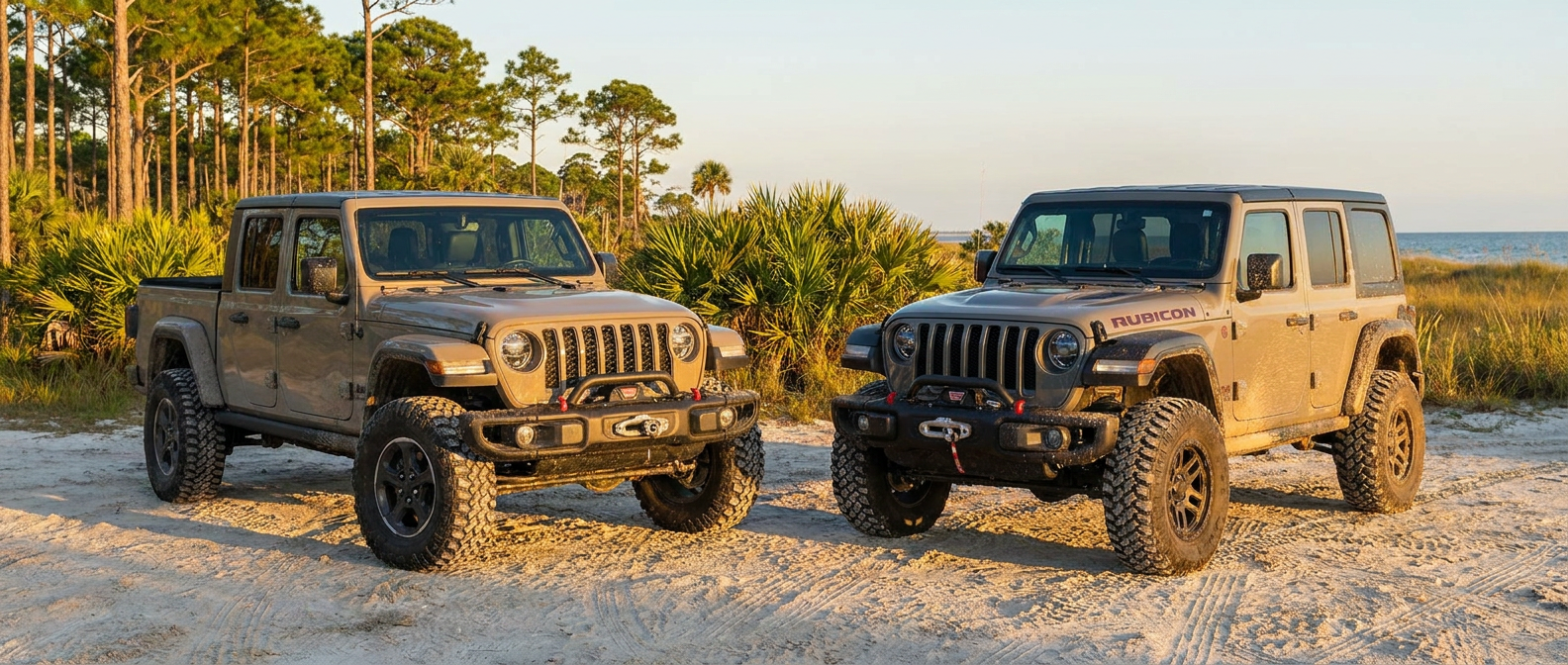
Both are Trail Rated, both drop their doors for a Saturday on the Gulf, and both will handle the sandy double-tracks of Point Washington State Forest without drama. The call comes down to one habit of yours. If you haul more than you explore, the 2026 Jeep Gladiator is your truck. If you explore more than you haul, the Wrangler's your Jeep. One spec makes or breaks the decision, the Gladiator's 5-foot open bed, and everything flows from there.
- The 2026 Gladiator tows up to 7,700 lbs. and carries up to 1,720 lbs. of payload. The Wrangler's max tow (on a properly equipped four-door Rubicon) is 5,000 lbs. with a much lower payload ceiling.
- The Wrangler is shorter and more maneuverable. The Gladiator stretches to 218 inches long, which matters for parking, garage fit, and tight trail switchbacks.
- Both deliver identical off-road DNA, including Trail Rated 4x4 systems and available locking differentials on Rubicon trims.
- If you need an open bed to haul building materials, a kayak, or a loaded cooler alongside your gear, only the Gladiator can do it without a roof rack and a prayer.
- If daily driving, open-air fun, and tight Gulf Coast parking are the priority, the Wrangler wins on practicality.
What's the Real Difference Between These Two Jeeps?
The two Jeeps share most of their hardware, so they're closer than they look at first, a shared platform, a 3.6L Pentastar V6, and the same four-wheel-drive architecture, yet Jeep built the Gladiator on a stretched frame and swapped the enclosed cargo area for a bed, and that move changes who each vehicle is for. The Gladiator rides a 137.3-inch wheelbase against the four-door Wrangler's 118.4 inches, and its enclosed cargo area gives way to a five-foot steel pickup bed. The swap is no small change. It shifts the entire use case.
| Spec | 2026 Jeep Wrangler (4-door) | 2026 Jeep Gladiator |
|---|---|---|
| Length | 188.4 in | 218.0 in |
| Wheelbase | 118.4 in | 137.3 in |
| Ground clearance (base) | 9.7 in | 10.0 in (up to 11.6 in, Mojave) |
| Max towing (properly equipped) | 5,000 lbs | 7,700 lbs |
| Max payload (properly equipped) | ~1,218 lbs | 1,720 lbs |
| Cargo: open bed | None | 5 ft (35.5 cu ft) |
| Cargo: enclosed (seats up) | 31.7 cu ft | N/A (open bed) |
| EPA combined MPG | 19-21 mpg (config dependent) | 19 mpg |
| Water fording (equipped) | Up to 34 in | Up to 30 in |
| Turning circle | 38.8 ft | 44.5 ft |
Sources: Jeep.com, EPA fuel economy ratings.
Does the Gladiator Lose Off-Road Ground to the Wrangler?
The Gladiator gives up a little off-road ground, though not in ways most Florida Panhandle trails will ever expose, since both Jeeps wear Trail Rated badges and both offer the Rubicon package with front and rear locking differentials and low-range transfer cases. Those transfer cases produce up to a 100:1 crawl ratio on the Wrangler Rubicon with a manual transmission, as Jeep lists it, and the Gladiator Rubicon matches those locking diffs. A fair question before you commit is whether the Gladiator's extra length really costs you anything in the dirt. For most Panhandle runs, it won't.
Where the gap shows up is in tight trail geometry. Put the Gladiator's 44.5-foot turning circle next to the Wrangler's 38.8 feet and you feel it on switchbacks and in congested parking. At Point Washington State Forest, where sandy single-lane tracks force occasional pull-offs for passing, that extra 6 feet of turning radius registers. You feel it, though it doesn't ever rule the Gladiator out.
The Wrangler's shorter wheelbase, 96.8 inches on the two-door and 118.4 on the four-door, also buys a better breakover angle on rock piles and rolled terrain. The Gladiator's longer frame sacrifices some breakover performance, though the Mojave trim claws it back with Fox shock-equipped suspension and 11.6 inches of ground clearance. For Florida's reality of sand, mud, shallow crossings, and flatwoods, the Gladiator keeps up and you'll never feel shortchanged. For a dedicated rock-crawling build, the Wrangler Rubicon is the sharper tool.
The Wrangler also fords deeper water, up to 34 inches when properly equipped, as Jeep rates it. That capability earns its keep in Florida's wet season, when low-lying trail sections behind the coast can hold standing water well into October. You'll want that reach then.
Hauling, Towing, and the Open Bed That Changes Everything
The open bed is where the Gladiator earns its keep for any Panama City buyer whose weekends involve real hands-on work, and it's the one job the Wrangler simply cannot match, so picture a normal Saturday and the split becomes obvious almost right away. You're hauling treated lumber from the home improvement store on Saturday morning, then loading a kayak and a cooler for St. Andrews Bay in the afternoon. The Wrangler can do one of those. It can't do both. Not without a cargo rack bolted to the roof and a willingness to strap things down in ways that turn highway driving into an adventure.
The Gladiator's 5-foot bed holds 35.5 cubic feet of open cargo, rated to carry up to 1,720 lbs. of payload when properly equipped. The bed swallows an 8-foot sheet of plywood (it'll overhang, yes, but it fits the bed width at 56.8 inches). It also holds a flat-bottomed kayak, a cooler, and a week's worth of camp gear at once, no need to give up the rear seat for passengers. Browse our current Gladiator inventory to see which trims are in stock.
The Wrangler's enclosed cargo area gives you 31.7 cubic feet behind the second row with the seats up, or 72.4 cubic feet with them folded. The space earns its keep for gear. What it won't do is swallow a kayak, a generator, or a stack of decking boards without you planning around it. The Wrangler's max tow rating of 5,000 lbs. on a properly equipped four-door Rubicon handles a bass boat or a small camper trailer. The Gladiator's 7,700-lb. ceiling pulls a heavier bay boat, a loaded utility trailer, or a mid-size camper without breaking a sweat.
The Daily Reality: Parking, Garages, and the Gulf Coast Commute
Day to day, the two Jeeps feel far more different than they look, because both read nearly identical at a stoplight and then feel completely different once you're easing into a parking garage or a tight driveway, and that daily gap matters more than any trail spec on paper.
The Gladiator runs 218 inches long. A standard single-car garage runs about 20 feet deep, or 240 inches, so it slots in with roughly 22 inches to spare. That margin sounds generous until you line it up against a Wrangler four-door at 188.4 inches, which hands you nearly three feet more clearance, and remember the Gladiator's tailgate closes at 218 but swings open to something far longer when you're backing into a stall. Panama City has no shortage of older residential driveways and parking structures that were never designed around full-size truck footprints.
Skip the mpg math on these two, because fuel economy is essentially a wash. Jeep's EPA estimates put the Gladiator at 17 city / 22 highway / 19 combined. A Wrangler four-door with the 3.6L V6 and automatic transmission rates 16 city / 22 highway / 18 combined. One mpg in real-world driving on Highway 98 won't decide this. Neither will the Wrangler 2.0L Turbo, which the EPA rates at 20 city / 22 highway for the four-door. Neither Jeep is an efficient daily driver by any measure. Pick your Jeep on capability, not mpg.
The Wrangler's removable doors and fold-down windshield carry over to the Gladiator too, so open-air fun isn't Wrangler-exclusive. Both let you strip the top on a Friday afternoon before the drive to the coast. The open-air draw is a shared strength, and it won't break the tie.
So Which One Should You Actually Pick?
The decision is cleaner than most comparison write-ups make it sound, because it really comes down to a single habit, and weekends that start with picking something up point toward the Gladiator while weekends that begin at a trailhead point back to the Wrangler. The two lists below just sharpen that line. We'd frame it the same way at the counter.
Pick the Gladiator if:
- You regularly tow a bay boat, a camper, or a utility trailer over 5,000 lbs.
- Weekend DIY means actual trips to the lumber yard, not just driving to the trailhead.
- You want to carry passengers and cargo in the same trip without choosing between them.
- The longer footprint doesn't create a daily parking problem.
Pick the Wrangler if:
- Your outdoor weekends are trail-first and the back seat holds gear, not lumber.
- You want maximum off-road maneuverability, including tight switchbacks and deeper water crossings.
- Parking in Panama City's older neighborhoods or beach-area lots is a regular reality.
- You want a two-door option, and the Gladiator comes only in crew-cab configuration.
One tradeoff we'll name straight out is that the Gladiator costs more and hauls more. If your use case doesn't call for that bed or that tow rating, you're paying for capability you'll never use. For a buyer whose weekends run on trail access and open-air driving, the Wrangler is the sharper, simpler tool. For anyone whose weekend starts with "I need to pick something up first," the Gladiator is the smarter choice.
Both sit in our Bay Chrysler Dodge Jeep Ram inventory, and we're glad to put you in either one for a proper test drive around town before you decide. Our financing team can walk you through your options when you're ready to get into numbers.
Frequently Asked Questions
Does the Jeep Gladiator have worse off-road capability than the Wrangler?
Not in any way most Gulf Coast drivers will actually notice. Both the 2026 Jeep Wrangler and the 2026 Jeep Gladiator are Trail Rated and offer the Rubicon package with front and rear locking differentials, standard 4-wheel drive, and low-range transfer cases. The real difference is geometry: the Gladiator's longer wheelbase (137.3 inches versus 118.4 inches on the Wrangler four-door) reduces its breakover angle and increases its turning circle to 44.5 feet versus 38.8 feet. On Florida's sand and pine flatwood trails, that gap is manageable. In serious rock-crawling terrain, the Wrangler Rubicon's shorter frame gives it a measurable advantage.
Can the Jeep Gladiator tow a boat or camper that the Wrangler can't?
Yes. The 2026 Gladiator is rated to tow up to 7,700 lbs. when properly equipped (per Jeep's published specifications). The 2026 Wrangler four-door Rubicon, also properly equipped, reaches 5,000 lbs. That 2,700-lb. difference covers the gap between a small bass boat and a larger bay boat, or between a lightweight camper and a mid-size travel trailer. If your typical trailer lands under 5,000 lbs., both vehicles handle the job. If it doesn't, the Gladiator is the right call.