




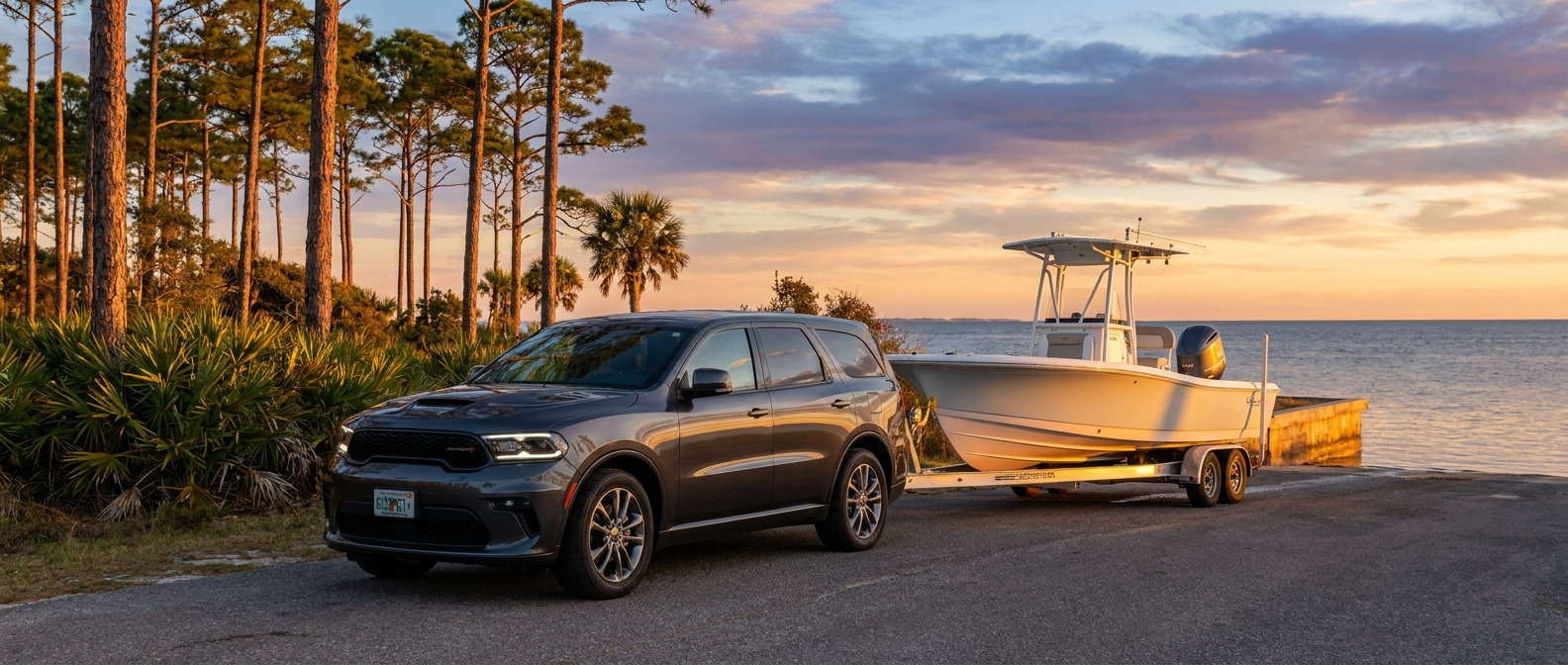
Let's be straight about the 2026 Dodge Durango. It isn't the most fuel-efficient 3-row SUV you can buy, and the 17.2 cubic feet of cargo space behind that third row will humble you fast if you pack without a plan. But it's also the only 3-row SUV in the segment that can seat seven passengers and tow up to 8,700 pounds in the same trip. For a Bay County family heading north on US-231 for Thanksgiving with a camper trailer hitched behind them, that combination doesn't exist anywhere else at this price tier. The trick is knowing which Durango tier actually pays off and which features are worth stepping up for on a Gulf Coast holiday run.
The Jeep Grand Cherokee covers two-row families with strong capability, but when you need all three rows plus a real tow rating, the Durango is a different conversation.
What Do You Actually Get at Each Tier?
At each tier you get a genuinely different holiday tool, from a V6 cruiser that'll pull a small Jon boat to a 6.4-liter V8 that handles the full 8,700 pounds, and the lineup is cleaner than it's been in years because Dodge reorganized it around four tiers that make real sense for family buyers. The differences between them are practical. You'll feel them on the road.
| Trim | Engine | Tow Rating | Key Holiday Features | Best Fit |
|---|---|---|---|---|
| GT (V6, RWD or AWD) | 3.6L Pentastar V6, 295 hp / 260 lb-ft | 6,200 lbs | 10.1-in Uconnect 5, Blind Spot Monitoring, backup cam, Apple CarPlay / Android Auto | Families towing a small Jon boat or utility trailer; mostly highway miles |
| GT Plus AWD (V6) | 3.6L Pentastar V6, 295 hp / 260 lb-ft | 6,200 lbs | Adds heated / ventilated Nappa leather, heated 2nd-row seats, wireless charging, adaptive cruise | Longer holiday runs where every-row comfort matters on the drive |
| GT HEMI V8 AWD | 5.7L HEMI V8, 360 hp / 390 lb-ft | 7,200 lbs (8,700 lbs w/ Tow N Go) | All of the above plus real V8 torque for loaded grades; Alpine audio on some configs | Families towing a center-console or a pop-up camper who want no second-guessing |
| R/T 392 AWD | 6.4L 392 HEMI V8, 475 hp / 470 lb-ft | 8,700 lbs | Maximum tow ceiling; Blacktop Redline package option | Buyers who want the full towing envelope and a vehicle that does not feel like a work truck |
Every single trim carries the 10.1-inch Uconnect 5 touchscreen and Blind Spot Monitoring as standard equipment. Dodge also lists over 50 seating configurations on the Durango, which means the cargo-versus-passengers tradeoff is something you manage by how you fold it, not a permanent constraint the truck imposes on you.
Cargo and Seating: The Tradeoff You Need to Understand Before You Pack
Cargo and seating on the Durango is a managed tradeoff rather than a fixed limit, because with all three rows up you've got 17.2 cubic feet behind the back seats, but fold those rows down and the same truck opens up to 85.1 cubic feet, so what you carry depends entirely on how you set it. A lot of writeups skip past that. We won't. With all three rows in use, the 2026 Durango gives you 17.2 cubic feet behind the third row. Dodge says that fits roughly four carry-on suitcases. Fine for a day run to Pensacola or a quick overnight, but a five-day Christmas trip with seven people packed for the weather means planning.
Fold-flat configurations:
- Fold the third row flat and cargo jumps to 43.3 cubic feet
- Fold both rear rows and you're at 85.1 cubic feet maximum, which holds a week's worth of luggage for five people without a roof box
Browse our current 2026 Durango inventory to see which trims and configurations we have on the lot right now.
Third-row legroom comes in at 33.5 inches. For kids and teenagers, that's genuinely comfortable. For adults on a two-hour run up US-231 to Dothan, it's workable. Workable is the right word, not roomy. At 38.6 inches, the second row is real adult space. If grandparents are riding in the middle, they won't complain.
Our practical playbook for Bay County holiday travel runs like this. Running seven passengers on a long trip? Use a hitch cargo carrier or a small utility trailer for the overflow luggage; the Durango's hitch is already there. Running five passengers? The 43.3-cubic-foot configuration handles a full holiday trip without compromise, and you've still got the third row available if the neighbor's kid needs a ride to the airport.
Explore financing options for the trim that fits your setup.
The Smart-Buy Framing: Which Trim Earns Its Keep for a Panhandle Family
For most Bay County families, the GT Plus AWD lands in the sweet spot, because it pairs an all-weather drive system with the comfort features that matter on a long holiday run, though anyone pulling a real center-console will want to keep reading toward the V8 before they sign. We'll walk through why we say that on the lot.
The base GT in rear-wheel drive is capable, but Gulf Coast weather from October through January runs the range from 75-degree afternoons to hard-freeze cold fronts that ice bridge decks. The Hathaway Bridge and DuPont Bridge both carry Gulf Coast commuters every morning; ice on those surfaces is a documented condition, not a theoretical one. AWD belongs on a Panhandle winter vehicle. Step from the GT RWD to the GT Plus AWD and you gain the drive system plus heated second-row seats (the relatives riding in the middle on the Thanksgiving run will absolutely notice), ventilated front leather (still relevant in October when the Florida sun bakes a black interior), wireless Apple CarPlay, and adaptive cruise for the long I-10 stretch between Tallahassee and the Panhandle.
The V6 GT Plus carries one tradeoff worth naming out loud. The 3.6-liter Pentastar V6 rates for 6,200 pounds of towing. That covers a small aluminum fishing boat, a personal watercraft on a double trailer, or a lightweight utility trailer. It won't cover a 19-foot center-console. For that, the GT HEMI V8 AWD is the move. Dodge rates the 5.7-liter HEMI at 360 horsepower and 390 lb-ft of torque; the tow ceiling climbs to 7,200 pounds without the Tow N Go package and 8,700 pounds with it. That 390 lb-ft of torque matters more than the horsepower number when you're loaded and holding speed through the grades near Chipley on US-231 North.
The R/T 392 and its 475-horsepower 6.4-liter V8 is genuinely impressive, and it also unlocks 8,700 pounds of towing. For the family that wants the ceiling and wants to feel the engine, it earns its trim. But for pure holiday-prep value, the balance of tow rating, comfort tech, all-weather drive system, and everyday livability, the GT Plus or the GT HEMI V8 is where we'd put most Panama City families.
If towing is not in the picture and you need pure passenger-and-cargo volume, the Chrysler Pacifica handles that differently and deserves a comparison.
FAQ
Does the 2026 Dodge Durango have enough room for a family of seven on a long holiday trip?
It fits seven, but cargo planning is required. Dodge lists 17.2 cubic feet of space behind the third row when all seven seats are occupied. Roughly four carry-on suitcases. For a multi-day holiday run with a full family, fold the third row to unlock 43.3 cubic feet for five passengers, or use a hitch cargo carrier to keep all seven seats available with overflow storage outside the cabin. The third row offers 33.5 inches of legroom, which works well for children and teenagers and holds up for adults on shorter drives.
Which 2026 Durango trim is best for towing a boat in Bay County?
The GT V6 tows up to 6,200 pounds, which handles a small aluminum fishing boat or a PWC on a trailer. If you're pulling a larger center-console or a pop-up camper, the GT HEMI V8 AWD is the right step. Dodge rates the 5.7-liter HEMI at 360 horsepower and 390 lb-ft of torque, moving the tow ceiling to 7,200 pounds standard or 8,700 pounds with the Tow N Go package. For most Bay County boaters, that V8 configuration covers the boat and the family in one trip without the R/T 392 price step.