




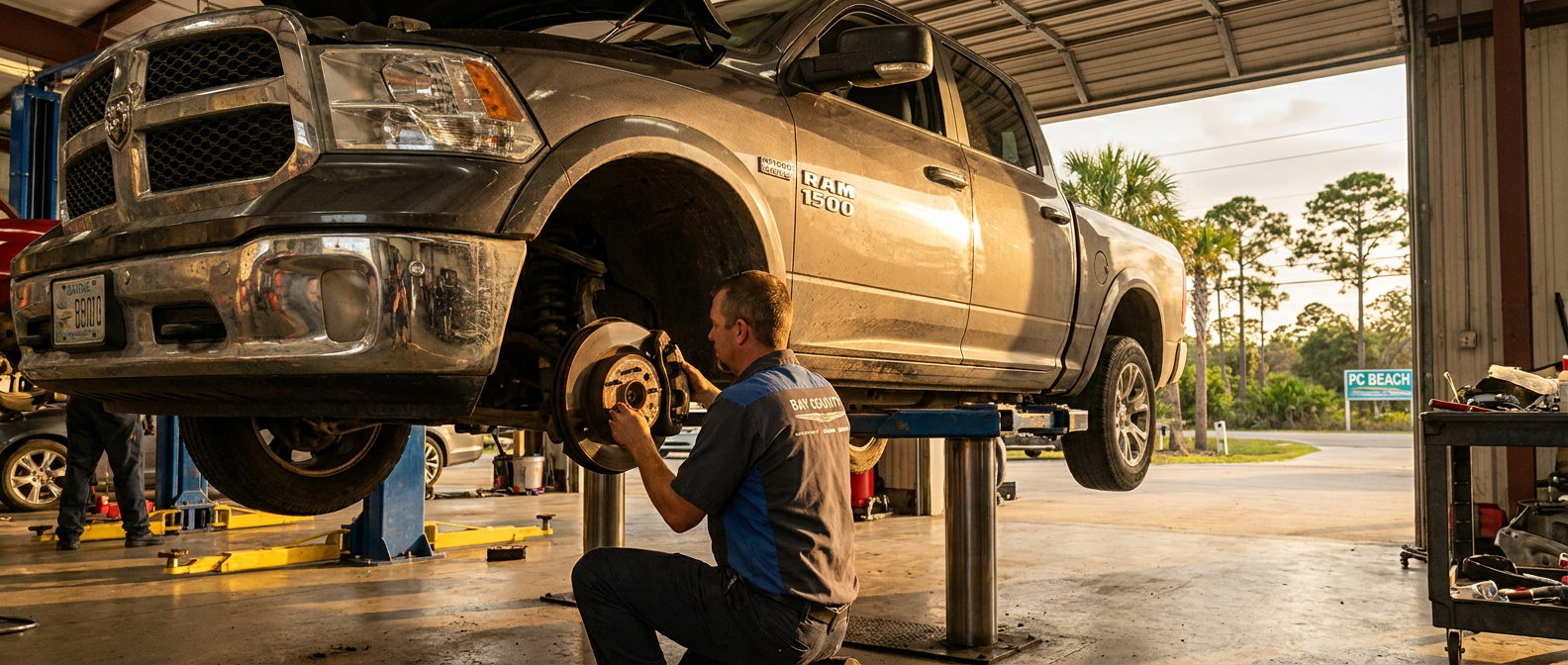
US-98 ranks among the busiest corridors in Bay County on a regular Tuesday. Add Thanksgiving and Christmas traffic, active construction lane shifts toward the Hathaway Bridge, and the humidity our Gulf Coast air bakes into brake components all year long, and you've got a corridor that puts real, measurable stress on your braking system before you even leave the Panhandle.
We see up close what stop-and-go traffic on this road does to brake components. A brake check before the holidays pays off for Panama City drivers, and the reasons tie directly to this stretch of road and this climate.
Book a brake inspection at Bay Chrysler Dodge Jeep Ram before you travel
Why Does US-98 Make This an Urgent Question?
US-98 earns the urgency because the road does specific things to your brakes, and each condition lines up with a service item built to address it. Below is the straightforward fit.
| US-98 / Gulf Coast Condition | The Brake Component It Affects | Why It Matters Here |
|---|---|---|
| Stop-and-go congestion near the Hathaway Bridge (FDOT documents over 50,000 vehicles/day) | Brake pads and rotors (repeated heat cycling) | Repeated moderate braking wears pads faster than highway cruising and cycles heat into rotors constantly |
| Active construction lane shifts; sudden merges and speed changes | Pad thickness and rotor surface condition | Unexpected stops demand full braking capacity, not nearly-worn pads |
| Gulf Coast salt air and humidity year-round | Caliper slides and rotor edges | Sustained coastal salt exposure causes deeper corrosion on unswept rotor edges and can seize caliper slides |
| Glycol-based brake fluid absorbs atmospheric moisture over time | Brake fluid boiling point | Moisture lowers the fluid's boiling point; repeated hard stops in traffic can push degraded fluid toward vapor formation, which softens pedal feel |
| Holiday travel: long highway runs after months of short Gulf Coast trips | Entire brake system | Short-trip driving never fully heats the system enough to burn off moisture; a long I-10 run with loaded passengers is often the first real test |
The Humidity Factor Is the One Most Bay County Drivers Miss
Brake fluid on the Gulf Coast pulls moisture out of the air over time, and that slowly lowers its boiling point, a change you won't notice on short errands but can feel as a softer pedal when you ride the brakes through slow traffic. Most hydraulic brake systems use glycol-based fluid, which is hygroscopic, meaning it draws water from the air. Our air (sitting right off St. Andrews Bay and the Gulf) carries that moisture year-round. Over time the absorbed water lowers the fluid's boiling point. When you're riding the brakes through slow traffic near the Port Panama City interchange, the system heats up, and if the boiling point has dropped, you may feel the pedal go softer than you'd expect.
We're not talking catastrophic failure in normal circumstances. We're talking about a gradual loss of the firm, confident pedal feel you should have when you need it most.
Correcting it takes very little time. A technician checks the brake fluid and flushes it if moisture content runs too high, one of the fastest service items there is.
The Jeep Grand Cherokee's four-wheel disc brakes both rely on clean, dry fluid for consistent pedal response. When customers ask us why the pedal feels different on a loaded holiday run vs. a quick trip across town, fluid condition is one of the first things we look at.
What a Real Brake Inspection Covers (and What It Doesn't)
A real brake inspection measures each component against its service limit, something a quick peek through the wheel spokes can't do, so treat that glance as a first screen and not the full answer. An actual inspection covers four areas.
Pad thickness. New pads start at roughly 10 to 12 mm of friction material. The widely accepted replacement threshold sits around 3 mm. At that point you're at the edge of reliable stopping performance. Pads below 3 mm should come off before a long trip, full stop.
Rotor condition. The pad only sweeps a band across the middle of the rotor, which leaves the edges exposed. Those unswept edges are where Gulf Coast corrosion builds up. Sustained salt-air exposure can create deep corrosion that causes uneven contact and the pulsing pedal feel that's easy to write off as just how brakes behave in this climate. It isn't normal. The rotors need attention.
Caliper slides. Salt air and humidity seize caliper slides over time. A seized slide means the pad drags instead of releasing cleanly. A dragging pad causes uneven wear and, in practice, a vehicle that doesn't stop as squarely as it should on a wet road after a November rain.
Brake fluid condition. Moisture content matters here, as described above, and a technician can check it. If it's past the service interval for your vehicle, a flush is cheap insurance before a highway run with a full passenger load.
What a brake inspection does NOT tell you is whether your brakes are "fine." It tells you where each component sits relative to its service limit. Those are different measures. "Fine" is subjective. A pad at 3.2 mm sits technically above the threshold and practically due for replacement before you add highway miles in the rain.
Schedule Your Pre-Holiday Brake Inspection
The Honest Tradeoff: When It's Worth Waiting vs. When It Isn't
We'll be direct about the call. If your pads measured 6 mm at your last oil change three months ago, you're almost certainly fine for a holiday run to Tallahassee or Pensacola, and not every vehicle needs brake work before the holidays. The inspection tells you where you stand.
Where it gets genuinely important comes down to three scenarios. Pads already at or near 4 mm, a vehicle that sees heavy stop-and-go in the US-98 corridor regularly, or a truck or SUV that'll be towing or loaded with passengers and cargo for the trip. Loaded weight increases braking demand. The heavier the vehicle, the more the pads and rotors are doing on every stop. A fully loaded Grand Wagoneer with seven passengers and holiday luggage asks a lot more of its brakes than the same vehicle empty.
We'll concede the tradeoff openly. Brake service is a real upfront cost, and if your system genuinely has plenty of life left, that work could wait. The inspection itself is how you learn which situation you're in. Skip it and guess, and you're making a decision with no real information. That's the part we'd push back on.