




Fall here doesn't mean frost on the windshield. The Panhandle just wrapped five months of sustained heat, humidity, salt air, and hurricane-season driving, and your vehicle's carrying every bit of it. Get ahead of it now, and October turns into your easiest month. Ignore it, and the first cold front finds the weakness.
Jeep Wranglers, Ram 1500 trucks, Chrysler Pacificas, and everything else rolling into our service bay this time of year has come through the same Gulf Coast summer, which hits a vehicle harder than any northern fall checklist accounts for. Summer leaves its mark.
What Goes on the Checklist?
The full print-and-go list sits below, and every item on it speaks directly to what five months of Gulf Coast heat, humidity, and salt air actually do to vehicles driven in Panama City and the surrounding Panhandle, which is a very different problem than a northern winter. A northern winter has nothing to do with it. Check the boxes, then bring whatever needs attention to our service team, and we'll take it from there.
Fall Service Checklist (Gulf Coast Edition)
- [ ] Battery load test (critical, see details below)
- [ ] Tire tread depth measured at 4/32", not just the 2/32" legal minimum
- [ ] Tire pressure corrected for fall temperature swings
- [ ] Wiper blades replaced (sun-baked rubber won't clear a November downpour)
- [ ] Brake fluid inspected for moisture absorption
- [ ] Brake pads and rotors checked for salt-accelerated wear
- [ ] Engine coolant condition verified after months of heat cycling
- [ ] Serpentine belt and hoses inspected for cracking, glazing, or softness
- [ ] Engine air filter checked after high-pollen, high-dust summer months
- [ ] Cabin air filter inspected (humidity drives mold growth faster here)
- [ ] Undercarriage inspected for salt-air corrosion on brake lines and connectors
- [ ] Windshield checked for chips that expand in temperature swings
- [ ] All exterior lights verified (wiring connectors corrode in coastal humidity)
- [ ] Mopar multipoint inspection to catch anything the checklist missed
Why the Gulf Coast Makes Each Item Count Differently
Most fall maintenance articles get written for drivers watching the thermometer slide into the teens, which is fair enough up north, though it barely describes a Panama City October, where the real work is undoing what five months of heat already did. Our challenge here isn't ice. The enemy is five months of 90-degree heat, humidity above 70 percent, and salt air piling up on everything.
Battery. The battery is where a Gulf Coast summer shows up first, and it's heat doing the damage. AAA data puts average battery life in hot southern climates at around three years, compared to five years or more in cooler northern climates. Heat speeds the chemical reactions inside the battery, drives internal corrosion, and evaporates fluid. A battery that barely survived summer, with the A/C running every single day, can read fine in the morning and quit on you by afternoon. Have it load-tested now, before a no-start strands you in a parking lot on a warm November day.
Schedule a multipoint inspection and ask us to load-test the battery while the vehicle's in the bay. We'll fold it right into our routine check.
Tires. Tires take two hits on the Gulf Coast that most national checklists skip right over. First, Florida UV drives sidewall oxidation year-round, not just through summer, and those sidewall cracks rarely show at a glance because they build from the inside out. Second, the legal minimum tread depth of 2/32" genuinely isn't the right threshold for a market that still gets rain in October. AAA testing found that tires worn to 4/32" required an average of 87 additional feet to stop on a wet road at 60 mph compared to new tires. At 2/32", that stopping-distance gap approximately doubles. October in Panama City averages around 3.5 inches of rain across roughly nine rainy days, so that wet-road gap's doing real work.
Use 4/32" as your replacement trigger, not 2/32". The quarter test works well here, with Washington's head just disappearing into the tread groove putting you right at that threshold. And check tire pressure cold, in the driveway before you pull out, since an hour on hot Panhandle pavement adds real PSI and can mask a tire that's actually low.
Wiper blades. Mopar recommends replacing conventional wiper blades at least every six months, and Florida's UV and ozone environment makes the aggressive end of that interval the right call. Blades that cracked and hardened through summer won't seat cleanly on curved glass, and they'll streak in every direction during a November squall on US-98. The honest downside is real. You may have replaced them back in spring and still need a fresh set now. Call it the Gulf Coast interval, and it's worth every bit.
Jeep Grand Cherokee owners with rear wipers should check those too. The rear blade gets overlooked because it's easy to forget back there, and it takes the same UV punishment as the front.
Brake fluid. Brake fluid is hygroscopic, which means it pulls moisture straight out of the surrounding air. Gulf Coast humidity from June through September pushes that absorption faster than a temperate climate manages in a full year. Absorbed moisture lowers the fluid's boiling point, and that matters the moment you're hauling a trailer or running down a long Panhandle grade under sustained braking. If your fluid hasn't been exchanged in two years or more, fall's the time to handle it.
Coolant, belts, and hoses. Year-round heat cycling wears down coolant and rubber here faster than the national-average service intervals assume. Check the coolant condition yourself (it should run clear or slightly tinted rather than brown or oily). Serpentine belts pick up surface glazing and micro-cracks from the sustained high underhood temperatures, and coolant hoses soften, swell, or harden depending on how they're failing. A visual check takes two minutes. A failed hose on I-10 won't be anywhere near that quick.
| Item | Why it matters on the Gulf Coast |
|---|---|
| Battery load test | Heat cuts battery life to roughly 3 years; a passing voltage test doesn't reveal capacity loss |
| Tread depth at 4/32" | AAA testing: tires at 4/32" need ~87 extra feet to stop on a wet road vs. new at 60 mph |
| Wiper blades | UV and ozone harden rubber; Mopar recommends replacement at least every 6 months |
| Brake fluid exchange | Hygroscopic fluid absorbs coastal humidity; absorbed moisture lowers the boiling point |
| Belt and hose inspection | Sustained heat causes glazing on belts and softening or cracking in hoses |
| Undercarriage check | Salt air accelerates corrosion on brake lines, electrical connectors, and suspension hardware |
| Cabin air filter | High humidity and pollen load clogs media faster and can drive mold growth in the filter |
Your Print-and-Go Fall Recap
Everything above folds down to one practical move, and we'd rather you make it early than late, so print this page, bring it in, and schedule the service visit now, before the weather shifts and the service bay fills up with everyone who put it off until the last week.
Priority 1 (do this week): Battery load test. Wiper blade replacement. Tread depth check with a gauge or quarter test.
Priority 2 (at the service visit): Brake fluid inspection and exchange if overdue. Belt and hose visual. Coolant condition. Engine and cabin air filters. Undercarriage check.
Priority 3 (while in the bay): Full Mopar multipoint inspection to cover lights, steering, suspension, and anything the checklist above missed.
The honest tradeoff worth naming is simple. Handling all of this at once costs more up front than spacing it out. But spacing it out on a vehicle fresh off a Gulf Coast summer means one of those deferred items finds you first, usually the battery or the wipers.
Book your fall service visit at Bay Chrysler Dodge Jeep Ram and we'll walk through the checklist with you, item by item.
Frequently Asked Questions
Does Panama City weather really require a different fall maintenance approach?
Yes, and the difference is direction. Up north, fall maintenance is about bracing for freezing temperatures, so you winterize fluids, swap tires, and check cold-weather battery performance. In Panama City, you're running the opposite way. You're sizing up what five months of 90-degree heat, sustained humidity around 70-plus percent, and salt air off the Gulf just left behind in the vehicle. Batteries fade faster in heat than in cold. Rubber components crack from UV and ozone, while freeze-thaw never enters the picture. Wiper blades harden in the summer sun. The checklist items look a lot like a northern one, but the reasons behind each one are entirely different.
How do I know if my battery needs replacement versus just a recharge?
A surface-charge voltage test will read a passing number even on a battery that's lost significant capacity from heat damage. The test that actually tells you something is a load test, which applies a simulated cranking load and measures how the battery performs under real demand. A battery that clears the voltage check but struggles on the load test is one that's working fine on a cool morning and failing on a hot afternoon with the A/C running. AAA data places average battery life in hot southern climates at around three years. If yours is at or past that mark, get a load test in before the mild-weather months become the cooler months, rather than waiting to see what happens.
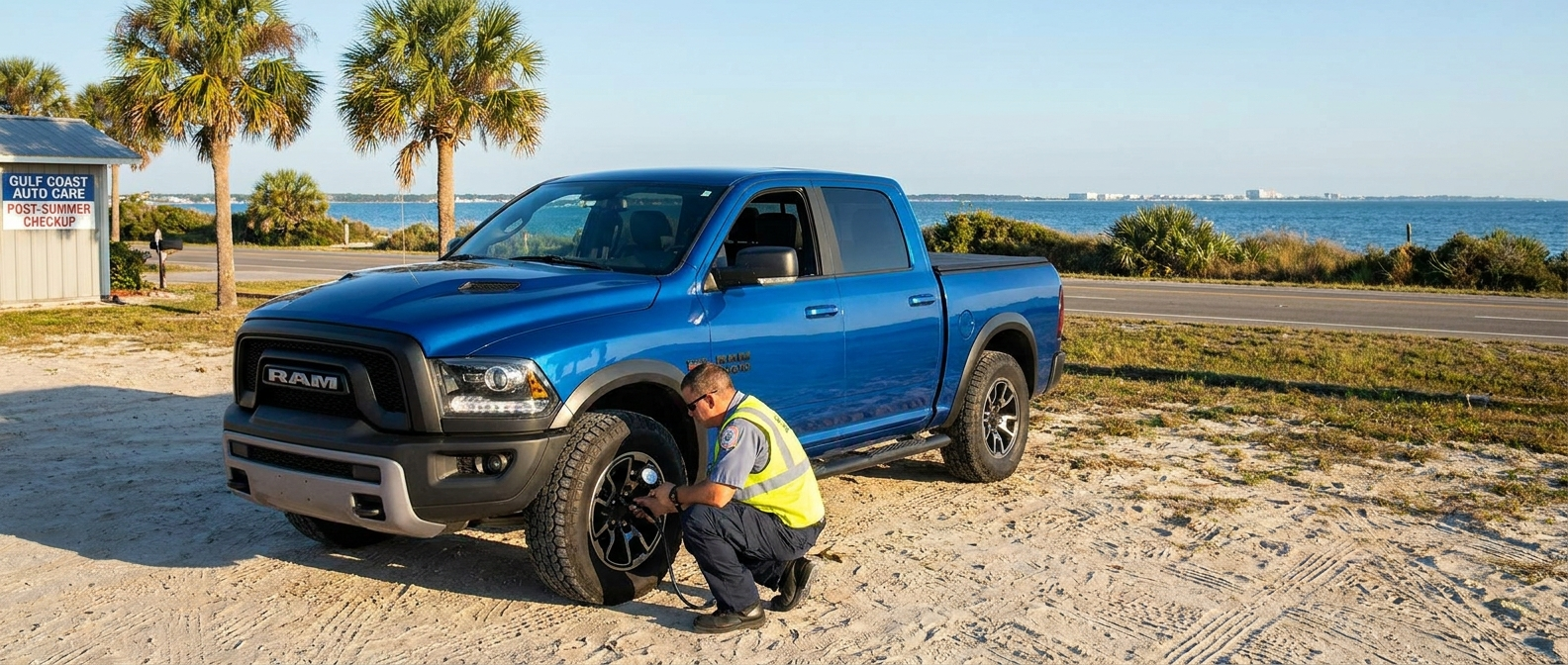
Fall here doesn't mean frost on the windshield. The Panhandle just wrapped five months of sustained heat, humidity, salt air, and hurricane-season driving, and your vehicle's carrying every bit of it. Get ahead of it now, and October turns into your easiest month. Ignore it, and the first cold front finds the weakness.
Jeep Wranglers, Ram 1500 trucks, Chrysler Pacificas, and everything else rolling into our service bay this time of year has come through the same Gulf Coast summer, which hits a vehicle harder than any northern fall checklist accounts for. Summer leaves its mark.
What Goes on the Checklist?
The full print-and-go list sits below, and every item on it speaks directly to what five months of Gulf Coast heat, humidity, and salt air actually do to vehicles driven in Panama City and the surrounding Panhandle, which is a very different problem than a northern winter. A northern winter has nothing to do with it. Check the boxes, then bring whatever needs attention to our service team, and we'll take it from there.
Fall Service Checklist (Gulf Coast Edition)
- [ ] Battery load test (critical, see details below)
- [ ] Tire tread depth measured at 4/32", not just the 2/32" legal minimum
- [ ] Tire pressure corrected for fall temperature swings
- [ ] Wiper blades replaced (sun-baked rubber won't clear a November downpour)
- [ ] Brake fluid inspected for moisture absorption
- [ ] Brake pads and rotors checked for salt-accelerated wear
- [ ] Engine coolant condition verified after months of heat cycling
- [ ] Serpentine belt and hoses inspected for cracking, glazing, or softness
- [ ] Engine air filter checked after high-pollen, high-dust summer months
- [ ] Cabin air filter inspected (humidity drives mold growth faster here)
- [ ] Undercarriage inspected for salt-air corrosion on brake lines and connectors
- [ ] Windshield checked for chips that expand in temperature swings
- [ ] All exterior lights verified (wiring connectors corrode in coastal humidity)
- [ ] Mopar multipoint inspection to catch anything the checklist missed
Why the Gulf Coast Makes Each Item Count Differently
Most fall maintenance articles get written for drivers watching the thermometer slide into the teens, which is fair enough up north, though it barely describes a Panama City October, where the real work is undoing what five months of heat already did. Our challenge here isn't ice. The enemy is five months of 90-degree heat, humidity above 70 percent, and salt air piling up on everything.
Battery. The battery is where a Gulf Coast summer shows up first, and it's heat doing the damage. AAA data puts average battery life in hot southern climates at around three years, compared to five years or more in cooler northern climates. Heat speeds the chemical reactions inside the battery, drives internal corrosion, and evaporates fluid. A battery that barely survived summer, with the A/C running every single day, can read fine in the morning and quit on you by afternoon. Have it load-tested now, before a no-start strands you in a parking lot on a warm November day.
Schedule a multipoint inspection and ask us to load-test the battery while the vehicle's in the bay. We'll fold it right into our routine check.
Tires. Tires take two hits on the Gulf Coast that most national checklists skip right over. First, Florida UV drives sidewall oxidation year-round, not just through summer, and those sidewall cracks rarely show at a glance because they build from the inside out. Second, the legal minimum tread depth of 2/32" genuinely isn't the right threshold for a market that still gets rain in October. AAA testing found that tires worn to 4/32" required an average of 87 additional feet to stop on a wet road at 60 mph compared to new tires. At 2/32", that stopping-distance gap approximately doubles. October in Panama City averages around 3.5 inches of rain across roughly nine rainy days, so that wet-road gap's doing real work.
Use 4/32" as your replacement trigger, not 2/32". The quarter test works well here, with Washington's head just disappearing into the tread groove putting you right at that threshold. And check tire pressure cold, in the driveway before you pull out, since an hour on hot Panhandle pavement adds real PSI and can mask a tire that's actually low.
Wiper blades. Mopar recommends replacing conventional wiper blades at least every six months, and Florida's UV and ozone environment makes the aggressive end of that interval the right call. Blades that cracked and hardened through summer won't seat cleanly on curved glass, and they'll streak in every direction during a November squall on US-98. The honest downside is real. You may have replaced them back in spring and still need a fresh set now. Call it the Gulf Coast interval, and it's worth every bit.
Jeep Grand Cherokee owners with rear wipers should check those too. The rear blade gets overlooked because it's easy to forget back there, and it takes the same UV punishment as the front.
Brake fluid. Brake fluid is hygroscopic, which means it pulls moisture straight out of the surrounding air. Gulf Coast humidity from June through September pushes that absorption faster than a temperate climate manages in a full year. Absorbed moisture lowers the fluid's boiling point, and that matters the moment you're hauling a trailer or running down a long Panhandle grade under sustained braking. If your fluid hasn't been exchanged in two years or more, fall's the time to handle it.
Coolant, belts, and hoses. Year-round heat cycling wears down coolant and rubber here faster than the national-average service intervals assume. Check the coolant condition yourself (it should run clear or slightly tinted rather than brown or oily). Serpentine belts pick up surface glazing and micro-cracks from the sustained high underhood temperatures, and coolant hoses soften, swell, or harden depending on how they're failing. A visual check takes two minutes. A failed hose on I-10 won't be anywhere near that quick.
| Item | Why it matters on the Gulf Coast |
|---|---|
| Battery load test | Heat cuts battery life to roughly 3 years; a passing voltage test doesn't reveal capacity loss |
| Tread depth at 4/32" | AAA testing: tires at 4/32" need ~87 extra feet to stop on a wet road vs. new at 60 mph |
| Wiper blades | UV and ozone harden rubber; Mopar recommends replacement at least every 6 months |
| Brake fluid exchange | Hygroscopic fluid absorbs coastal humidity; absorbed moisture lowers the boiling point |
| Belt and hose inspection | Sustained heat causes glazing on belts and softening or cracking in hoses |
| Undercarriage check | Salt air accelerates corrosion on brake lines, electrical connectors, and suspension hardware |
| Cabin air filter | High humidity and pollen load clogs media faster and can drive mold growth in the filter |
Your Print-and-Go Fall Recap
Everything above folds down to one practical move, and we'd rather you make it early than late, so print this page, bring it in, and schedule the service visit now, before the weather shifts and the service bay fills up with everyone who put it off until the last week.
Priority 1 (do this week): Battery load test. Wiper blade replacement. Tread depth check with a gauge or quarter test.
Priority 2 (at the service visit): Brake fluid inspection and exchange if overdue. Belt and hose visual. Coolant condition. Engine and cabin air filters. Undercarriage check.
Priority 3 (while in the bay): Full Mopar multipoint inspection to cover lights, steering, suspension, and anything the checklist above missed.
The honest tradeoff worth naming is simple. Handling all of this at once costs more up front than spacing it out. But spacing it out on a vehicle fresh off a Gulf Coast summer means one of those deferred items finds you first, usually the battery or the wipers.
Book your fall service visit at Bay Chrysler Dodge Jeep Ram and we'll walk through the checklist with you, item by item.
Frequently Asked Questions
Does Panama City weather really require a different fall maintenance approach?
Yes, and the difference is direction. Up north, fall maintenance is about bracing for freezing temperatures, so you winterize fluids, swap tires, and check cold-weather battery performance. In Panama City, you're running the opposite way. You're sizing up what five months of 90-degree heat, sustained humidity around 70-plus percent, and salt air off the Gulf just left behind in the vehicle. Batteries fade faster in heat than in cold. Rubber components crack from UV and ozone, while freeze-thaw never enters the picture. Wiper blades harden in the summer sun. The checklist items look a lot like a northern one, but the reasons behind each one are entirely different.
How do I know if my battery needs replacement versus just a recharge?
A surface-charge voltage test will read a passing number even on a battery that's lost significant capacity from heat damage. The test that actually tells you something is a load test, which applies a simulated cranking load and measures how the battery performs under real demand. A battery that clears the voltage check but struggles on the load test is one that's working fine on a cool morning and failing on a hot afternoon with the A/C running. AAA data places average battery life in hot southern climates at around three years. If yours is at or past that mark, get a load test in before the mild-weather months become the cooler months, rather than waiting to see what happens.