




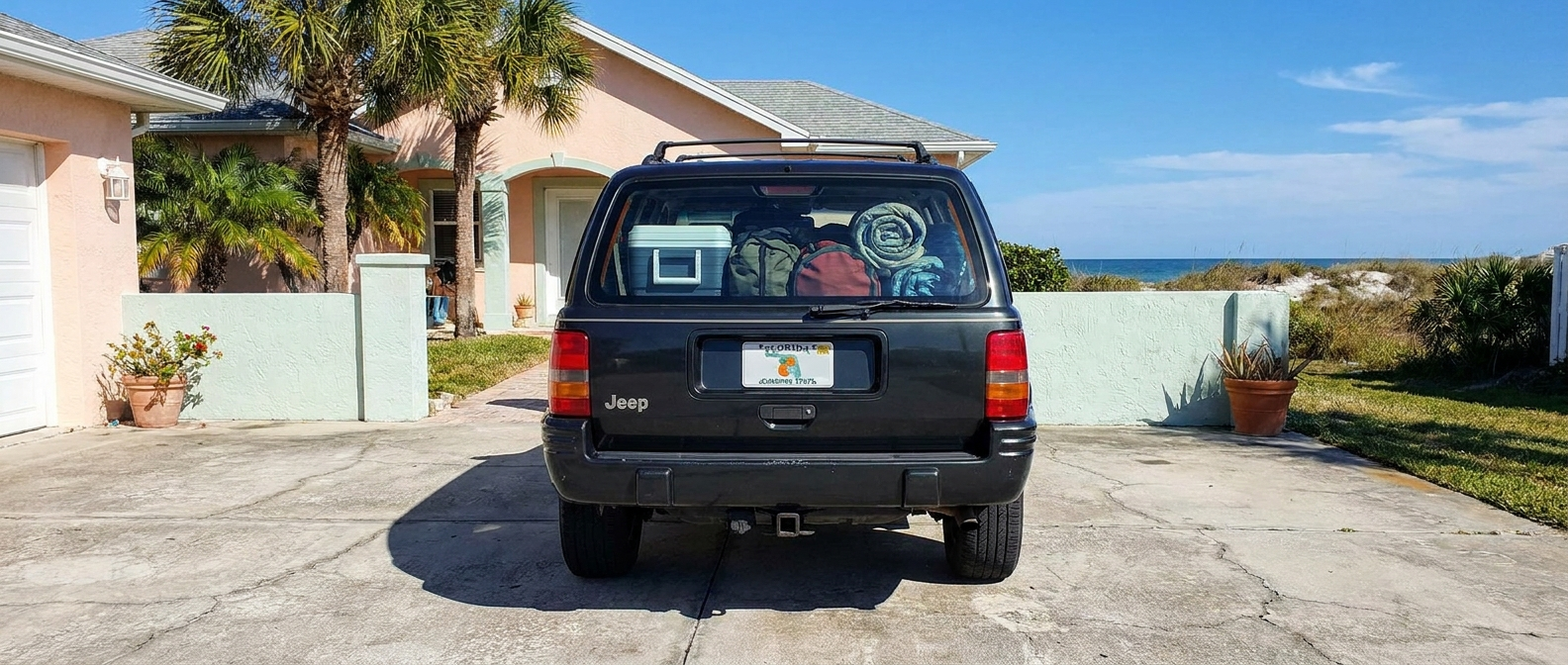
You're loading the truck with kids, a casserole dish, and a week's worth of bags, and the last thing you want is to learn somewhere past Dothan that you should have checked something before you left. We prep vehicles for long Panhandle runs at Bay Chrysler Dodge Jeep Ram, and we'll give it to you straight. The Gulf Coast puts specific stresses on vehicles that make fall prep more important here than it would be in a lot of the country.
- Check your battery first. Florida heat and Gulf Coast salt air shorten battery life to roughly 2.5-3 years, and a battery that started the summer at 75% charge may not finish November.
- Tire pressure drops with temperature. Panama City's November overnight lows can dip into the low 40s, and tires lose roughly 1 PSI for every 10-degree temperature drop.
- Wednesday, November 25 is the hardest driving day on I-10 and US-231. Leave Tuesday or early Thursday morning instead.
- Oil, coolant, brake fluid, and wiper fluid should all be confirmed before a multi-hour run north.
- Pack a basic roadside kit: jumper cables or a jump starter, a flashlight, a tire pressure gauge, and your owner's manual.
The checks below aren't ranked by drama. They're ranked by what's most likely to actually strand a Bay County vehicle on a Thanksgiving weekend.
Schedule your pre-trip inspection at Bay Chrysler Dodge Jeep Ram
Which Checks Are the Real Make-or-Break Items for This Drive?
Battery and tires are the two that can genuinely leave you stranded, in that order, and nearly everything else on this list can still get you to the next exit without wrecking the weekend. So start at the top of the table and work your way down.
| Check | Why It Matters Here | What to Look For | Pass / Act |
|---|---|---|---|
| Battery health | Gulf Coast heat and salt air corrode terminals and shorten battery life to 2.5-3 years in Florida vs 4-5 in cooler climates | Slow crank, dim lights, corroded terminals | Test before the trip; replace if over 3 years old |
| Tire pressure | November overnight lows in the low 40s; tires lose ~1 PSI per 10-degree drop | Check cold, use door-jamb sticker PSI (not the sidewall) | Inflate to spec the morning you leave |
| Tire tread | 400+ miles round-trip on I-10; worn tread extends stopping distance significantly in wet conditions | Penny test: if you see Lincoln's full head, you're below 2/32" | Replace before the trip if below threshold |
| Engine oil | Long highway runs at sustained RPM build heat; dark/gritty oil has less protective capacity | Pull the dipstick; dark and gritty means change it | Change if within 1,500 miles of your interval |
| Coolant level | Florida running temps already stressed the system all summer | Check the overflow reservoir when cold | Top off with correct spec fluid if low |
| Brake fluid | Absorbed moisture over time lowers its boiling point | Visual check on reservoir; look for dark discoloration | Service if fluid looks dark or hasn't been done in 2 years |
| Wiper blades | November brings Panhandle rain; UV degrades rubber fast in coastal FL | Streak test on a wet windshield | Replace if they streak or chatter |
| Spare tire | A flat somewhere on US-231 between Fountain and Cottondale is a long wait | Confirm it's inflated; check for jack and lug wrench | Inflate to spec listed in owner's manual |
Which Checks Do People Skip (and Why That's a Mistake on This Particular Drive)?
The three checks easiest to skip are the battery terminals, the wiper blades, and the spare, and skipping them on this run is a real gamble, because the stretch of US-231 north of Panama City through Youngstown and Fountain is genuinely rural. There are long gaps between exits, limited cell signal in sections, and tow truck response times that can run well into the evening on a holiday weekend. That changes the calculus on "I'll deal with it when I get back."
The three checks easiest to skip are below, with the reason each one matters on the US-231 and I-10 corridor.
1. Battery terminal inspection. Panama City sits right on the Gulf Coast, and salt air moves through engine compartments constantly. The corrosion you can see as a whitish-green crust on the terminals impedes the electrical connection. A battery that reads adequate voltage can still fail to deliver reliable starts once that connection is compromised. Clean the terminals yourself with a wire brush and baking-soda paste, or have it done at a shop. It takes ten minutes.
2. Wiper blades. Florida's UV exposure degrades wiper rubber faster than in most states. A blade that cleared your windshield fine during the last summer storm may streak badly on a cold, foggy November evening on I-10. You'll run into that fog over the Apalachicola River lowlands east of Marianna, and streaking wipers at highway speed at dusk are not a minor inconvenience.
3. The spare. A full-size spare needs its pressure checked, while a space-saver spare has a posted maximum speed and a maximum mileage range. Typically 50 mph and 50-70 miles depending on your vehicle, which means if you flat somewhere past the I-10 junction, you're not driving the rest of the way on it. Verify in your owner's manual.
Browse our pre-owned inventory if your current vehicle needs an upgrade before the holidays
The tradeoff worth naming is simple. These checks take an afternoon, and if your schedule doesn't allow for all of them, do the battery and tire pressure first, full stop. The others matter, but those two have the shortest gap between "ignored" and "stranded."
The Gulf Coast Battery Problem (It's Not Like Up North)
Summer, not winter, is what wears out a battery on the Gulf Coast, which is the opposite of what colder-state prep guides will tell you, and it matters here because much of the damage is already done by the time November arrives. In colder states, winter is the season that kills batteries, the cold reduces cranking capacity, and a marginal battery gives out in January. In Florida, and especially in the coastal Panhandle, summer does that work. Sustained heat causes internal battery fluid to evaporate, which exposes lead plates and accelerates degradation. Then the salty, humid air works on the terminals themselves throughout the year.
The practical result is that car batteries in Florida typically last 2.5 to 3 years rather than the 4-5 you'd expect in a northern climate. If your battery is approaching or past the three-year mark, Thanksgiving week is not the moment to find out whether it has one more trip in it. Get it tested. Most shops, including ours, can run a load test in about 15 minutes, and a load test tells you the actual reserve capacity, not just the resting voltage.
On the service side, we do notice that trucks and SUVs running lots of accessories (winches, light bars, after-market audio) put additional demand on batteries the factory specs don't account for. If you've added anything that draws current, factor that in when you're deciding whether to test or just replace.
When Should You Actually Leave From Panama City for Thanksgiving 2026?
Leaving Tuesday before noon or early Thursday morning is your safest window, and the one day to avoid is Wednesday, November 25, because Thanksgiving 2026 falls on Thursday, November 26 and the travel window runs from Tuesday the 24th through Monday the 30th. Timing really is prep.
Wednesday, November 25 is the worst day to drive. As historically the heaviest outbound driving day of the year on US corridors, Wednesday afternoon congestion on I-10 between Tallahassee and Atlanta is significant. US-231 northbound into Alabama will feel it too, especially through the Dothan area.
The best options from Panama City:
- Leave Tuesday, November 24, before noon. Traffic is lighter, and you arrive rested before the holiday chaos peaks.
- Leave Thursday morning (Thanksgiving Day itself). Roads are historically quiet once the prior-day rush clears. You sacrifice a few hours of the morning, but you're trading stress for calm.
- Return Monday, November 30, rather than Sunday the 29th. Sunday is consistently the heaviest return travel day of the holiday period on both roads and at airports.
That timing advice costs nothing and saves real time. But it only works if the vehicle is ready before you go.
See our Jeep Grand Cherokee inventory, a capable option for the holiday run
Pros and Cons of Getting a Professional Pre-Trip Inspection vs Doing It Yourself
| Pros of Professional Inspection | Cons of Professional Inspection |
|---|---|
| Trained eyes catch things a visual walk-around misses (brake pad thickness, belt wear, suspension looseness) | Takes time to schedule and wait; shouldn't be left to the last minute |
| Electronic battery load test gives you actual reserve capacity, not just resting voltage | Costs money, even for a basic inspection |
| Service records create documentation if anything goes wrong on the road | May surface items you weren't planning to address before the trip |
| Technician can top all fluids to exact spec in one visit | Dealership shops can get busy the week before Thanksgiving |
| Pros of DIY Pre-Trip Check | Cons of DIY Pre-Trip Check |
|---|---|
| Free; can be done any morning before work | Can't run a battery load test or measure brake pad thickness without tools |
| You know your own vehicle's quirks and history | Easy to rationalize skipping something that "looks fine" |
| Covers the basics (tire pressure, visual fluid check, light test) quickly | Doesn't catch slow leaks, worn belts, or marginal battery performance |
Our honest take is to run the DIY check yourself the week before, then book the professional inspection if your battery is over two years old, your brakes haven't been looked at in 18 months, or your oil interval is coming up. Those three conditions each justify a shop visit on their own merits.
Which Driver Is This Guide Really For?
Which driver you are changes how much prep you actually need, because not everyone driving north from Panama City this Thanksgiving is in the same situation, and the right amount of work scales with the age and load of your vehicle. Here's the breakdown.
You're the "drive it and see" type. Your Ram 1500 or Jeep Wrangler has been running fine all fall. You changed the oil in August and you're not worried. That's fair, provided your battery is under three years old, your tires have good tread, and your brake pads aren't making noise. Confirm those three things and you're probably fine for a run to Dothan or Montgomery, nothing fancy required.
You've got an older vehicle with 80,000+ miles. This is where the full checklist earns its time. Belts, hoses, and cooling system components that held up through another Florida summer deserve a look before you put 400-plus miles on them in a single weekend. Book the inspection.
You're hauling a trailer. A Ram 1500 or Jeep Grand Cherokee pulling a trailer puts additional load on brakes, transmission, and the hitch connection itself. Confirm your trailer wiring harness is functional (brake lights, turn signals), check the hitch ball and coupler for wear, and verify your tow vehicle's transmission fluid hasn't gone overdue.
You've got a vehicle that sat for any stretch this fall. A vehicle parked for more than a few weeks can develop flat spots in tires, a battery that didn't fully recharge, and brake rotors with surface rust that will pulse on the first few hard stops. None of these are disasters, but they're worth knowing before you're on I-10.
The bottom line is simple. Prep is proportional to risk, so a newer truck that's been driven regularly needs less, while an older vehicle that's been sitting, or one that's carrying a trailer or a full family load, needs more.
Frequently Asked Questions
What's the hardest part of driving from Panama City to Thanksgiving dinner. Weather or traffic?
For most Bay County families heading north, traffic is the bigger issue, especially on the Wednesday before Thanksgiving (November 25 in 2026), which is historically the heaviest driving day of the holiday period. Panama City's November weather is generally mild, with AccuWeather forecasting November 2026 highs in the mid-to-upper 60s and overnight lows that can drop into the low 40s. That temperature swing is enough to affect tire pressure, so check your tires the morning you leave, not the day before.
How do I know if my battery will make it through a long highway drive?
The best indicator isn't how the car starts in your driveway. It's a load test, which measures actual reserve capacity under demand. In Florida, battery lifespan is typically 2.5 to 3 years (compared to 4-5 years in cooler climates) because sustained summer heat causes internal battery fluid to evaporate and accelerates plate degradation. If your battery is approaching or past the three-year mark, get it load tested before the trip.
How early should I leave Panama City to beat Thanksgiving traffic?
Leaving Tuesday, November 24 before noon is the lowest-stress option for outbound travel. If you're departing Wednesday, get on US-231 or I-10 before 10 a.m.. Afternoon congestion on both corridors builds sharply after noon. Thanksgiving Day itself is historically the quietest driving day of the holiday week. For the return, Monday November 30 is considerably lighter than Sunday November 29, which is consistently the busiest return-travel day of the year on both roads and at airports.