




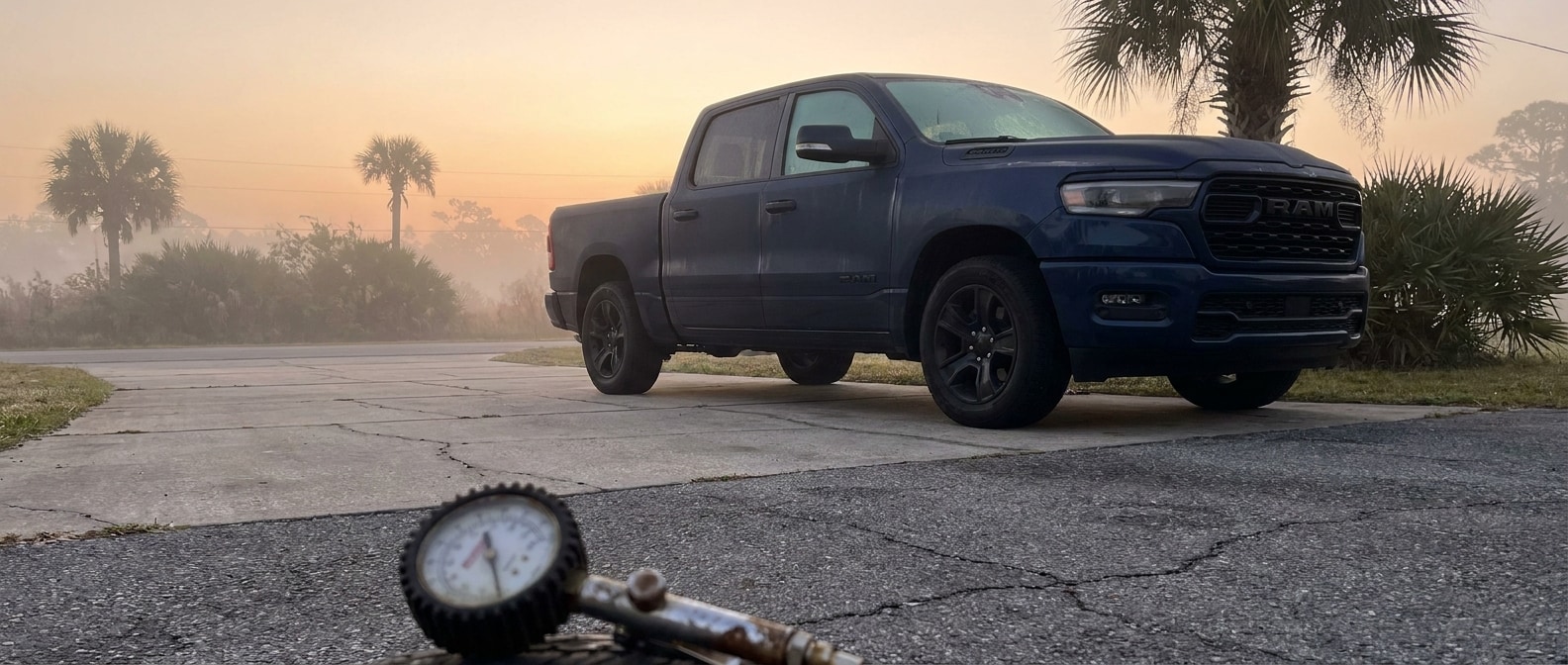
October in Panama City is a gift. The summer humidity finally eases up, the crowds thin out, and you can roll down US-98 with the windows open and actually enjoy it. There's a small catch nobody talks about, though. Those cooler nights are quietly pulling PSI out of your tires while you sleep.
None of this is a minor annoyance. A truck or SUV running 2-4 PSI low handles differently, wears unevenly, and burns a little more fuel on every run down to the beach or across the Hathaway Bridge. The fix takes about three minutes, which is the good news. You just have to know what's happening and which number to aim for.
- Tire pressure drops roughly 1 PSI for every 10-degree Fahrenheit temperature fall. Panama City's October overnight lows can sit 15-25 degrees below the afternoon high, so losing 2-3 PSI overnight is normal.
- Your TPMS warning light is not always a sign of a nail or a leak. In October, it's often just physics.
- The correct target pressure is printed on your driver-side door jamb sticker, not on the tire sidewall.
- Check your tires cold, meaning before you drive or after the truck has sat at least three hours. A warm tire reads 3-5 PSI higher than it actually is at rest.
- If you're consistently fighting this every fall, a quick pressure top-off at our service department takes it off your plate entirely.
What Actually Matters When You're Choosing How to Handle Low Fall Pressure?
Two variables really drive your call here, and both come down to physics you can measure, namely how far the overnight temperature falls while you sleep and whether the gauge in your hand is reading a cold tire or one still warm from the road. Generic national advice misses the Panama City version of this. You've been driving through summer heat since May. Your tires were filled somewhere around 90 degrees. Now the overnight low is 58, and a TPMS light is staring at you before you've had your first cup of coffee.
| Factor | What It Does | Key Number | The Honest Tradeoff |
|---|---|---|---|
| Temperature drop overnight | Air contracts, pressure falls | ~1 PSI per 10 degrees F drop | Unavoidable physics; only fix is topping off in the morning |
| Checking warm vs. cold | Friction heat inflates the reading | 3-5 PSI artificially added after driving | A warm check tells you nothing reliable; cold checks only |
| Your door jamb target | Manufacturer-set for your load/suspension | Varies by model (see below) | The sidewall max is NOT the target; don't inflate to it |
| TPMS warning threshold | Triggers at 25% below placard per NHTSA FMVSS No. 138 | Example: ~26 PSI on a 35-PSI tire | The light can stay off even when you're borderline low |
| Nitrogen fill | Holds pressure more consistently through temp swings | No moisture in the gas = less fluctuation | Slightly harder to top off in a pinch; most stations use air |
The last column matters more than most guides admit. Your TPMS is a late-warning system rather than a real-time monitor, and it won't catch a 2-PSI drop. Keeping an eye on it is on you.
Your Door Jamb Number Is the Only One That Counts
The only pressure target worth trusting sits on the placard inside your driver-side door jamb, because that figure is matched to your exact truck, SUV, or van, while the big number molded into the tire sidewall is only the maximum that tire can hold. So forget the sidewall. Seriously. It has nothing to do with what your specific vehicle is engineered to run.
For the vehicles we see most on our lot in Panama City, here's the general territory to get you oriented. These numbers are typical ranges for factory configurations. Always confirm against your own door sticker, since trim and tire size change the spec.
Jeep Wrangler owners typically see 35-37 PSI, front and rear. The Jeep Grand Cherokee runs 33-36 PSI, depending on trim and wheel package. Ram 1500 trucks in standard street configuration commonly sit around 36 PSI cold (heavy-duty and off-road packages run higher). Treat those as starting points. Your door jamb is the authority.
Any customer who comes in with a cool-morning TPMS question gets walked through the same quick list of checks.
- Check pressure before driving, or after the truck has sat for at least three hours, which gives you a true cold reading.
- Use a quality gauge rather than leaning on the TPMS readout on your dash. The system has a resolution of about 1 PSI and activates late by design.
- Check all four tires, not just the one the system flagged. Temperature affects all four equally; the first one to cross the threshold is usually just the one that started slightly lower.
- Add air to hit the door jamb target rather than topping off arbitrarily. Overinflation left over from the summer is also a real issue.
- If you're running a lifted Jeep or oversized aftermarket tires, the door jamb pressure may no longer apply. Your tire manufacturer's spec for that specific tire is what you need.
Match the Gear to How You Actually Drive
How you load and drive the vehicle decides how much a low reading actually costs you, which is why a Ram 2500 or Ram 3500 hauling materials across Bay County carries a different tire pressure concern than a Jeep Wrangler running down to St. Andrews State Park for the weekend. The physics are identical. The stakes are different.
If you're towing or hauling anywhere close to rated capacity, running even 2-3 PSI low matters more than it does on an empty passenger run. Underinflated tires under load generate heat through sidewall flexion, and that heat accelerates wear. If you're doing trail runs or driving on sand, you're likely already airing down intentionally to around 18-20 PSI for flotation. Airing down is correct for soft surfaces. Just remember to air back up to placard before you hit the pavement.
For the daily driver, whether that's a Jeep Grand Cherokee on the school run or a Chrysler Pacifica loaded with gear, a once-a-month cold check from October through March covers you. Panama City's temperature swings don't get extreme, but they move your PSI by 2-3 points through this stretch of the year, and that's enough to matter.
We'll say one thing plainly here. If you're not a gauge person and this feels like one more chore, bring it by our service team. A pressure check and top-off is quick, and you drive away with four tires confirmed cold at the right number. Worth something heading into fall.
FAQ
Why does my tire pressure light come on in the morning but go off by lunchtime in Panama City?
The October temperature swing is doing exactly what the physics predict. Tire pressure drops roughly 1 PSI for every 10-degree Fahrenheit fall in temperature. When Panama City overnight lows dip into the upper 50s and your afternoon high was in the low 80s, your tires can lose 2-3 PSI overnight. Per NHTSA's FMVSS No. 138, your TPMS warning light activates when pressure falls 25% or more below the placard recommendation. Once you start driving and the tires warm from friction, pressure climbs back toward placard range and the light shuts off on its own. That doesn't mean your tires are fine, though. It just means they warmed up. Check them cold and top off to the door jamb number.
Do I need to check all four tires, or just the one the TPMS light flagged?
Check all four. Temperature acts on every tire equally, so the one that triggered the warning is usually just the tire that was already a touch lower than the others when the season changed. A proper cold check on all four tires and an adjustment to your door jamb target will clear the issue and keep you from chasing the same light every other morning through November.