




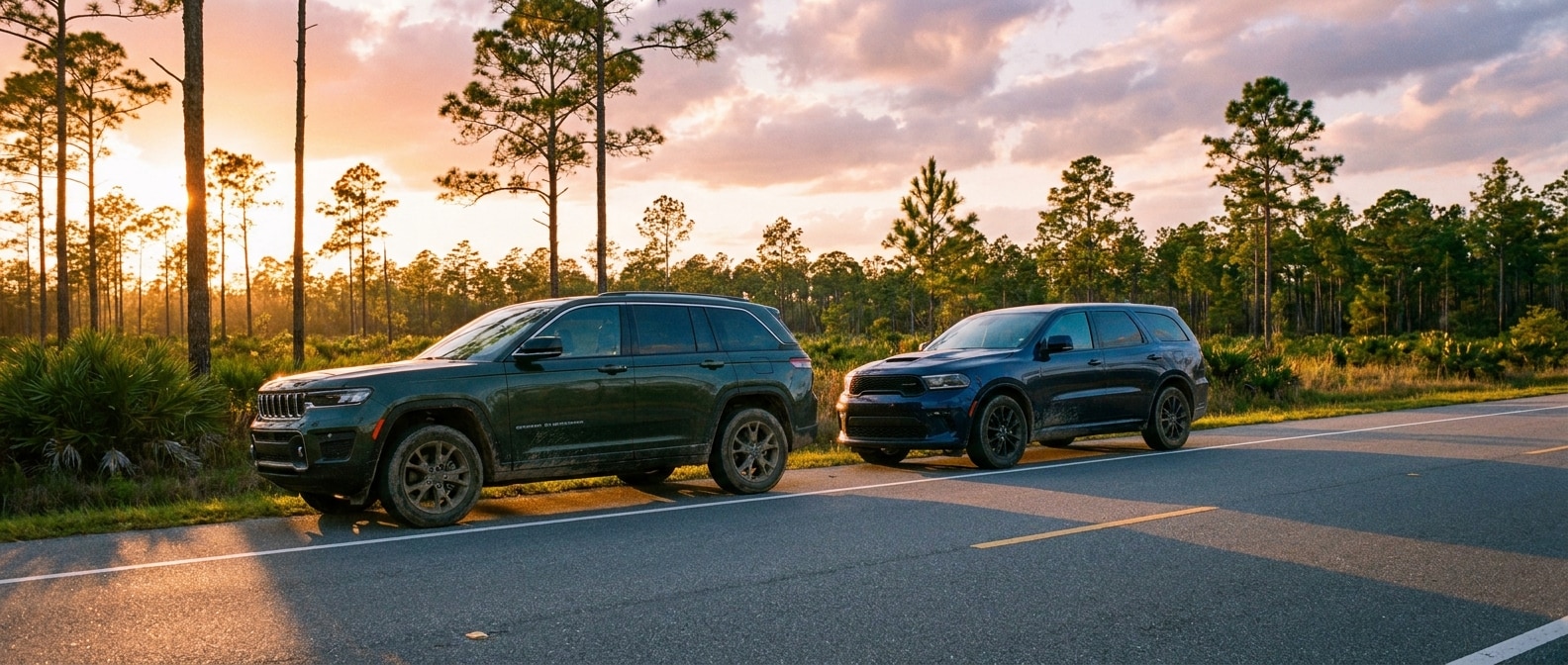
October on the Florida Panhandle is one of the better times of year to load up and go. Crowds thin out, temperatures settle into the 60s and 70s, and there's real ground to cover between here and the coast. A fair question before a fall trip is whether the 2026 Jeep Grand Cherokee or the Dodge Durango fits the drive better. They're genuinely different vehicles for genuinely different families. The right call depends on who's riding along and what's riding on the hitch.
- The 2026 Grand Cherokee is the pick for a five-person family focused on daily cargo access and fuel efficiency. The EPA rates its 2.0L Hurricane turbo at 21 city and 27 highway in 4x2 configuration.
- The 2026 Dodge Durango wins when you're filling a third row or pulling more than 6,200 pounds. Its 5.7L HEMI V8 tows up to 7,200 pounds (8,700 with the Tow N Go Package).
- Behind your passengers, the Grand Cherokee puts 37.7 cubic feet of cargo space to work. The Durango puts 17.2 cubic feet behind its third row. That difference shapes every loaded road trip.
- Both vehicles tow 6,200 pounds with the base V6. Beyond that number, only the Durango's V8 options apply.
- If you're not filling that third row or pulling above 6,200 pounds, you're paying in fuel and cargo awkwardness for seats you won't use.
What's the Real Difference Between These Two SUVs?
The core difference is seating architecture, and the honest trade is that the Grand Cherokee gives five people more usable cargo while the Durango gives seven people seats at the cost of that cargo, so the better SUV depends on how full the cabin gets. The standard Grand Cherokee seats five across two rows. The Durango runs three rows as standard on most trims, which looks like a clean win. Load it for a road trip, though, and you'll find just 17.2 cubic feet of cargo space behind that occupied third row. Picture roughly the volume of a large rolling suitcase and a backpack.
| Spec | 2026 Jeep Grand Cherokee | 2026 Dodge Durango |
|---|---|---|
| Standard seating | 5 passengers | 7 passengers |
| Cargo (behind rear seat) | 37.7 cu ft | 17.2 cu ft (3rd row up) |
| Max cargo (seats folded) | 70.8 cu ft | 85.1 cu ft |
| Base engine | 3.6L V6, 293 hp | 3.6L V6, 295 hp |
| Available engine | 2.0L Hurricane turbo, 324 hp | 5.7L HEMI V8, 360 hp |
| EPA combined (V6, base config) | 22 mpg combined | 20 mpg combined (RWD) |
| V8 EPA combined (AWD) | Not available | 16 mpg combined (5.7L) |
| Base tow capacity | 6,200 lb | 6,200 lb (V6) |
| Max tow capacity | 6,200 lb | 8,700 lb (5.7L + Tow N Go) |
| Available 4WD systems | Quadra-Trac I / II / Quadra-Drive II | AWD (standard on V8 trims) |
Does the Third Row Change Everything for a Panhandle Road Trip?
Yes, for a seven-person household the third row changes everything, and for a family of five it changes almost nothing worth paying for, so the question really answers itself once you count how many bodies ride along on a typical weekend. If you're regularly moving seven people, the Durango's third row isn't optional equipment. It's the reason you buy it.
On a loaded US-98 run toward Destin or down into Gulf County, the Dodge Durango's 5.7L HEMI V8 with AWD delivers 360 horsepower and 390 lb-ft of torque. AWD comes standard on V8 trims, and the platform handles a fully loaded passenger cabin without the engine strain you'd feel in a smaller crossover.
Behind that power sits the fuel bill. The EPA rates the 5.7L HEMI V8 Durango with AWD at 14 city and 21 highway, which is 16 mpg combined. Run a two-day Panhandle loop at highway speeds and you'll spend meaningfully more at the pump than a Grand Cherokee driver in the next lane. The Grand Cherokee's 2.0L Hurricane turbo earns an EPA-estimated 21 city and 27 highway in 4x2 form. Over several hundred miles, it adds up fast.
Seven passengers and a large trailer? Take the Durango and don't blink at the fuel cost. Five passengers and gear under 6,200 pounds of towing? The Grand Cherokee makes more sense.
How Much Can Each Vehicle Actually Tow?
Both vehicles tow the same 6,200 pounds with the base V6 when properly equipped with the Trailer Tow Package, so at the low end they're a dead heat, and the separation only shows up once your trailer climbs past that number into V8 territory. Jeep lists that figure for the 2026 Grand Cherokee with both the 3.6L V6 and the 2.0L Hurricane turbo. It covers a lot of Panhandle use cases. Most center-console boats, personal watercraft trailers, and smaller campers fall under that ceiling. For hauling from St. Andrews Bay to a launch site down the coast, 6,200 pounds is plenty for a 20-to-21-foot bay boat rig.
Where the Durango separates itself is above that number. Its 5.7L HEMI V8 moves the tow rating to 7,200 pounds, and the Tow N Go Package pushes that to 8,700 pounds. Full-sized travel trailers and heavier inboards come into range. The Grand Cherokee has no V8 option, so its ceiling stays at 6,200 pounds with the Hurricane turbo or 6,000 pounds with the 4xe hybrid. If your trailer is under 6,200 pounds, you lose nothing by choosing the Grand Cherokee. If it isn't, the Durango is your only path between these two.
Browse the 2026 Grand Cherokee lineup to compare Trailer Tow Package availability across trims, and you'll know what fits before you come in.
Off-Road Capability for Fall Panhandle Trails and Sand Access
The Grand Cherokee takes this one clearly, and the catch is that the advantage stays theoretical unless your fall plans actually leave the pavement, because on graded roads both SUVs get where they're going and the gap opens up on soft sand or unimproved two-tracks. Jeep offers three 4WD systems on the 2026 model. Quadra-Trac I is full-time, Quadra-Trac II adds Selec-Terrain, and Quadra-Drive II brings a rear electronic limited-slip differential on the Summit. The Selec-Terrain system covers five modes including Sand and Mud, which is what you'll want on softer ground. For the sandy access roads near Grayton Beach State Park in Walton County or the softer two-tracks around Cape San Blas, that capability matters. Cape San Blas is in Gulf County.
The Durango runs AWD, but it's a pavement-biased system on a platform built for road performance rather than trail work. It handles a graded gravel road without issue. Soft sand and unimproved coastal access are a different story, and that's no knock on the Durango. It was engineered for a different job entirely. Just know where each vehicle excels before you plan a stop that leaves the pavement.
Which One Should You Pick?
The answer really comes down to two questions you can settle before you ever turn a key, how many passengers are riding and what's on the hitch, and once you have both numbers the choice tends to make itself. Everything else between these two is secondary to seats and towing.
Choose the 2026 Jeep Grand Cherokee if:
- Your travel group is five people or fewer
- Your trailer or boat falls at or under 6,200 pounds
- Fuel economy across longer highway runs matters to your budget
- You want real 4WD options for Panhandle trails or sandy access roads
- A more refined two-row interior for those five people is a priority
Choose the 2026 Dodge Durango if:
- You're regularly filling a third row with real passengers
- You need to tow more than 6,200 pounds (7,200 with the HEMI V8, 8,700 with Tow N Go)
- The V8 driving character matters to you on its own terms
- You're willing to accept 16 mpg combined as the cost of that power and seating capacity
One note worth adding here is the Grand Cherokee L, Jeep's three-row option, which is worth a direct comparison against the Durango if a third row is on your list. It's a separate conversation, and a useful one. But if it comes down to the two-row Grand Cherokee and the Durango, size your SUV to the people and the trailer you're actually running, not the maximum version of either.
We've got both on the lot. See our current Grand Cherokee inventory, and come take the keys for the one that fits your fall plans.
Frequently Asked Questions
Does the Jeep Grand Cherokee L make the Dodge Durango irrelevant?
Not quite. The Grand Cherokee L adds a third row and reaches approximately 84.6 cubic feet of maximum cargo space, which puts it in direct competition with the Durango on seating capacity. It also brings Jeep's Selec-Terrain 4WD systems to the three-row format, which the Durango can't match off-road. Where the Durango still wins is towing above 6,200 pounds. A Grand Cherokee L tow ceiling stays at 6,200 pounds, the same as the two-row model. If your trailer runs heavier than that, the Durango's HEMI V8 options are still the only path.
Is the Dodge Durango still being made for 2026?
Yes, the 2026 Dodge Durango is current production. The lineup was updated with a reintroduced V6 GT trim alongside the 5.7L HEMI V8, the 6.4L HEMI V8 in the R/T 392 Launch Edition, and the supercharged 6.2L SRT Hellcat. Dodge still builds the Durango as its full-size three-row SUV, and it is available on our lot. It is not discontinued.