




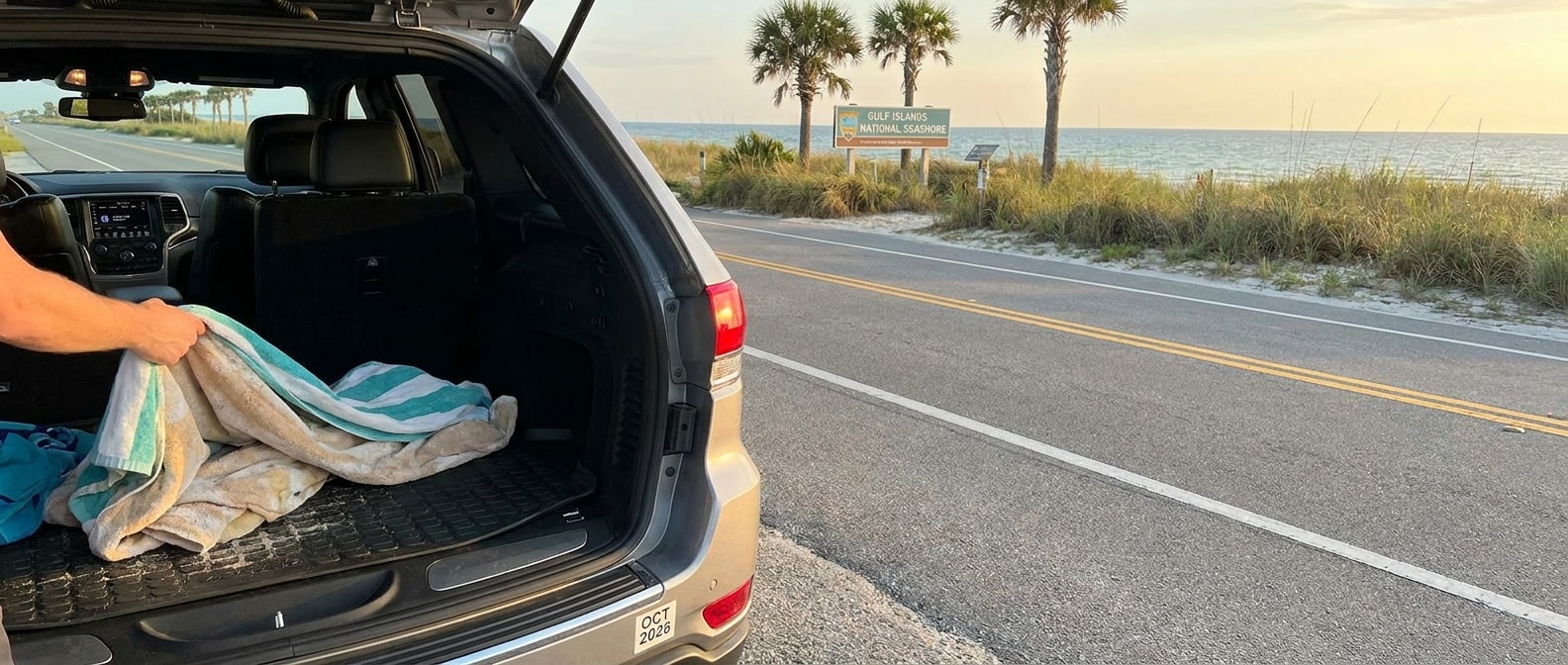
Beach season around Panama City Beach doesn't end on Labor Day. The Gulf stays in the mid-to-upper 70s through early October, and plenty of local families keep hauling wet towels, sandy chairs, and dripping coolers well into fall. So the interior of your Jeep Wrangler, your Chrysler Pacifica, or your Jeep Grand Cherokee is still taking a beating right now. The good news is that the salty, sunscreen-mildew combination that's settled into your seats isn't permanent. It just needs a real cleanup, not a pine-tree air freshener.
Here's what actually works, and why.
Does a Quick Vacuum Actually Fix the Smell?
A quick vacuum gets the job started, but it won't finish it, because that first pass only lifts the visible sand and leaves the fine quartz Panama City Beach is known for buried in the seat seams and carpet backing, where your AC keeps pulling the odor back out. That quartz really is unusually fine, made up of small particles that stay cool underfoot even in summer heat. Once it works down into damp carpet, a household vacuum can't pull it back out, and the sand keeps releasing odor from inside the weave.
The table below lays out what each step in the cleanup process addresses, so you know which ones you can skip and which ones you can't.
| Cleanup Step | What It Fixes | Can You Skip It? |
|---|---|---|
| Remove and shake floor mats | Loose surface sand and salt | No, do this first |
| Vacuum seats and carpet (multiple directions) | Embedded quartz particles in fabric | No, needs multiple passes |
| Brush-then-vacuum carpet | Fine sand gripping damp fibers | Only if carpets are bone dry |
| Fabric shampoo or baking soda treatment | Odor embedded in cloth fibers | Not if there's a lingering smell |
| Wipe all hard surfaces with damp cloth | Salt residue on dash, door panels, trim | No, salt residue is the source |
| Check and replace cabin air filter | Vent-borne salt and mildew odor | No, especially after a long humid summer |
| Run AC on "fresh air" mode with windows cracked | Flush stale HVAC air out of ducts | No, takes 10 minutes and costs nothing |
| Activated charcoal bag (24-48 hours) | Residual airborne odor molecules | Optional but worth it for stubborn cases |
The two steps you'll be tempted to skip are the cabin air filter and the hard-surface wipe-down. Both punch well above their weight.
Where Does the Smell Actually Come From?
The smell comes from more than just the sand, and three separate odor sources are working together inside your cabin at the same time, so a single air-freshener scent will only cover all three of them at once and still won't fix any one of them.
Fine quartz sand holding moisture. Panama City Beach's sand is genuinely fine. On the beach that fineness is a feature, and in your carpet it's a problem. Fine particles grip damp fibers tightly, which is why vacuuming alone after a wet-beach day doesn't clear the smell. The sand is still there, locked into the weave, and it releases odor as it dries and re-wets through the humidity cycles.
Salt residue on every hard surface. After a long season of in-and-out loading of gear, that salt residue builds up on door jambs, seat-belt anchors, and the plastic trim around your cargo area. Gulf air carries it in on every breeze. It doesn't smell strongly on its own, but combined with heat and humidity it adds to the overall "beach car" baseline.
The cabin air filter and AC evaporator. The cabin filter and evaporator are the pair that catches people off guard, since Florida's summer heat means the AC runs hard from roughly April through October (our longest stretch behind the wheel with the system working). The evaporator coil cycles between wet and dry as it pulls humidity out of the cabin air. The cabin air filter catches everything that rides in on the Gulf breeze, from salt crystals and fine sand to pollen and moisture. A clogged or saturated filter doesn't just smell on its own. It also slows airflow across the evaporator, so condensation sits on the coil longer, and that's where mildew takes hold in the ductwork. Every time you turn the fan on, those duct odors blow straight into your face.
An activated charcoal cabin filter actually helps here, because the porous carbon adsorbs odor molecules instead of just filtering particles. It'll go after vent-based odors at the source. For Jeep Wrangler owners who run with the top off, this is worth a close look. Open-air time packs more Gulf particulates through the cowl intake than a sealed cabin ever would.
- [ ] Remove all gear from the cargo area, under the seats, and door pockets before vacuuming
- [ ] Shake and beat floor mats vigorously away from the vehicle
- [ ] Vacuum the entire cabin in two directions, forward-back and side-to-side, to lift embedded sand
- [ ] Use a stiff-bristle brush on carpet areas before a second vacuum pass if the carpet was damp
- [ ] Wipe down all hard surfaces, the dash, door trim, cargo sill, and seat-belt anchors, with a damp microfiber cloth to remove salt residue
- [ ] Apply baking soda to cloth seats and carpet, let it sit for at least 15 minutes, then vacuum it up
- [ ] Check the cabin air filter, which sits behind the glovebox on most vehicles, and replace it if it looks gray or clogged, and consider upgrading to an activated charcoal filter
- [ ] Run the AC on fresh-air mode with windows cracked for 10 minutes to flush the ducts
- [ ] Place an open container or bag of activated charcoal in the cabin overnight for stubborn residual odor
- [ ] For Chrysler Pacifica owners: pull the third-row seat cushions up and check underneath; that's where wet gear lands and where odor hides longest
Schedule a Detail and Cabin Filter Check
Plan It This Way: The End-of-Season Routine That Actually Sticks
Timing is the tricky part of this cleanup, and the window matters just as much as the method you use, because clean too soon and you'll only repeat the whole job, clean too late and the odor has already settled deep into the foam and fabric. Push it too early, back in August, and you'll just redo it, since September weekends at St. Andrews State Park are still fully in play. Leave it too late, into December, and the odor has had weeks to embed in the foam and fabric.
The right window for Panama City Beach drivers is right about now. In October the beach crowds thin out, but Gulf water temps are still in the low-to-mid 70s, so plenty of families take at least a few more weekend runs before November. A mid-October deep clean catches the tail end of the season. You do it once, it holds, and you're not airing out a musty interior when the weather cools down and you start running the heat.
For a working-family vehicle like a Chrysler Pacifica or a Ram Ram 1500 that's been pulling beach duty all summer, the honest tradeoff looks like this. The full checklist above takes two to three hours if you do it yourself, and the cabin air filter swap is an extra 15 minutes with a basic tool set. Our service team handles cabin filter replacements quickly, and a fresh filter going into winter means the heat system won't push months of accumulated salt and dust back through the cabin every time you run the defrost.
One thing that doesn't work is masking the odor and hoping it clears on its own. Air fresheners cover it. They don't fix it. Sand and salt particles keep releasing odor as the humidity fluctuates, and a saturated cabin filter keeps reseeding the air every time the fan runs. Deal with the source now, and the cabin stays fresh through the cooler months without any additional effort.
FAQ
Why does my car still smell after I've cleaned it?
If you vacuumed and wiped everything down and the smell is still hanging around, the likeliest culprit is the cabin air filter or the AC evaporator. The filter sits in the HVAC system and catches salt, fine sand, and moisture all season long. A clogged or saturated filter releases those odors back into the cabin every time the fan runs. Replace it, and think about an upgrade to an activated charcoal filter, and you'll clear vent-based odors that no amount of carpet cleaning can reach.
Does baking soda actually remove beach smell, or does it just mask it?
Baking soda genuinely neutralizes odors instead of covering them, since it works through a chemical reaction with acidic odor compounds rather than adding a competing scent the way an air freshener does. For fabric seats and carpet, sprinkle it on, let it sit at least 15 minutes, longer for stronger odors, then vacuum thoroughly. It's especially effective on cloth surfaces. For airborne odors, activated charcoal in an open bag or container works through adsorption, which means the porous carbon physically traps odor molecules from the air.
How often should I replace my cabin air filter if I live on the Gulf Coast?
Most manufacturers recommend replacing the cabin air filter every 12,000 to 15,000 miles under normal driving conditions. In a coastal environment like the Florida Panhandle, that interval can run shorter. A heavy summer of Gulf salt air, high humidity, and frequent in-and-out beach loading speeds up how fast the filter media saturates. If you're getting vent odors or weaker airflow, it's worth pulling the filter and checking it regardless of mileage. Our service team can take a look as part of any service visit.