





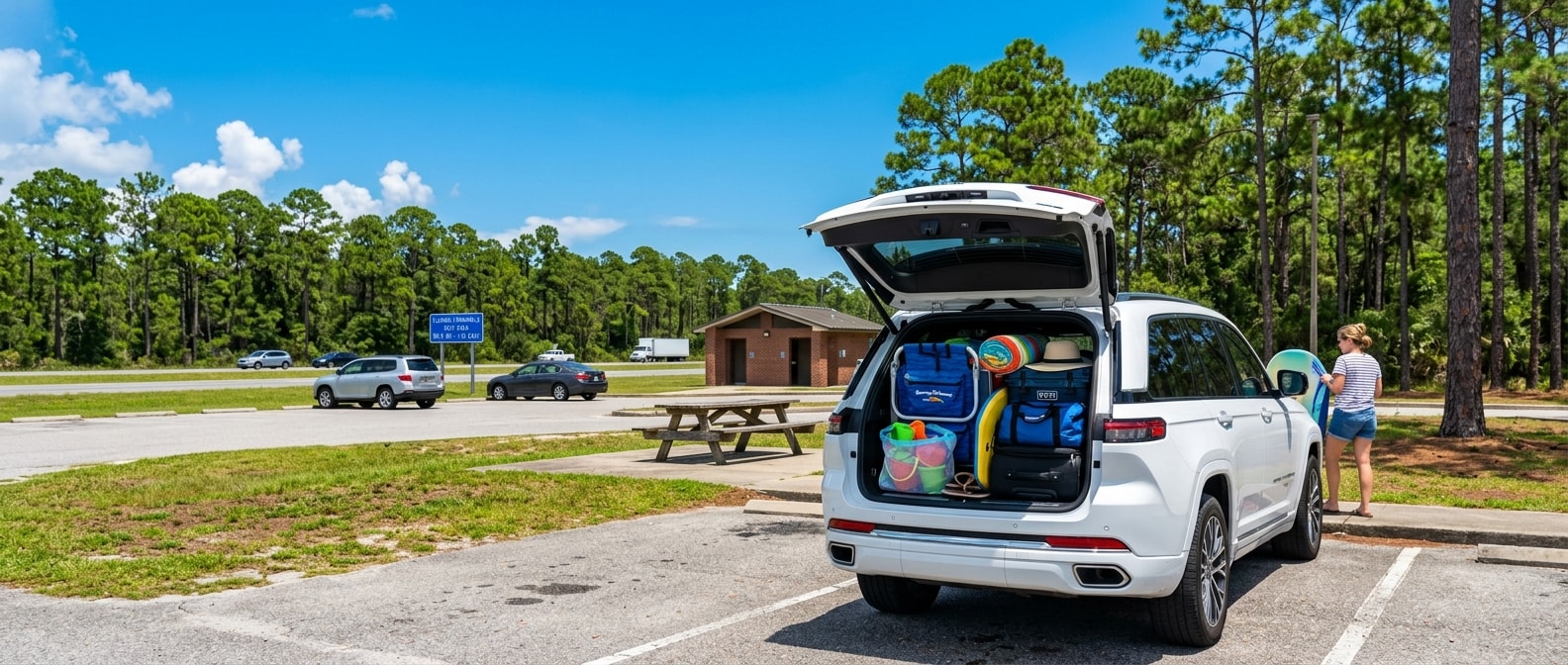
The Panama City to Mobile run comes in at exactly 186 miles. Call it a single tank, a handful of pine trees, a long flat stretch on I-10, and one genuinely beautiful crossing over Escambia Bay on the western end. A Jeep Grand Cherokee handles it comfortably and fits more than you'd expect. Before you load up, here's what to know.
Browse our Grand Cherokee inventory at Bay Chrysler Dodge Jeep Ram
Will It All Actually Fit?
Yes, for a family of four or five with full road-trip gear, it fits without drama, though the honest caveat is that the two-row Grand Cherokee isn't the biggest cargo box in its class, since it's built for people comfort ahead of raw hauling space. What it gives you is 37.7 cubic feet of usable space behind the rear seat, and a full 70.8 cubic feet when you fold the second row flat. According to Jeep's own dimensions, the cargo floor behind the second row measures about 41 inches wide and 31 inches deep. That number tells you what actually loads.
For this specific route, we're talking luggage for two or three nights in Mobile, a cooler, beach chairs if you're stopping anywhere along US-98 on the way out, and the usual family bag pile. Here's how it maps out.
| Load Item | Dimension / Weight (reference) | Fits? How |
|---|---|---|
| Full-size rolling suitcase x2 | ~28" long x 19" wide x 11" deep each | Yes, both upright side-by-side with seats up; 37.7 cu ft floor confirmed |
| Weekend duffel bag x2 | ~24" long, flexible | Yes, stacks flat on top of hard luggage or slides into corners |
| 48-qt hard cooler | ~24" long x 15" wide x 16" tall | Yes, goes in last, widthwise on the passenger side with room for duffels beside it |
| Beach chair x2 (folded) | ~36" long, 6" diameter | Tight with seats up, but vertical along the driver-side wall (easier with one rear seat folded) |
| Dog crate (30" intermediate) | 30" long x 19" wide x 21" tall | Yes, seats folded; the 41" cargo width handles it with room beside |
| Luggage for 5 passengers | Combined heavy weekend load | Fold the second row: 70.8 cu ft, problem solved |
The 41-inch cargo width is the number that matters most when you're packing a real mixed load. Most 28-inch suitcases fit side by side with an inch to spare. A rigid cooler slots in beside them without forcing the liftgate shut. Because the Grand Cherokee stands 70.8 inches tall overall (per Jeep), the liftgate opening sits high. You're not crouching to load. At 7 a.m. on a driveway, that matters more than you'd think.
One detail we flag on a longer haul is the under-floor storage beneath the cargo floor, which holds a full-size spare. That spare steals some depth from a flat-floor competitor. It's a real loss if you measure by raw volume, but it earns its keep.
Loading It Right for I-10
Loading for this drive is straightforward as long as you respect highway speed, because the route is uncomplicated but not featureless, running mostly flat and dead-straight with no elevation change to fight against on a full load. You'll head west on US-231 or through town to pick up I-10 W near Marianna, then run almost dead-straight through scrubby Panhandle pine forest until the road opens up as you approach Pensacola. The crossing over Escambia Bay on the I-10 bridge is the visual punctuation at the end. After that, I-10 drops briefly into Alabama and you're in Mobile in minutes.
What that route means for packing is long highway miles with a single sensible gas stop around Pensacola (roughly 100 miles in) and no serious elevation change to worry about. In September, you're into the Gulf Coast's late-summer pattern of high humidity, afternoon heat, and a real chance of a fast-moving thunderstorm. Plan for that when you're thinking about roof cargo.
See what Grand Cherokee trims are available now
The load order that works:
- Hardest, heaviest items go in first, flat on the floor. Cooler and hard-sided luggage against the back of the folded seats (or the rear wall with seats up). A low center of gravity matters at highway speed.
- Soft bags fill gaps and stack on top. Duffels conform to the irregular space and settle down over the drive, which is fine.
- Beach chairs or long soft gear along one wall. The 41-inch cargo width lets you lay a folded chair parallel to the driver's side without blocking rear-passenger legroom when the seats are up.
- Anything loose (snacks, charging cables, small bags) goes in the rear footwells or the second-row door pockets. The Grand Cherokee's rear door pockets are genuine pockets, not slots.
- Secure the cooler with a cargo net or bungee across the load. The I-10 speed limit through the Panhandle is 70 mph. A loose cooler becomes a problem at a hard brake.
Tip: If your load is right at the seams with seats up, fold just the driver-side rear seat. You keep a rear passenger seat on the other side and pick up a meaningful cargo shelf. It's not an all-or-nothing choice.
Get a pre-trip service check before you leave
Per Jeep, the 2026 Grand Cherokee carries a 1,280-pound payload rating, meaning five adults plus a full luggage load still lands well inside the limit on a typical family trip.
Fueling the Run
The 2026 Grand Cherokee with the 2.0-liter Hurricane 4 Turbo engine earns an EPA-estimated 27 mpg on the highway and pairs with a 23-gallon fuel tank, so you'll clear this 186-mile run on a single tank with plenty in reserve, though a full load and hard-working A/C will pull the real-world number down a touch. Jeep lists the driving range at up to 529 miles on that configuration. On a 186-mile run at highway speeds, you're looking at roughly 6.9 gallons used under ideal conditions. In practice, a full family load, some A/C working hard against September Gulf Coast heat, and normal highway speeds will land you closer to 24-25 mpg (still well above the class average). You won't need to stop for fuel unless you choose to.
See Current Grand Cherokee Offers
If you're towing anything on this trip (a small boat trailer to launch in Mobile Bay, for example), that changes the math. The Grand Cherokee tows up to 6,200 pounds when properly equipped with the Trailer Tow Package, per Jeep. Towing at that range pulls fuel economy meaningfully lower, and a fuel stop around Pensacola becomes the right call.
The route is well-served for fuel. There's no dead stretch, and you'll pass through or near Chipley, DeFuniak Springs, Crestview, and Pensacola with gas stations at every exit.
Job Done
For 186 miles on a single tank with everybody comfortable, the Grand Cherokee delivers on this run without much of a stretch, though it asks you to accept a two-row cargo box rather than the deepest hold in the segment. The verified 37.7 cubic feet of cargo space with seats up handles a realistic family load without asking anyone to leave anything behind. Fold the seats and 70.8 cubic feet takes care of the oversized situations. The Hurricane Turbo's 27 mpg highway rating means the fuel math works cleanly for this exact distance.
If cargo volume alone is your deciding factor and you need a third-row option, the Grand Cherokee L stretches to 84.6 cubic feet maximum. That's the right answer if you're regularly running seven people and a full load. For five people and real gear on a Panhandle trip, the standard two-row Grand Cherokee fits the mission without compromise.
Categories:
Social