




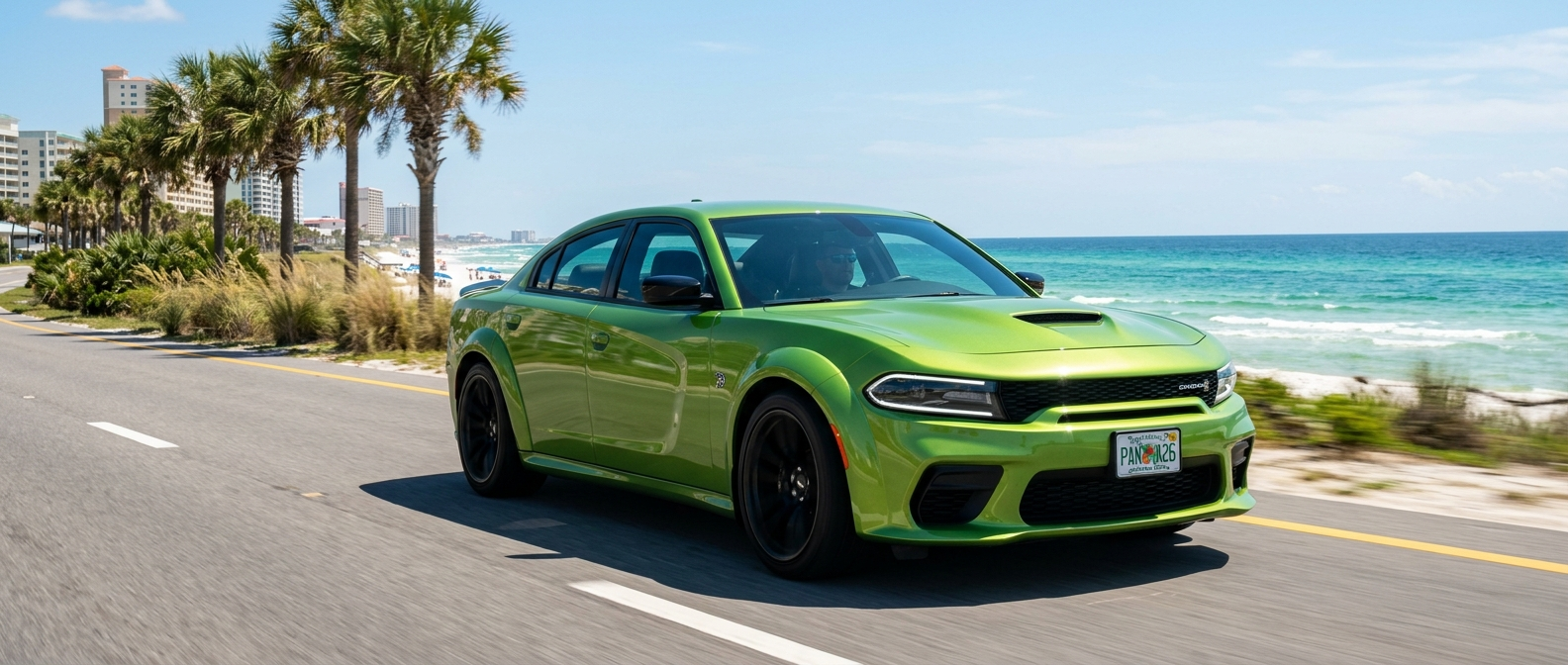
Browse our 2026 Dodge Charger inventory
The horsepower number stops people cold. A six-cylinder Charger. But this isn't a step down from the old Hemi. Instead, it's a genuinely different kind of car, quieter at highway cruise, faster to 60, and now available in a four-door body with AWD standard. The Hyundai Sonata across the comparison aisle is excellent at what it does. So let's be straight about what the choice comes down to for a Panama City driver.
Key Takeaways
- The 2026 Charger Sixpack R/T makes 420 hp with standard AWD; the EPA rates it at 17 city and 26 highway mpg.
- The 2026 Hyundai Sonata SE makes 191 hp; the EPA rates it at 28 city and 38 highway mpg.
- The Charger carries 22.8 cubic feet of trunk space versus the Sonata's 15.6 cubic feet.
- Passenger cabin volume is nearly identical between the two.
- For buyers who want genuine power and stability on the Gulf Coast corridor, the Charger's twin-turbo torque and AWD deliver something the Sonata simply isn't designed to offer.
- If fuel economy is your primary budget lever, the Sonata wins. That's a real tradeoff, and this post doesn't pretend otherwise.
What Do the Specs Actually Mean?
The specs below tell two stories at once, and they're both true: the Charger wins on power and cargo while the Sonata wins on fuel economy, so treat the table (drawn from Dodge and Hyundai spec sheets and cross-checked against EPA fuel economy data) as a starting point rather than a final answer.
| Spec | 2026 Dodge Charger R/T Sixpack | 2026 Hyundai Sonata SE |
|---|---|---|
| Engine | 3.0L Twin-Turbo I6 | 2.5L I4 |
| Horsepower | 420 hp | 191 hp |
| Torque | 468 lb-ft | 181 lb-ft |
| 0-60 mph | Approx. 4.6 sec | Approx. 7.5 sec |
| EPA City / Hwy MPG | 17 / 26 | 28 / 38 |
| Drivetrain | Standard AWD (on-demand RWD) | FWD standard; AWD available |
| Curb Weight | 4,816 lbs | Approx. 3,232 lbs |
| Trunk / Cargo | 22.8 cu ft | 15.6 cu ft |
| EPA Passenger Volume | 103.1 cu ft | 104.4 cu ft |
Passenger room comes out almost dead even. The Charger's bold exterior footprint gives you a cabin that seats five adults comfortably, and the Sonata holds right up there with it. Where they split is cargo and power. The Charger's trunk runs nearly 46 percent larger. Load it with coolers and gear for a weekend at the beach, and you'll feel the difference the first time.
The fuel economy gap is real, and we're not going to smooth it over. EPA rates the Charger R/T at 17 city and 26 highway. On the Sonata SE, EPA puts it at 28 city and 38 highway. The spread matters for anyone running regular stop-and-go miles on US-98 between Panama City and Panama City Beach, especially in summer when the corridor slows to a crawl with tourist traffic.
Where the Charger's Twin-Turbo Actually Earns Its Keep
Explore financing options at Bay Chrysler Dodge Jeep Ram
The twin-turbo earns its keep most in the everyday moments and not on the drag strip, because 468 lb-ft of torque turns into instant response from a standing start, the kind you'll feel merging onto a highway or pulling away from a light in daily Panama City driving. Dodge engineered the 3.0L Sixpack so 88 percent of peak torque is on tap from 2,500 rpm. You'll feel it on the on-ramp onto US-231. You feel it passing a slow-moving RV on the stretch east of town. The Sonata's 181 lb-ft suits its weight class just fine. It simply plays in a different tier of response.
Standard AWD matters here too, and it's not only about wet pavement. The Hathaway Bridge carries US-98. It pulls consistent Gulf Coast crosswinds, and lighter front-wheel-drive sedans handle them with more visible body movement. At 4,816 lbs with AWD and a low center of gravity relative to its mass, the Charger sits planted through the wind in a way that makes a longer drive relaxing instead of demanding.
Get a Value on Your Current Car
Pros and Cons: Charger Sixpack vs. Sonata
| Charger Sixpack Pros | Charger Sixpack Cons |
|---|---|
| 420 hp and standard AWD in a four-door sedan | 17 mpg city is a genuine cost over time |
| 22.8 cu ft trunk; 46% more cargo than the Sonata | 4,816 lb curb weight; not an agile car in tight spaces |
| Dual-zone auto climate control standard | Suspension leans firm on rougher road surfaces |
| On-demand rear-wheel-drive mode for driving character | Entry cost is substantially higher than the Sonata |
| Settled, planted feel on coastal crosswind routes | Full power output benefits from premium fuel |
| Sonata SE Pros | Sonata SE Cons |
|---|---|
| EPA-rated 28/38 mpg; Hybrid Blue reaches 47/56 mpg | 191 hp; passing and merging require more planning |
| Lower fuel spend over a year of Gulf Coast commuting | FWD is base; AWD costs extra |
| Lighter, easier to place in tight downtown parking | 15.6 cu ft trunk is noticeably smaller |
| Refined, quiet daily driver | Less rear-seat headroom than the Charger |
| Available hybrid system cuts stop-and-go fuel cost | It is a practical sedan, not a driver's car |
Who the Charger Actually Fits
Visit Bay Chrysler Dodge Jeep Ram
The Charger isn't the right answer for every buyer who asks about it, and we'll say so up front: if fuel economy and the lowest operating cost over a Panhandle year top your list, the Sonata earns that recommendation, but if you want real power in a genuine sedan, the Charger is built for you. The Sonata Hybrid Blue, which the EPA rates at 47 city and 56 highway, sits in a tier of efficient the Charger can't touch.
The Charger fits a specific buyer. Someone who wants a real sedan and not a crossover, with room for the family and enough power to make the drive feel alive. Someone running from Panama City to Pensacola who wants a car that doesn't fade into background noise. Someone who gets that the 2026 Charger isn't the old car at all. In truth, it's a grand tourer with a new platform, a new engine, and four-door practicality the previous generation never had.
We'll be straight with you. You can't have 420 horsepower and 38 highway miles per gallon in the same car. You pick what matters more.
Weigh the Charger's tradeoff against how you actually drive, and if it sounds right, stop in and let us put you in the seat. Take Thomas Drive out to the Hathaway Bridge, and it'll tell you everything the spec sheet can't.
Frequently Asked Questions
Is the 2026 Dodge Charger comfortable enough for daily driving in Panama City?
Yes, and it's more comfortable than older Charger generations. The 2026 Sixpack platform is built around the new twin-turbo inline-six, which runs quieter under highway cruise than the outgoing Hemi V8. Its four-door body seats five adults with 103.1 cubic feet of EPA-rated passenger volume, and standard dual-zone climate control handles the Gulf Coast's year-round humidity better than a single-zone system. At 4,816 lbs of curb weight, the ride does lean firm, so it's not a luxury sedan. On longer stretches of US-98, though, that mass gives you a stable, planted feel that holds up well over the distance.
How does the 2026 Charger's gas mileage compare to the Hyundai Sonata?
The gap is significant, and it's worth knowing before you decide. EPA rates the 2026 Charger R/T Sixpack at 17 city and 26 highway mpg. The 2026 Hyundai Sonata SE earns 28 city and 38 highway from EPA, which works out to roughly 46 percent more highway efficiency. Go up to the Sonata Hybrid Blue and EPA estimates climb to 47 city and 56 highway. If your daily driving leans heavy on stop-and-go miles in US-98 traffic, that difference adds up month to month. The Charger trades fuel economy for performance, interior space, and AWD stability. Whether that trade is worth it depends entirely on what you need the car to do.