




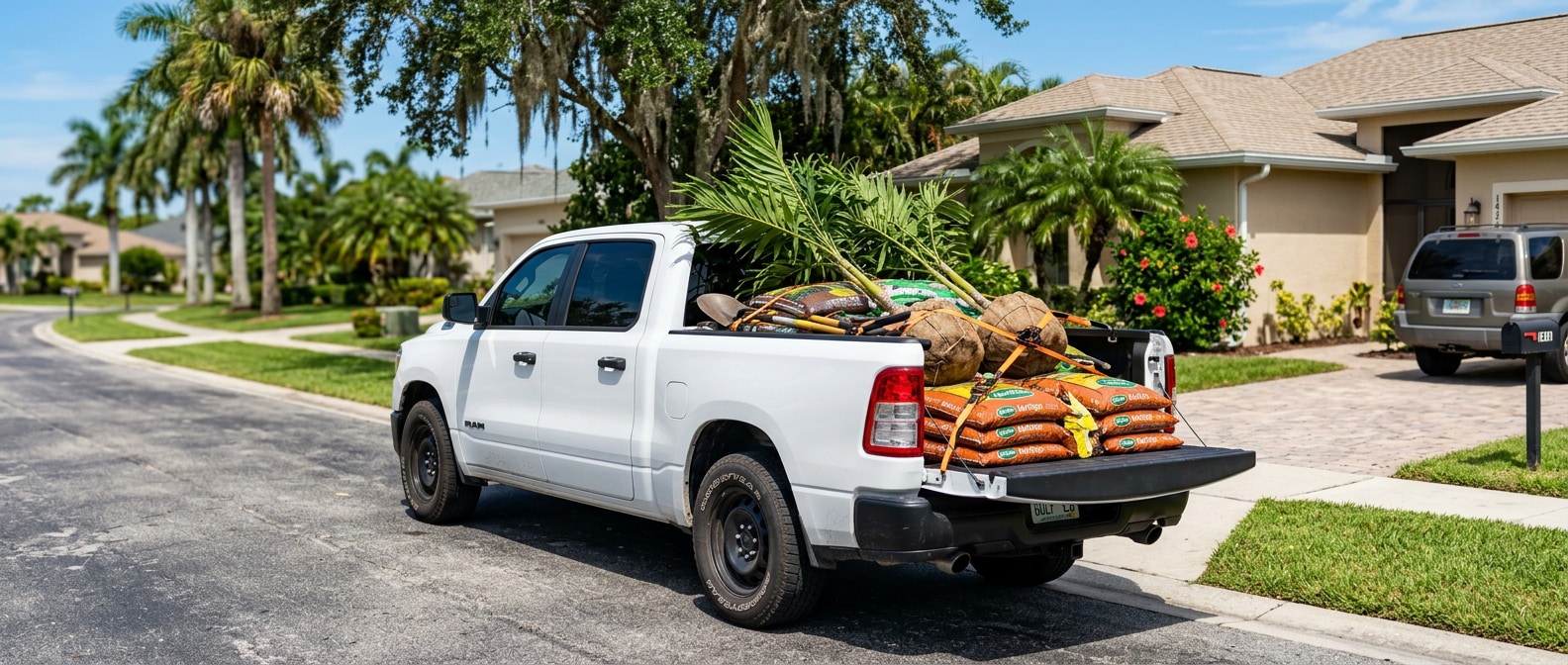
You've got a project. Maybe it's the backyard re-do you've been putting off since the last storm rolled through, or a driveway paver job you finally scheduled for September when the worst of the heat backs off. You looked up "Ram 1500 payload" and the brochure says up to 2,360 pounds. So you're good, right?
Sort of. The 2,360-pound figure covers a specific build (Tradesman or Express, Quad Cab, 4x2, lightest engine). Your truck's actual number lives on the yellow Tire and Loading Information sticker inside your driver-door jamb, and it counts you, anyone riding with you, anything in the bed, and the tongue weight of any trailer you've hooked up. Add options and crew seats, and a typical Crew Cab 1500 lands somewhere between 1,400 and 1,800 pounds of real-world capacity. That's still a lot of mulch. But it's not unlimited.
The 2026 Ram 1500 handles the three most common Bay County project hauls cleanly when you know which load you're dealing with. Two of them fit with room to spare. One of them is a Ram 2500 conversation.
Will It Fit? The Bay County Haul Table
Ram's 6'4" bed measures 76.3 inches long, 66.4 inches wide at the rails, and 21.5 inches deep, according to Ram's published specifications. The usable floor between the wheel wells runs about 51 inches wide, which decides what lays flat and what stacks. Three real Gulf Coast project loads show how the numbers play out below.
| Load | Estimated Weight | Fits the Ram 1500 6'4" Bed? | Notes |
|---|---|---|---|
| 40 bags of mulch (40 lbs each) | ~1,600 lbs | Yes, comfortably | Stack two layers, distribute front to back, close tailgate |
| Half-pallet of 12"x12" concrete pavers (approx. 48 pieces) | ~1,200 lbs | Yes, with margin | Lay flat between wheelwells; 51" floor width accommodates standard paver stacks |
| One cubic yard of wet fill dirt (Bay County sandy loam) | ~2,400-2,700 lbs | Exceeds most 1500 configs | At or past the limit (a Ram 2500 is the right call here) |
| Full 4x8 sheet of plywood or OSB (load of 20 sheets) | ~800 lbs | Yes, with tailgate down | 76.3" bed interior length requires tailgate down for full 8-foot sheet; width clears at 51" floor |
| Post-storm debris run (mixed yard waste, ~half-cord) | ~1,000-1,200 lbs | Yes | Keep load level with rails; mound over 21.5" depth adds wind drag and spill risk |
Payload figures sourced from the 2026 Ram Trucks Payload and Towing Guide. Weight estimates for fill dirt reflect typical wet density of Bay County sandy loam soil. All payload calculations must be confirmed against the specific truck's door-jamb sticker.
How to Load Your Ram for a Gulf Coast Project
Knowing your payload number gets you halfway, but loading that weight correctly is the half that keeps a Panhandle haul safe, because a bed balanced wrong shoves the rear suspension low and lightens the steering right when you need it merging into traffic. Weight distribution matters as much as total weight.
Load the heaviest material forward in the bed, over the rear axle. Shifting weight to the tailgate end throws the rear suspension low and lifts front-wheel traction. In a parking lot that hardly matters. It matters plenty when you're merging onto US-98 with 1,400 pounds of pavers and traffic is moving.
The Ram 2500 is worth knowing about here, because the step up is significant. Ram's 6.4L HEMI V8 in the 2500 is rated at up to 4,580 pounds of payload in a regular cab 4x2 configuration (per Ram's towing and payload guide), close to double the typical 1500 real-world number. If you're running full cubic yards of material on repeat trips, the 2500 earns its keep in fewer runs. The Bay Chrysler Dodge Jeep Ram new inventory carries both, and the door-jamb sticker on each individual truck is your definitive answer before you load anything.
For the landscaping and contractor work that defines a big chunk of Bay County truck use, the Ram 1500 in a Tradesman or Big Horn configuration with the 6'4" bed covers mulch runs, paver loads, and debris hauls cleanly. The Tradesman's lighter curb weight is what preserves the higher payload ceiling.
Step-by-Step: Reading Your Ram's Actual Payload Before the First Haul
Following these steps means you'll never guess at your truck's real number, since the payload figure printed on the door jamb already accounts for your exact cab, drivetrain, and options in a way no brochure can.
- Open the driver's door fully. Look at the inside edge of the door frame near the latch. Find the yellow Tire and Loading Information sticker.
- Locate the combined weight figure. It reads "The combined weight of occupants and cargo should never exceed XXX kg / YYY lbs." That number is your payload in plain English.
- Subtract your body weight (and any passengers riding along). Whatever is left is your bed budget.
- If you're towing anything, subtract 10 percent of the trailer's loaded weight from your remaining budget. That's tongue weight eating into payload.
- Compare that final number against your load estimate. Forty 40-pound bags of mulch is 1,600 pounds. Four hundred 16-inch pavers at roughly 25 pounds each is 1,000 pounds. Wet fill dirt runs about 2,700 pounds per cubic yard.
- Still not sure? Bring your VIN into Bay Chrysler Dodge Jeep Ram at 636 W 15th St and we'll pull the exact config specs in a few minutes. No guesswork.
Job Done: Match the Truck to the Haul
For Bay County work, the 1500 versus 2500 question comes down to how heavy your loads run and how often, with the 1500 covering the bulk of everyday landscaping and project trips while the 2500 takes over once you're routinely past two thousand pounds a run.
The Ram 1500 is the right truck for mulch runs, half-pallet paver loads, yard-waste hauls, and general project trips where you're staying under roughly 1,500 pounds of bed material on a typical Crew Cab build. It rides better empty, fits a standard garage, and the 3.6L V6 eTorque's 2,360-pound ceiling (in the optimal build) gives genuine breathing room for the loads a Bay County project actually calls for.
The genuine downside is real. Add a Crew Cab, 4x4, and a few option packages, and that ceiling drops. A well-equipped Crew Cab 4x4 can land around 1,400 pounds of real capacity. Enough for the landscaping loads above. Not enough for a full yard of wet fill dirt. Know your number. Check the sticker.
If your work involves repeated cubic-yard loads, commercial debris runs, or materials that consistently push past 2,000 pounds per trip, the Ram 2500 with the 6.4L HEMI (rated up to 4,580 lbs payload per Ram's guide) is the truck that earns back its cost in fewer trips and no worrying about the sticker. Bay County's active construction and renovation market is exactly where that call starts to make sense.
Either way, our team can walk you through the door-jamb number on every truck we stock, so you leave knowing exactly what it'll carry, not estimating from a brochure.
By the Bay Chrysler Dodge Jeep Ram Team | September 2026