




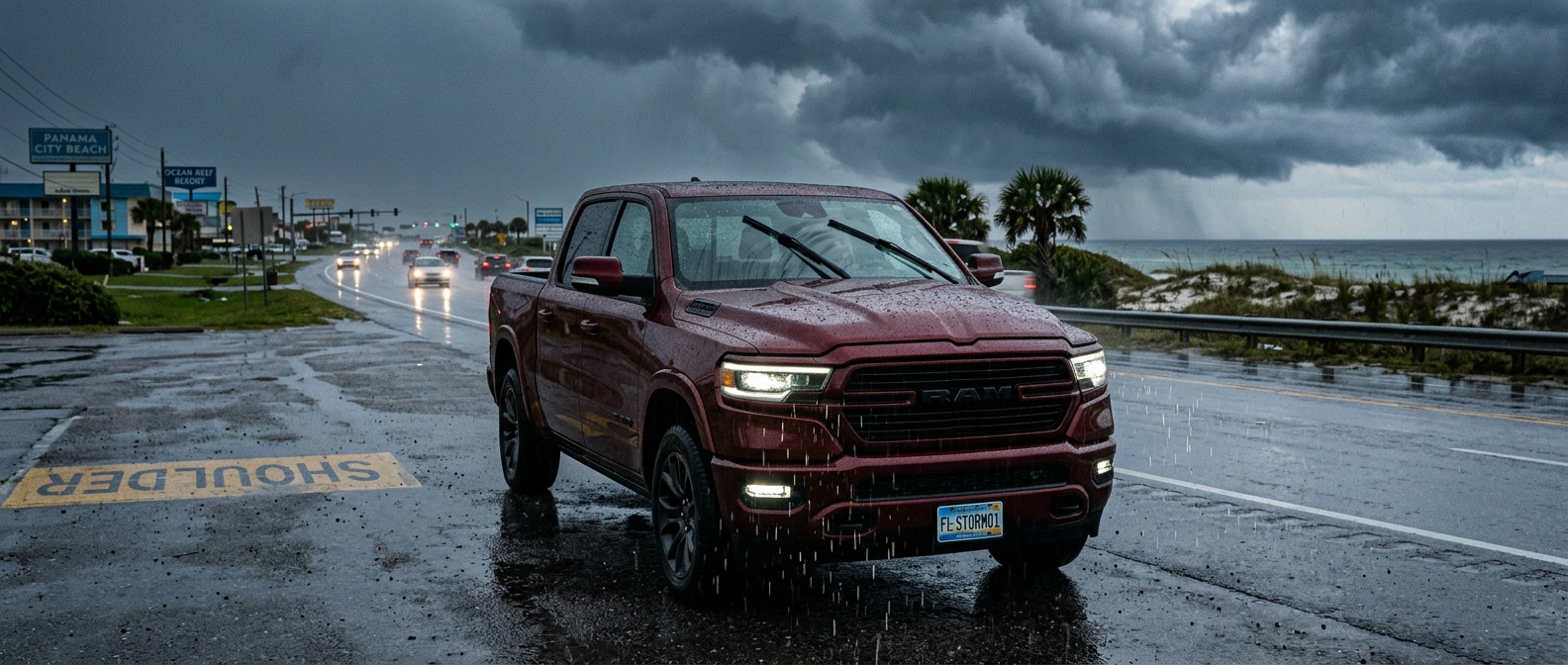
Keeping your windshield clear in a Florida downpour comes down to fresh wiper blades (replaced every six months in Gulf Coast heat), clean glass on both sides, the A/C running with recirculation OFF, and headlights on. That combination handles the three things that actually wreck visibility here: degraded rubber, summer fog, and the legal requirement other guides forget to mention.
Which Wiper Blade Setup Actually Works in Panama City's Rainy Season?
A beam-style blade replaced every six months is the setup that holds up in Panama City's rainy season, and while the constant rain gets the blame, the Gulf Coast sun does most of the damage to the rubber before a single drop ever falls on the glass. Panama City sits on Florida's Gulf Coast. The area averages right around 60 inches of rainfall annually, and June through September is when that number really piles up. August alone can dump 8 to 10 inches on the Panhandle. That kind of workload speeds up blade wear, but the UV does its damage first.
Wiper rubber breaks down from UV and heat even when the blades never move. The compound stiffens and loses the flex it needs to follow your windshield's curve. So by the time you hit a summer squall on US-98, blades that looked fine in the driveway are already smearing or chattering. Most manufacturers call for new wiper blades every 12 months, and service guidance for hot, humid climates like ours pushes that down to every six months.
| Sign of worn blades | What's happening | Fix |
|---|---|---|
| Streaking after a full wipe | Rubber edge dried, hardened, or cracked from UV exposure | Replace blades |
| Squeaking or chattering | Rubber lost flexibility, no longer smoothly contacts glass | Replace blades |
| Smearing (water spreads into a film) | Edge too rounded, or road-oil residue transferred to rubber | Clean glass AND replace blades |
| Skipping (blade jumps across glass) | Blade has taken a permanent curve from sitting in heat | Replace blades |
| Lines left after wipe | Wiper arm bent, or rubber edge has a nick | Check arm, replace blade |
There's a real tradeoff worth naming. Beam-style blades hold up better than conventional frames in our conditions because they've got no exposed metal bracket to corrode and lose contact pressure. They do cost a bit more. On a truck or a family hauler, a set of quality beam blades every six months counts as maintenance, and it's worth it. Cheap conventional blades every three months is the other path, and either one works. The mistake is waiting until you can't see.
Why Does the Windshield Fog Up Even With the A/C Running, and How Do You Clear It Fast?
In a Florida summer that fog usually forms on the OUTSIDE of the glass, which means running the A/C harder only makes it worse, the opposite of what winter driving up north taught you to do. Drivers who move down from the Midwest run into this one first. The mechanism is straightforward. Your A/C cools the cabin and the glass, then humid outside air (and Bay County air in August is very humid) hits that cool outer surface and condenses right there. Push the A/C harder and you just widen the temperature gap.
Fast defog sequence for a summer downpour:
- Turn wipers on. This clears the condensation layer already on the glass and confirms whether you're dealing with exterior or interior fog.
- Switch A/C to FRESH AIR mode (recirculation OFF). This brings drier outside air into the cabin, reducing the temperature gap between the glass and the air outside.
- Aim airflow at the windshield with the fan on medium to high.
- Slightly crack a rear window if fog persists. It lets humid cabin air escape and equalizes pressure.
- If interior fogging is also a factor, run the defroster with heat briefly to draw moisture off the glass surface.
The step that's easy to skip is switching off air recirculation. Recirculation is the culprit. It traps humid cabin air and keeps regenerating the temperature differential that drives exterior fog. So turn it off first.
Schedule a Wiper and Visibility Check
What Else Do Panhandle Drivers Regularly Miss During a Heavy Rainstorm?
Two habits slip past even seasoned Panhandle drivers during a heavy rainstorm, and both cost you visibility, with the first being an actual Florida law about headlights and the second being a washer-fluid choice that quietly wears down how clearly you see. Both are easy to miss when the rain's really coming down.
The headlight law. Under Florida Statute 316.217, headlights are required during any rain, and that includes broad daylight and any level of visibility. Any rain, any time of day. The Florida Driver License Handbook also specifies that headlights must be on when your wipers are running. On plenty of vehicles, daytime running lights aren't the same as headlights, so check that yours are actually on and not just the DRLs. In a heavy Panhandle squall on Back Beach Road, a gray SUV running only DRLs is almost invisible to traffic coming up behind.
Washer fluid matters more than you'd guess. Plain water evaporates and leaves mineral deposits that streak the glass and degrade wiper rubber. A quality washer fluid with water-beading technology keeps the glass cleaner between wipes and helps the blades glide. Down here on the Gulf Coast, a formula that also cuts bug residue earns its keep. Bug splatter plus summer rain makes a smearing film that worn wipers can't clear on their own.
Skip the technique talk for a moment, because none of it fixes a windshield with a pitted or hazy surface. UV-induced haze (often called "windshield crazing") scatters light from oncoming headlights and makes night-rain visibility genuinely tough. If the glass looks milky or throws a big halo around lights, you've got a glass-condition issue, not a wiper problem.
FAQ
How often should I replace wiper blades in Florida?
Every six months is the realistic interval for Gulf Coast Florida drivers. Most manufacturers specify 12 months, but that guideline is for temperate climates. Panama City's combination of intense UV exposure, heat, and heavy summer rainfall degrades the rubber compound faster than the national average. If blades are streaking, chattering, or smearing rather than clearing cleanly, replace them regardless of age.
Does Florida law require headlights to be on in the rain?
Yes. Under Florida Statute 316.217, headlights are required during any rain, including daylight hours. The Florida Driver License Handbook also states that headlights should be on whenever wipers are in use, including on the intermittent setting. Daytime running lights don't satisfy this requirement on all vehicles. When your wipers go on, your headlights go on.
Why does my windshield fog up in the rain when the A/C is already running?
In Gulf Coast summer conditions, windshield fog typically forms on the OUTSIDE of the glass. Your A/C cools the interior and the windshield surface; humid outside air contacts that cooler glass and condenses. Running the A/C harder makes the temperature gap larger and the fogging worse. The fix is to switch off air recirculation (fresh air mode), aim airflow at the windshield, and consider cracking a rear window slightly to equalize cabin and outside humidity.
By the Bay Chrysler Dodge Jeep Ram Team | September 2026