




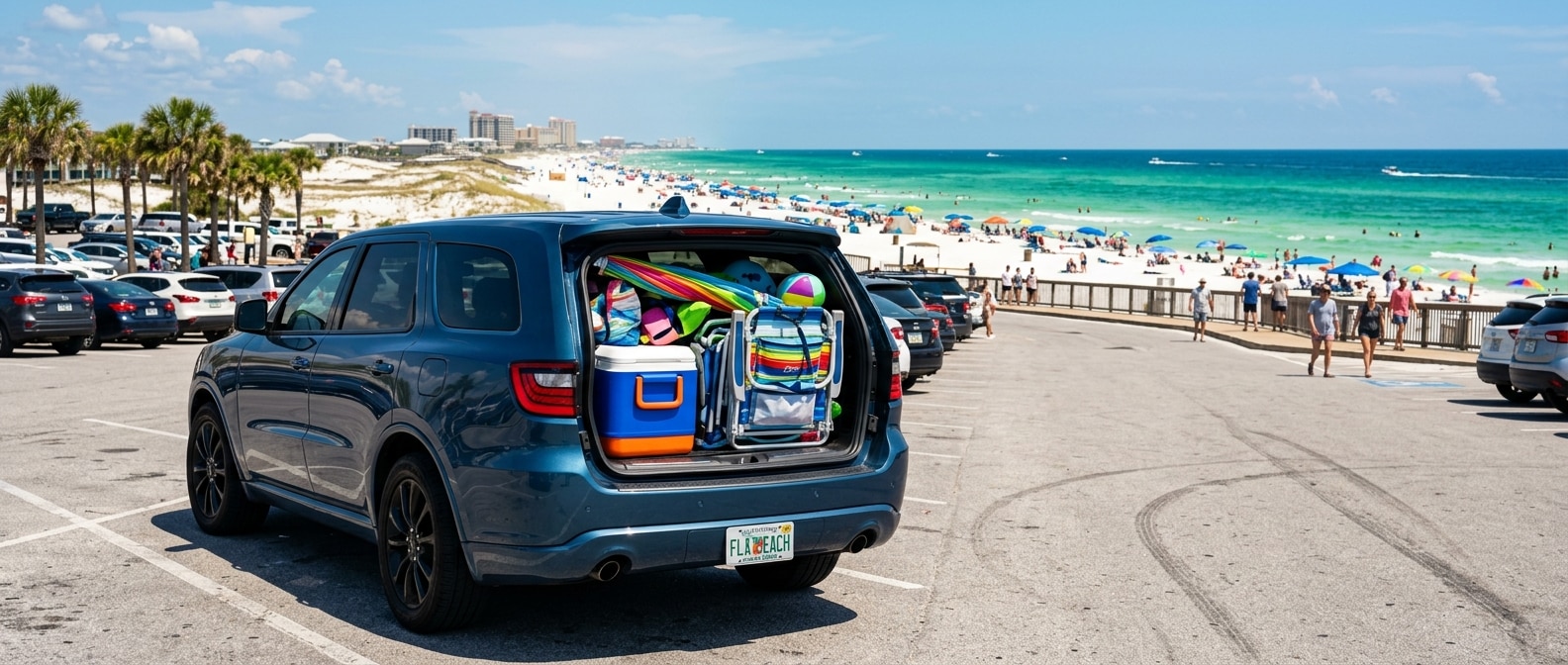
US-98 westbound into Destin on a summer Friday will slow you down for the better part of the last fifteen miles. You already knew that. What catches families off guard is arriving at a crowded beach access lot and realizing the Durango is packed in the wrong order. Somebody has to climb out, move a bag, re-fold a row, and do it in ninety-degree heat with a parking attendant waiting. The fix is picking your seat-and-cargo split at home, in your driveway, before the trip starts. We'll walk you through it here.
What You Need Before You Start
Check the Durango's specs against your actual family load before you pack a thing. Run the short list below. It takes about five minutes and saves you the driveway reshuffle later.
| Item | Spec / Check |
|---|---|
| Third-row legroom | 33.5 inches (fine for under-5'6" kids, tight for adults) |
| Cargo behind third row | 17.2 cubic feet |
| Cargo behind second row | 43.3 cubic feet |
| Maximum cargo (all seats folded) | 85.1 cubic feet |
| Fuel tank capacity | 24.6 gallons |
| V6 EPA highway rating | 25 mpg (RWD) / 24 mpg (AWD) |
| V8 5.7L EPA highway rating | 21 mpg (AWD) |
| US-98 drive: Panama City to Destin | Approx. 56 miles westbound |
| Beach access bags that survive sand | Mesh or hard-shell only (fabric absorbs) |
| Roof cargo carrier (if using) | Check Durango roof load rating in owner's manual |
Gather that load the night before, and stack it in the garage in the order you'll unpack at the beach. Your stack becomes the packing order in the Durango.
Configuring Seats and Cargo for the Emerald Coast
Configuring the seats comes down to one honest call, seats or cargo, and the decision is simpler than it looks once you count heads first. Three real scenarios cover nearly every family heading toward Destin or Fort Walton Beach, and picking yours at home keeps you out of a hot parking lot doing math.
Step 1: Count your passengers and be honest about the third row.
The Durango seats seven, and third-row legroom measures 33.5 inches. Kids up to about middle school age ride fine back there. A full-grown adult will feel the pinch on a 56-mile run. If your group is two adults and two kids, use the second row only and leave the third row folded. You gain 43.3 cubic feet for gear and keep everyone comfortable through Freeport and Santa Rosa Beach.
Step 2: Load the third row only if it makes sense for your headcount.
Traveling with three kids or joining grandparents? The third row earns its keep. Fold it flat only when cargo genuinely outranks that seat. Try to split it both ways and someone ends up perched on a soft cooler. Don't do that. Pick one, seat or cargo zone.
Step 3: Use the 17.2-cubic-foot cargo area strategically.
With the third row up, that 17.2-cubic-foot space behind it is your "grab zone" for the beach. Load it with the items you'll reach for first. Towels in a mesh bag on top, sunscreen bag, water bottles, flip-flops. The Henderson Beach State Park lot in Destin has almost no shade, so you want in-and-out speed. Cooler goes here too, lengthwise if it's a 50-quart, standing upright if it's a smaller 24-can size, whichever one you packed.
Step 4: Stack soft bags in the second-row footwells when all seven seats are occupied.
Seven bodies plus a full beach load is tight. The Durango's second-row footwells are deep. Flat soft bags (dry bags, mesh beach totes) slide under second-row seats easily. Hard-shell items don't. Keep those in the cargo zone only.
Step 5: Secure loose items before you hit US-98.
US-98 westbound through Panama City Beach runs at normal highway pace until you clear the tourist corridor. After that, the stop-and-go patches between Santa Rosa Beach and Destin get genuinely unpredictable in summer. Anything that can roll forward in a braking event needs to be wedged or netted. There are cargo anchor points in the floor of the load area, so use them.
Step 6: Decide your fuel stop before you go.
The V6 Durango earns an EPA-rated 25 mpg on the highway in RWD configuration. The 5.7L HEMI V8 drops to 21 mpg highway. On a 56-mile one-way trip, the difference is a few miles of range, not a range crisis. But factor in that US-98 traffic will cut your real-world mileage below the highway rating on the outbound leg. If you're running the V8, plan a fuel stop in Panama City Beach on the way rather than in Destin, where the stations near the harbor area can back up in peak season.
One Honest Tradeoff: Fuel Economy vs Capability on This Corridor
For this corridor, the V6 is the sensible engine on a plain beach day. The V8 pays off the moment you add a trailer, so match the powertrain to the trip you actually take. The V6 Durango (18 city / 25 highway, EPA-rated) costs noticeably less to run on this kind of round-trip than the 5.7L HEMI V8 (14 city / 21 highway). The gap is real, and it adds up across a summer of Destin weekends. The V8 earns its keep if you're towing a boat to Destin Harbor or running a heavier camper to Grayton Beach State Park. For a pure beach-day family load, the V6 makes the most sense, and we won't pretend otherwise.
What the V8 does give you is effortless merge power on the US-98 ramp from the bypass, a different sound at highway cruise, and genuine towing headroom if your needs change. The choice should match how you'll actually use it.
Schedule a Pre-Trip Service Inspection
Your Print-and-Go Packing Recap
Snap a photo of this list before you back out of the driveway, because it captures the whole load order in one screen. The sequence below is what works for the Panhandle run, from staging the night before to your last fuel stop.
- Night before: Stage all gear in the garage in unpack order (what you grab first at the beach goes in last)
- Morning of: Fuel to full if running the V8; check tire pressure (heat on asphalt expands air, but the bigger concern is starting underinflated on a hot day)
- Load order: Cooler in first (against rear seat back, upright), hard-shell items next, soft bags last
- Third-row decision: Made before you start loading, not after
- Grab zone: 17.2 cubic feet behind the third row is your beach access bag area only
- Second-row footwells: Flat soft bags only; no hard items under seats
- Cargo anchors: Hook in anything that can shift during a braking event on US-98
- Fuel stop: Panama City Beach outbound, not Destin
Browse our current Durango inventory at Bay Chrysler Dodge Jeep Ram.
Want help matching the right Durango spec to your family's Gulf Coast trips? Our team at Bay Chrysler Dodge Jeep Ram in Panama City will walk you through the seat configuration options and available trim levels in person.
By the Bay Chrysler Dodge Jeep Ram Team | September 2026
Frequently Asked Questions
What is the cargo space in a 2026 Dodge Durango with the third row up?
With the third row in use, the 2026 Dodge Durango offers 17.2 cubic feet of cargo space behind that seat. Fold the third row flat and that grows to 43.3 cubic feet. Fold all rear seats and you reach 85.1 cubic feet.
Is the third row of the Durango comfortable for a long drive to Destin?
The 2026 Durango's third row measures 33.5 inches of legroom. That's a workable space for kids and shorter teens but a tight fit for adult passengers on a 56-mile drive. If your group includes adults in row three, seriously consider whether the cargo trade-off is worth it.