




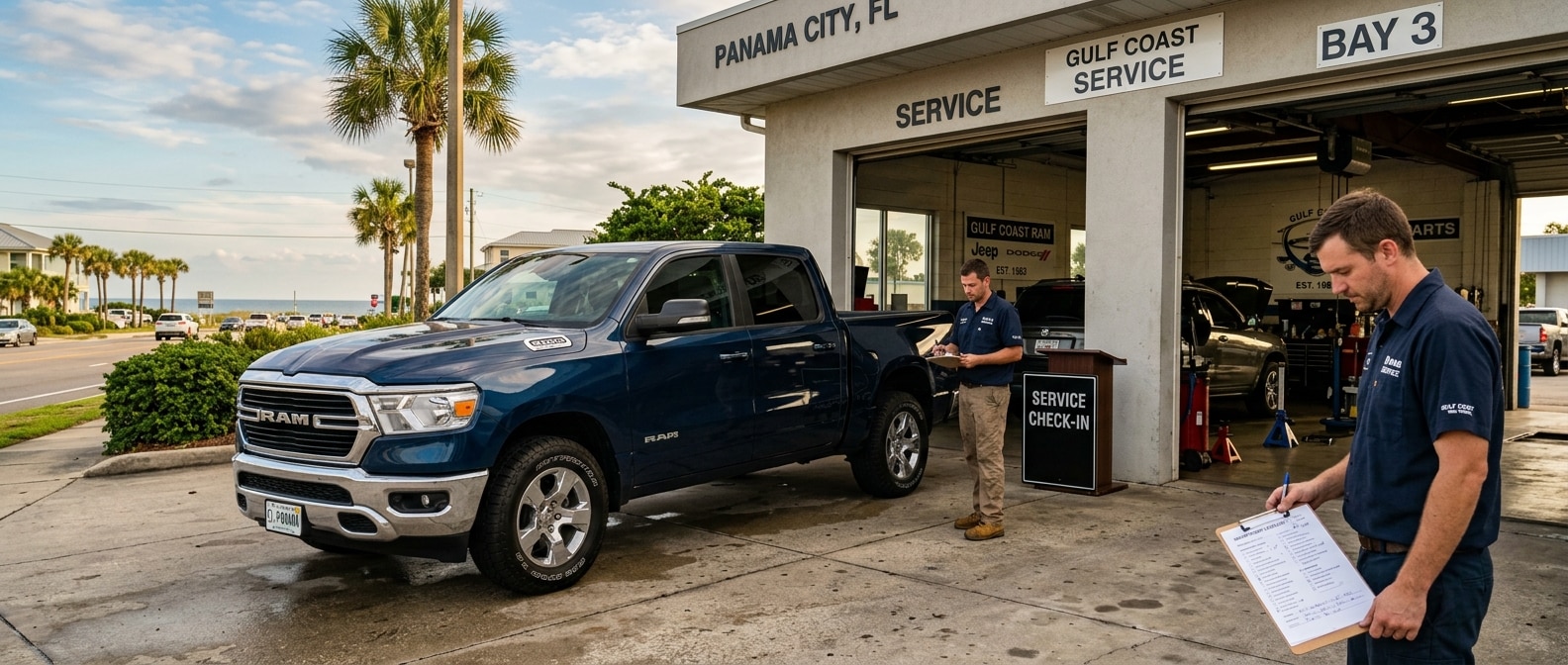
Down here on the Gulf Coast, a vehicle's maintenance history is more than a nice line on a window sticker. It's the single most verifiable thing you can hand an appraiser when you're ready to trade up. Generic maintenance advice tends to skip the part that matters most here, which is that Panama City's environment makes the maintenance-to-resale connection more direct and more measurable than almost anywhere inland.
Salt air drifts miles inland from the Gulf year-round. UV radiation in Bay County ranks among the most intense of any market in the continental U.S. Add Florida's relentless cycle of afternoon downpours followed by baking sun, and you've got conditions that speed up every form of cosmetic and mechanical wear. An appraiser looking at two otherwise identical trucks knows it. The one with documented, on-schedule service tells a clean story. Without it, a truck gets a conservative estimate, because the appraiser assumes the worst about everything they can't see.
The Ram 1500 is the right place to start, and it anchors the whole picture in this market.
What Do You Actually Get at Each Maintenance Tier?
Documented service isn't one line item but a stack of individual jobs, and each one either protects value or quietly erodes it, which is why the three ownership approaches below land so differently with a used-vehicle appraiser here. Read the tiers as signals, not chores. Every entry either builds the paper trail or leaves a hole in it.
| Maintenance Tier | What You're Actually Doing | What It Tells an Appraiser | Who It's For |
|---|---|---|---|
| On-schedule, documented | Oil and filter changes within Ram's condition-based indicator window (never past 10,000 miles or 12 months), tire rotations, brake inspections, battery checks at every service | Clear paper trail; conservative appraisal assumptions are replaced by evidence | Owners planning to trade within 3-5 years or finance the next purchase |
| Partial/sporadic, some records | Occasional oil changes, some documented, some not; no consistent service file | Appraiser fills gaps with worst-case assumptions; documented items carry partial credit only | Owners who intend to keep indefinitely but may change their mind |
| Neglected, no records | No folder, no receipts, no dealer history; may have zero-dollar chain-lube oil changes with no verification | Vehicle treated as unknown condition; spread between documented and undocumented wholesale value is consistently 3-7% | Owners focused purely on short-term cost, unaware of cumulative resale impact |
That 3-7% spread at the wholesale level is the number that's easy to underestimate, and it isn't theoretical. It's the difference between an appraiser lowering the offer because they're assuming a brake job and a set of tires are coming, versus knowing those items were already handled on schedule.
Why Panama City Makes This Gap Bigger Than in Other Markets
Panama City widens the gap because the coastal climate attacks a vehicle on several fronts at once, and while any market rewards documented care, this one punishes the lack of it faster and more visibly than an inland town ever would. The piece generic articles skip is worth sitting with.
Gulf Coast UV is aggressive. UV rays and heat go after a vehicle's clear coat, rubber trim, door seals, headlights, dashboard, and plastic panels. A vehicle parked outside in Bay County without documented preventive care ages visibly faster than the same model that's kept up in an inland Florida city. An appraiser can spot oxidized paint and brittle seals from across a lot.
Salt air is more than a paint problem. Sodium chloride carried in Gulf breezes dissolves into an active corrosive film when the humidity climbs. The film attacks the clear coat first, then bare metal, then electrical connections, then anything underneath with imperfect protection. An underdocumented vehicle here raises questions about the undercarriage and suspension that the same vehicle in, say, Atlanta simply wouldn't face.
The rain pattern matters too:
- A quick hard rain in September followed by morning sun concentrates any leftover salt and minerals into water spots that etch clear coat over time.
- When your service records show consistent wash and protection intervals alongside your mechanical service, that pattern shows up in the car's appearance at trade-in.
- This cycle speeds up cosmetic wear far faster than inland environments see.
The Jeep Grand Cherokee holds its value well in truck-and-SUV markets like Bay County, but only when the service history tells a coherent story. The 2026 Grand Cherokee added a new 2.0-liter Hurricane turbocharged inline-four (rated at 324 horsepower) that pairs greater output with the complexity of a turbo system. Turbo systems that haven't been kept on schedule are among the first things an inspection flags.
Staying current on service visits is the practical way to build that paper trail, and to catch undercarriage or seal issues in Panama City's environment before they turn into line items on an appraisal deduction sheet.
The Smart Move Before You Trade: Time Your Service, Keep Your Records
The most underrated move before a trade is to schedule a full service visit and arrive with every receipt you own, and it works not because a dealer doubts your word but because the appraisal process is systematic and documentation strips out the guesswork that'd otherwise drive conservative numbers.
A vehicle presented for trade-in or sale shortly after a documented oil change, tire rotation, and brake inspection signals readiness, and it removes one of the clearest levers a buyer or appraiser has. When they can see the brakes are fresh, the tires are current, and the oil was changed within the interval, there's no reasonable argument for a deduction on those items. The math is simple.
For Ram and Jeep owners in the Gulf Coast market, we'd add one thing. Keep anything tied to undercarriage care, seal conditioning, or paint protection in that same folder. Those records are specific to coastal environments and carry real weight here in a way they wouldn't in a landlocked market. The folder earns its keep here.
Browse what well-maintained local trucks and SUVs look like in our pre-owned inventory to see exactly what a complete service history does for vehicle presentation.
Schedule Your Service Appointment
Is Maintenance Record-Keeping Worth the Effort for Trucks You Plan to Keep?
Yes, and the payoff runs past resale into something you feel every day, which is the plain confidence of knowing exactly what's been done and when. Records help at trade-in, sure, but on a truck you keep, they mostly buy you fewer surprises.
A Ram 1500 or Jeep Grand Cherokee maintained to factory intervals routinely reaches high mileage without major unplanned repairs. Skipping oil changes does two kinds of damage. It lowers resale value, and it speeds the wear on the exact components that make trucks expensive to fix. The 5.7-liter HEMI V8 in particular, with its multi-displacement system, depends on high-quality, in-spec oil to cycle its lifters correctly. A conservative oil change interval isn't overcautious on the Gulf Coast; it's appropriate for the severe operating conditions that high heat, high humidity, and frequent towing all add up to.
The tradeoff is real. Documented maintenance takes time and money to build, and the payoff shows up at trade-in, at private sale, and in the lower odds of unplanned repair costs during ownership. If you plan to keep the truck for ten years, the records matter less at resale and more for your own peace of mind. Every gap in that folder is a potential deduction if you're thinking about trading in the next two or three years.
Our financing team works with buyers who bring in well-maintained vehicles, and they're often genuinely surprised at how the process smooths out when the service history is clean.
Frequently Asked Questions
Does a vehicle history report show my maintenance records?
A vehicle history report shows ownership changes, title events, accident reports, and odometer readings, but it won't automatically capture every oil change or tire rotation. Dealership and manufacturer service records can be linked to a VIN, which is one reason it helps to have your service performed at a dealership or to use a service that tracks digital records by VIN. Private garage visits with no invoice trail simply don't appear. For a Panama City buyer sizing up your truck, the physical folder of receipts often persuades more than the vehicle history report alone, because it fills the gaps the report can't.
How does Panama City's climate make maintenance more urgent than in other Florida cities?
Bay County's coastal position means vehicles here face salt air year-round, and it isn't just a seasonal thing. UV exposure in the Florida Panhandle runs intense, and the afternoon rain-then-bake cycle degrades paint and seals faster than it does on vehicles parked inland. So the gap between a maintained and a neglected vehicle turns visible sooner here than in central Florida, and appraisers working this market know what deferred Gulf Coast maintenance looks like.