


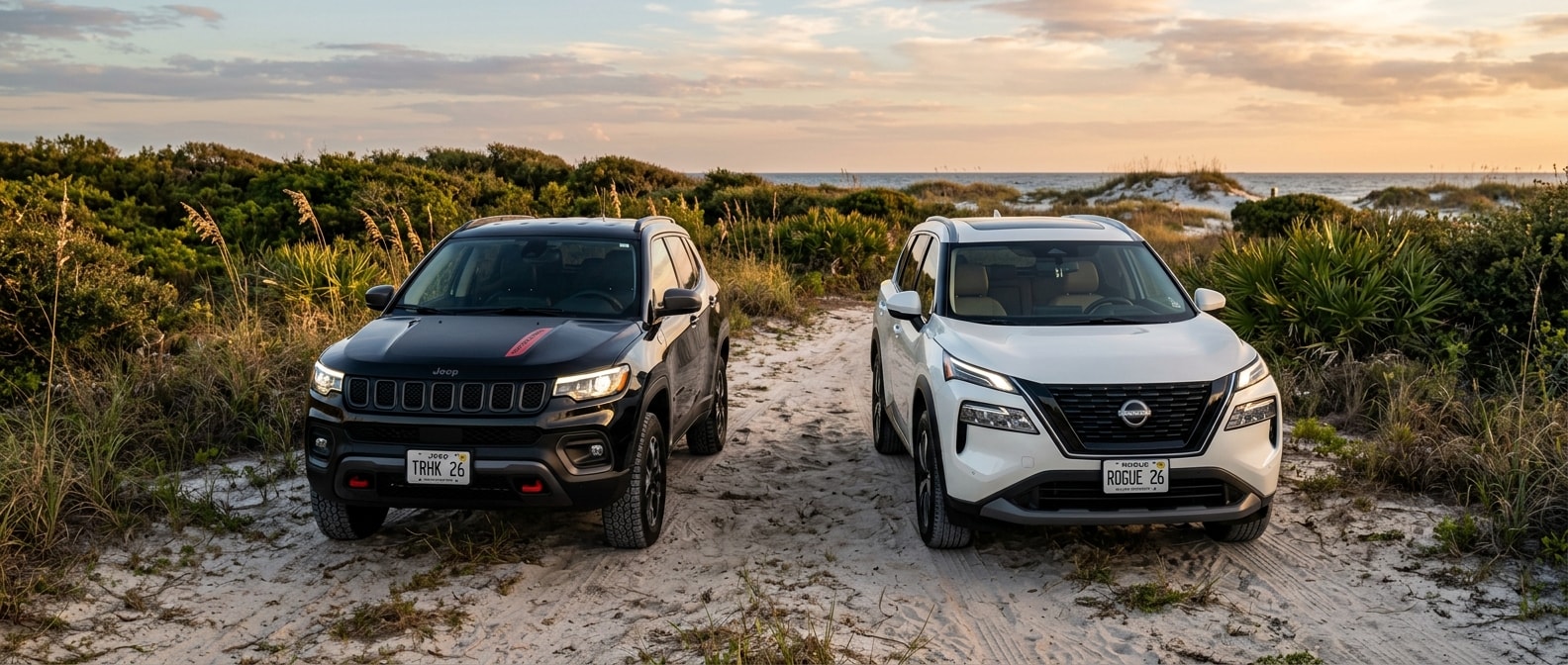
Drive US-98 every day, dodge the occasional flooded intersection after a Gulf squall, or just want a compact SUV that earns its keep on real Florida Panhandle roads? We can give you a clear answer. The 2026 Nissan Rogue wins on cargo, fuel economy, and NHTSA crash scores. The 2026 Jeep Compass wins on standard all-wheel drive across every trim, genuine water-fording capability, and real off-road credentials. Which advantage you need comes down to how you actually use the thing.
- The Rogue's case: 29/36 mpg city/highway (EPA), 36.5 cubic feet of cargo behind the rear seats, 5-star NHTSA overall rating, and a quieter cabin for long-haul family drives.
- The Compass's case: AWD is standard on every single trim (the Rogue charges extra for it on most); the Trailhawk fords up to 19 inches of standing water and carries a Trail Rated badge from Jeep.
- The deciding factor for Bay County: if you ever pull off onto soft sand, use beach access points, or drive through standing water after a storm, the Compass Trailhawk is the only one here built for it. If your life is school runs, US-98 commutes, and Costco hauls, the Rogue's cargo bay and fuel economy are hard to argue with.
- Our team's honest read: the Compass costs you roughly 6 mpg combined and about 9 cubic feet of everyday cargo versus the Rogue. That tradeoff is worth it for some buyers and irrelevant for others.
What's the Real Difference Between These Two?
Both SUVs sit in the same compact crossover class, price close to each other at comparable trims, and seat five, so at a glance they look interchangeable, yet the way each one handles traction, cargo, and standing water splits them hard once you get past the badge. The similarities stop there.
| Spec | 2026 Jeep Compass | 2026 Nissan Rogue |
|---|---|---|
| Engine | 2.0L turbo I4, 200 hp | 1.5L VC-Turbo I3, 201 hp |
| Torque | 221 lb-ft | 225 lb-ft |
| Transmission | 8-speed automatic | Xtronic CVT |
| AWD | Standard on all trims | Optional (standard only on Rock Creek/Platinum) |
| EPA Combined (base) | 26 mpg | 32 mpg |
| EPA Highway | 31 mpg | 36 mpg |
| Cargo (seats up) | 27.2 cu ft | 36.5 cu ft |
| Cargo (seats flat) | 59.8 cu ft | 74.1 cu ft |
| Ground Clearance (Trailhawk) | 8.6 in | 8.2 in (all trims) |
| Max Towing | 2,000 lbs | 1,500 lbs |
| NHTSA Overall | 4-star | 5-star |
| Water Fording | 19 in (Trailhawk) / 16 in (4x4) | Not rated |
The fuel economy gap is real and worth naming plainly. The EPA rates the Rogue at 29 city and 36 highway mpg (FWD), against 23 city and 31 highway mpg for the Compass. Call it a 6-mpg combined gap. Over 15,000 miles a year, that shows up at the pump. The Rogue wins this category, and it isn't close.
Cargo splits them just as hard. The Rogue's rear area measures 36.5 cubic feet behind the rear seats, while the Compass manages 27.2 cubic feet in the same setup. Fold everything flat and the gap holds, 74.1 cubic feet for the Rogue against 59.8 for the Compass. Hauling beach gear, luggage, or a stroller every day, you'll feel those missing cubic feet.
Does It Actually Matter Which AWD System You Get?
For Bay County roads, yes, the AWD system you choose changes what the SUV can actually do, because the Compass ships 4x4 on every trim while the Rogue treats it as an upgrade on most, and only one of the two is built to shrug off standing water after a Panhandle squall. Here the comparison gets specific rather than generic.
The Compass comes with 4x4 on every trim, including the base Latitude. On the Trailhawk, that system steps up to Jeep Active Drive Low with a 20:1 crawl ratio, Hill Descent Control, and four skid plates protecting the suspension, fuel tank, and driveline. Jeep rates the Trailhawk for 19 inches of water fording. Standard 4x4 Compass models handle 16 inches. Those are the specs from Jeep's own capability pages.
Around here, water after a hard rain pools fast at the low intersections off US-98, and depth is tough to judge from the driver's seat until you're already sitting in it. Give yourself margin before you commit the bumper.
The Rogue's Intelligent AWD is plenty capable for rain, light mud, and slippery pavement. It reads wheel slip and shifts torque rearward on its own, and the Rock Creek trim adds an Off-Road drive mode. But Nissan doesn't publish a water-fording depth for it, and the system is built for traction enhancement rather than trail use. The Rogue's 8.2 inches of ground clearance suits high curbs and rough pavement. It falls short of St. Andrews Bay-area beach sand or a flooded back road off US-98.
The honest tradeoff runs like this. If you need AWD for rain and never plan to go where a standard crossover can't follow, the Rogue's system is more than adequate, and you'll pocket the better fuel economy. Want to run coastal dune access roads around the Panhandle, or just want the peace of mind of a 4x4 that's been Trail Rated and water-tested? The Compass earns that credential in a way the Rogue can't match.
Browse our current Jeep Compass inventory to see which trims are on the lot right now.
Cargo, Comfort, and the Family Hauler Test
The Rogue is the better family hauler by a clear margin, since the Nissan's Divide-N-Hide cargo system gives the rear area six configurable layouts, and the low load floor and wide liftgate make loading bulky items noticeably easier, even if none of that helps the day you actually need to ford water. Full stop on the cargo question.
You get 74.1 cubic feet of maximum cargo with the rear seats folded flat. A meaningful advantage for families hauling beach gear between Panama City and their destination, or parents doing a dorm run down I-10.
The Compass's 59.8 cubic feet is still usable, but the shorter length (173.4 inches vs. the Rogue's 183.0 inches) shows up in back-seat space for taller passengers too. The Compass has 38.3 inches of second-row legroom to the Rogue's 38.5. Neither figure jumps off the page, though the Rogue's wider, longer cabin gives rear-seat passengers (taller teens especially) a more relaxed feel on longer drives.
Inside, the Compass cabin runs tighter and sportier by design. Fine if you're using this as your personal daily driver around town. Worth a thought if you're routinely running three kids and their gear through the summer traffic that stacks up on Front Beach Road every July and August.
The Compass delivers something quietly at the Trailhawk level. Its Convenience Group is now standard on the 2026 trim, where it used to be a paid option. Remote start, a heated steering wheel, heated front seats, and a power-adjustable driver's seat all come included. Real added value the 2026 model year brought.
See Current Compass and Rogue Alternatives on Our Lot
So Which One Should You Pick?
Which one you should pick depends on whether you weight capability or practicality, and we can map that to real buyer profiles in Bay County, because the Compass and Rogue each win decisively for a different kind of driver rather than splitting the difference.
Pick the 2026 Jeep Compass Trailhawk if: you use beach access roads, you drive back roads in the Tyndall Air Force Base corridor where flooding after heavy rain is a real condition, you want every trim to include 4x4 without an upcharge, or you want to tow a small trailer or personal watercraft (the Compass is rated for 2,000 lbs versus the Rogue's 1,500 lbs). The Trailhawk's Trail Rated badge is not a marketing graphic. It stands for standardized testing across five off-road categories, including a 19-inch water-fording depth that matters on the Gulf Coast.
Pick the 2026 Nissan Rogue if: you're putting a lot of miles on US-98 and want to spend less at the pump (32 mpg combined versus 26 for the Compass), you regularly carry a full load of passengers and gear, you want Nissan's 5-star NHTSA overall score, or the Rogue's Divide-N-Hide cargo flexibility matches how you actually use an SUV on a daily basis. The Rogue is the better all-rounder for buyers who don't need the Compass's off-road hardware.
The honest catch on the Compass: the IIHS flagged a "Poor" rating in its updated moderate overlap front test. A real data point, not a nitpick. If crash-test scores are a primary factor for your family, the Rogue's cleaner safety record tips the scale.
The honest catch on the Rogue: on most trims, AWD costs extra. If you spec a base Rogue FWD in a market where summer thunderstorms drop several inches of rain in an hour, you're leaning on front-wheel drive and standard traction control. The Compass never puts you in that position.
Both are solid SUVs in their own lane. The Compass is the one for buyers with a specific need for capability. The Rogue is the one for buyers who want the most practical, efficient, and cargo-friendly compact SUV at this price. We carry the Jeep Compass on our lot, and our team is happy to put you in a Trailhawk and let the specs speak for themselves.
Frequently Asked Questions
Does the 2026 Jeep Compass have better off-road capability than the Nissan Rogue?
Yes, by a significant margin on the Trailhawk trim. The 2026 Jeep Compass Trailhawk carries Jeep's Trail Rated certification and comes equipped with Jeep Active Drive Low (featuring a 20:1 crawl ratio), Hill Descent Control, four skid plates, all-terrain tires, and a water-fording depth of 19 inches. Standard Compass 4x4 models ford up to 16 inches of water. The Nissan Rogue's Intelligent AWD is designed for pavement grip and light traction loss in rain or snow; Nissan does not publish a water-fording rating for it, and its 8.2 inches of ground clearance is aimed at road use rather than trail use. For Gulf Coast buyers who use beach access roads or drive through standing water after storms, the Compass Trailhawk is the substantively more capable vehicle.
Which gets better gas mileage, the 2026 Compass or the 2026 Rogue?
The Rogue wins clearly on fuel economy. The EPA rates the 2026 Nissan Rogue at 29 city and 36 highway mpg (FWD trims), with AWD versions at 28 city and 35 highway. The 2026 Jeep Compass earns an EPA rating of 23 city and 31 highway mpg across all trims. That's a 6-mpg combined gap in favor of the Rogue. For a driver putting 15,000 miles a year on a vehicle, the difference is meaningful. The Compass's standard 4x4 system, larger fuel tank, and genuine off-road hardware are part of why it uses more fuel. If fuel economy is your primary concern, the Rogue is the straightforward choice.