




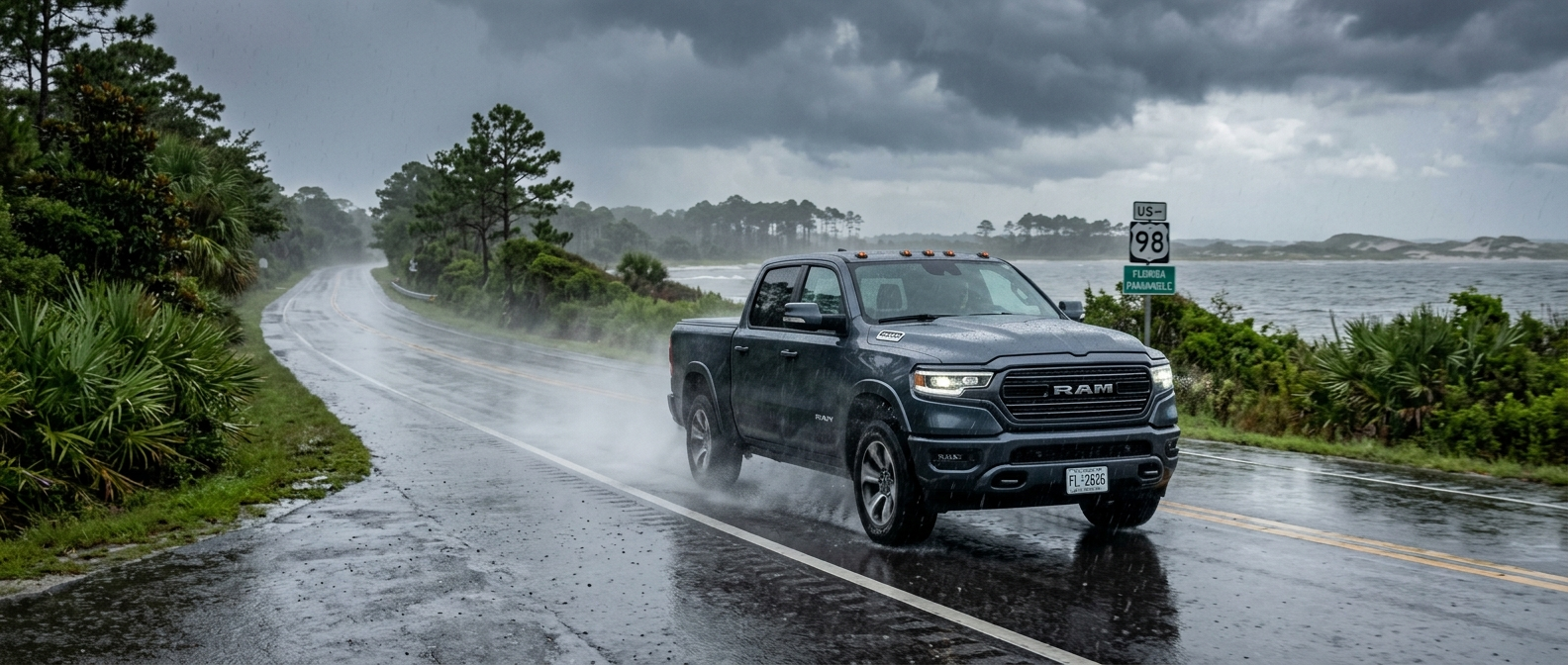
Hydroplaning on US-98 doesn't warn you. The road looks fine, the rain is ordinary, and then your steering goes light and you're floating. Tread depth decides whether your tires channel water or ride on top of it, and speed decides when the water wins. Both are yours to control. Get those two right and the storm loses most of its leverage.
- Replace tires at 4/32" of tread depth if you drive Bay County roads regularly in summer. The legal minimum of 2/32" isn't the safety threshold.
- AAA testing at 60 mph found that 4/32" tires required an average of 87 additional feet to stop on wet pavement compared to new tires.
- Keep tire pressure at the vehicle manufacturer's specification (not the max printed on the tire sidewall). Underinflation reduces the groove's ability to channel water out from under the contact patch.
- On standing water, dynamic hydroplaning can begin at speeds as low as 35 mph with worn tires. The speed limit on US-98 isn't your wet-pavement target.
- Tires with a higher void ratio (more groove volume) drain water faster and push the hydroplaning onset speed higher. Match the tire category to how wet your roads actually get.
Where you start depends on where you are right now. If your tires are already a question mark, jump to the decision table below. If you'd rather understand *why* the numbers behave the way they do on Panhandle roads, read straight through.
The Jeep Grand Cherokee is one of the vehicles we see most on US-98, and tire choice for a heavier SUV carries more weight than it first appears. Extra vehicle weight amplifies the consequences of low tread depth on standing water.
What Actually Determines Whether Your Tire Hydroplanes?
Whether a tire hydroplanes comes down to four variables, tread depth, speed, water depth, and tire pressure, and three of those four sit under your control right now while only the pooled water on US-98 is out of your hands.
| Variable | What It Does | Bay County Reality | Your Move |
|---|---|---|---|
| Tread depth | Grooves channel water out from under the contact patch; as depth shrinks, water volume the tire can displace per second drops | Flat terrain means water pools rather than running off; shallow tread loses the battle faster here | Replace at 4/32", not 2/32" (especially June through October) |
| Speed | Higher speed = more water the tire must displace per second; research shows dynamic hydroplaning can begin at 35 mph on standing water with worn tires | US-98 speed limit is 45-55 mph through town; many drivers maintain that in heavy rain | Slow down before you reach standing water, not after |
| Tire pressure | Proper inflation maintains the contact patch shape and groove geometry; underinflation deforms the footprint and chokes water evacuation | Florida's Gulf Coast heat accelerates pressure loss; tires lose roughly 1 psi per 10 degrees of temperature drop | Check cold pressure monthly using the door-jamb spec, not the sidewall max |
| Void ratio (groove volume) | All-season tires typically carry 20-25% void ratio; performance tires can drop to 15%, reducing water channeling significantly | Summer tourist traffic on US-98 often means trucks and SUVs loaded with beach gear, and heavier loads compress the contact patch more | Choose tires with a higher void ratio for a vehicle you run heavy or fully loaded |
Tread Depth: The Number That Actually Matters for This Road
The federal legal minimum tread depth is 2/32 of an inch, and that number is legal to drive on, but on a road that floods the way US-98 does it's nowhere near a safety threshold, so treat 2/32" as the floor you never want to reach rather than the point where you start shopping.
AAA testing at 60 mph found that tires worn to 4/32" needed an average of 87 additional feet to stop on wet pavement compared to new tires. The margin there isn't small. On a stretch like US-98 near Billings Avenue, where the outside lane has documented flood closures after heavy rain, those feet are the difference between a controlled stop and whatever comes next.
Get a tread depth check at our service department before peak storm season rolls in. It takes about two minutes, and we measure all four corners, not just the outside edge where wear shows up first.
What makes Bay County different from a generic wet-weather warning? Two things, really. First, the county averages about 80 thunderstorm days per year, according to Bay County's official flood hazard documentation. Call that a structural reality of driving here from June through October. Second, the terrain runs relatively flat, so water flows overland and pools in low spots and lingers there. A surface that looks barely damp can hide a quarter-inch of standing water in a dip you won't see until you're in it.
Research on worn smooth tires has shown hydroplaning can start on less than 0.04 inches of water. With decent tread, your grooves are buying you margin. Without it, you've got almost none.
AAA offers a three-zone framework that we think makes the most practical sense for Bay County drivers.
- Tread at 6/32" or deeper: full wet-weather capability, you're good
- Tread between 4/32" and 5/32": acceptable, but replacement should be on your radar before the next storm season
- Tread at 3/32": poor wet traction, prioritize replacement now
- Tread at 2/32" or below: at the legal floor, replace immediately
The Jeep Wrangler runs all-terrain tires from the factory that typically start around 12/32" to 15/32" of tread depth, noticeably deeper than passenger car tires. That depth buys you time on wet pavement even as the tires wear, though the same 4/32" threshold applies when replacement time comes.
Speed Is the One You Control in the Moment
Speed is the lever you can pull the moment the rain starts, and the physics behind it are well established. Research originally developed by NASA engineer Walter Horne set a simplified relationship where a smooth tire at 32 psi of inflation pressure hits full dynamic hydroplaning, meaning complete loss of contact between tire and road, at roughly 51-59 mph. That number describes a *smooth tire* (grooveless, the worst case). A tire with adequate tread depth pushes that onset speed 10 to 12 mph higher, according to peer-reviewed research from Virginia Tech.
Flip that around and a worn tire hydroplanes at 35 to 45 mph instead of 50-plus. The posted speed limit on US-98 through Panama City runs 45 to 55 mph in most stretches. If your tires sit below 4/32", there's no comfortable buffer left.
Slowing down before you reach standing water is what actually works. By the time you spot the shine of pooled water on a dark road mid-storm, you're often already at the entry point. Two habits matter here.
- Lift off the accelerator and let the vehicle slow on its own, since threshold braking on standing water with bad tires can make things worse
- Increase following distance to at least four seconds on wet roads, which gives you the reaction time to slow before you reach where the water is worst
Match the Tire to How You Actually Drive Bay County Roads
Ram 1500 owners raise a fair question before storm season, whether an all-terrain tire, the kind you might run for job-site or recreational access, gives worse wet-weather performance than a highway all-season, and the answer depends on the specific tire and how worn it already is. Some all-terrain tires carry large void ratios that drain water well. Others trade void ratio for bite, and their wet-pavement performance lands closer to a performance tire. Check the tire's UTQG traction rating, and an A or AA rating is what you want for regular Bay County wet driving, rather than assuming a truck tire handles wet pavement just because it's heavy-duty.
For most Bay County drivers, tire category lines up with real use in three tiers.
- All-season touring (higher void ratio, A or AA traction rating): the right call for drivers who primarily commute on US-98, US-231, or US-77 and run their vehicle in everyday loaded or family configurations
- All-terrain with a verified high void ratio: appropriate for drivers who also use back roads, boat ramps, or beach access routes, and who are willing to do the homework on the specific tire's wet ratings
- Performance summer tires: lower void ratio and noticeably reduced hydroplaning resistance. Not the right choice for a vehicle that spends June through October on Bay County roads in daily use
We'll give you the tradeoff straight. All-terrain tires in good condition on a heavier truck or SUV generally give you adequate wet-pavement performance. But once they wear past 4/32", their larger tread blocks and open shoulder grooves close up faster than a passenger tire's finer pattern, so you may reach the effective wet-weather cliff sooner than you'd expect. Check the tread gauge more often on all-terrain rubber.
Frequently Asked Questions
How fast can I safely drive on a wet US-98?
There's no single "safe wet speed." It depends on your tread depth, tire pressure, and the actual water on the road surface. What research tells us is that dynamic hydroplaning on standing water can begin at 35 mph with worn tires (below 4/32" of tread depth). With new tires at proper inflation, that threshold moves up by 10 to 12 mph. On US-98, where standing water can appear quickly in low sections during a Bay County thunderstorm, the practical answer is: slow to the point where you've got a four-second following gap and you're off the accelerator when you see spray from vehicles ahead. Bay County averages about 80 thunderstorm days per year, so this isn't a once-a-season calculation. It's a summer driving habit worth building.
Is the penny test good enough for checking tires in Florida?
The penny test tells you whether you've hit 2/32" (the federal legal minimum). In a state with Bay County's rainfall frequency, 2/32" isn't the replacement point. Use a quarter instead: if you can see above the top of Washington's head, you're at or below 4/32" and wet-weather performance has already declined measurably. AAA testing found that tires at 4/32" needed an average of 87 additional feet to stop at 60 mph on wet pavement compared to new tires. For drivers in the Florida Panhandle who are on wet roads from June through October, the quarter test is the better tool.