




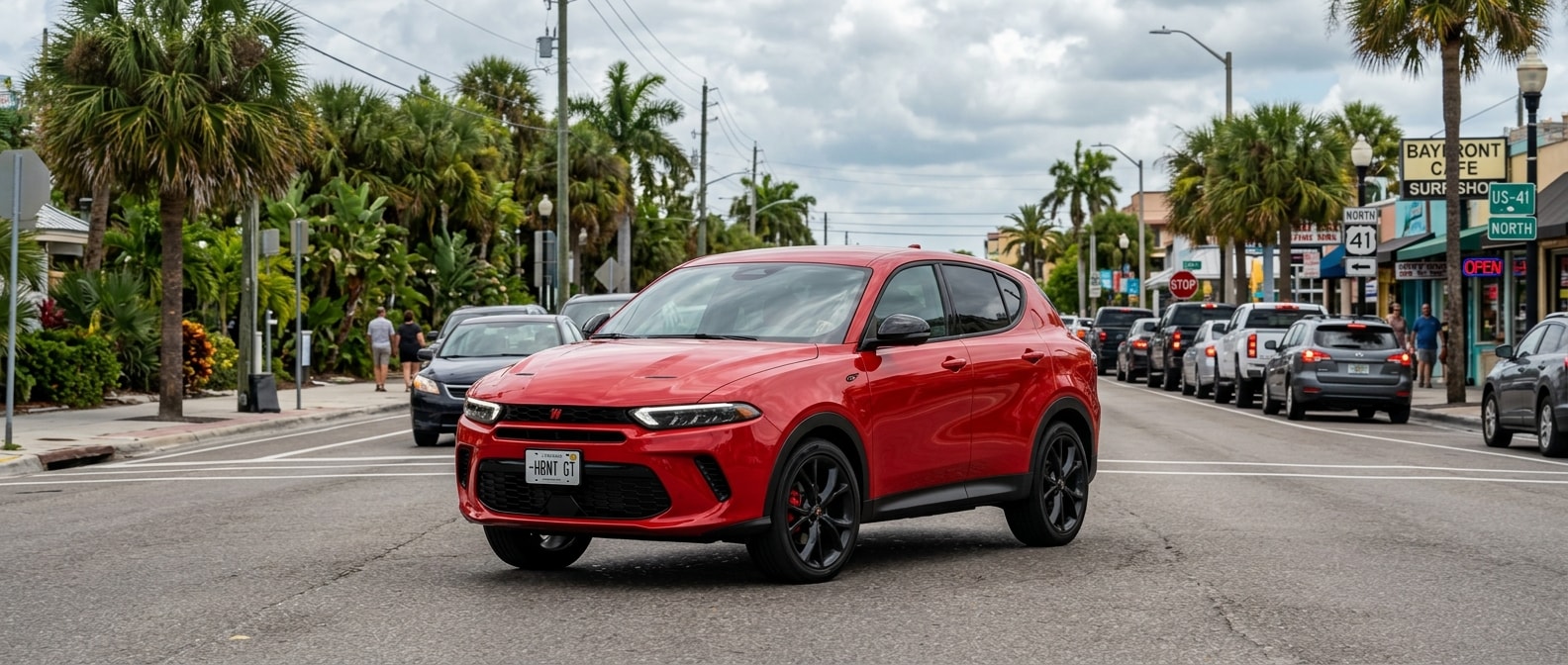
The 2025 Dodge Hornet is officially the last of its kind. Dodge confirmed in January 2026 that production has ended, and a meaningful number of new units are still sitting on dealer lots right now, some with significant manufacturer cash incentives attached (the part that's easy to miss). If you've been eyeing a compact SUV for your daily run along US 98 or Harrison Avenue, you've got a real window here. Set it up right, and the Hornet is one of the more interesting commuter buys in the Gulf Coast market. Set it up wrong, and you've paid a premium for features your commute will never use.
We'll walk you through how to spec, configure, and evaluate a remaining 2025 Hornet for a Panama City driving life. We'll take it step by step.
Browse available Hornet inventory at Bay Chrysler Dodge Jeep Ram
What Do You Actually Need Before You Walk onto the Lot?
Before you think about trim levels or color options, two things decide which Hornet makes sense for you. Nail down your one-way commute distance and whether you have a 120V outlet (standard household plug) or a 240V Level 2 charger at home. Those two numbers decide which trim works for your situation. Everything else is preference.
The quick reference for both 2025 Hornet configurations sits below.
| Spec | Hornet GT (Gas) | Hornet R/T (PHEV) |
|---|---|---|
| Engine | 2.0L Hurricane4 turbo I4 | 1.3L turbo + electric motor |
| Combined output | 268 hp / 295 lb-ft | 288 hp / 383 lb-ft |
| EPA city/hwy (gas) | 21 mpg / 29 mpg | 29 mpg combined (gas mode) |
| EPA electric range | None | 33 miles |
| 0-60 mph | 6.5 seconds | 5.6 seconds |
| Level 2 charge time | N/A | ~2.5 hours |
| Towing capacity | Verify at final config | 2,000 lbs |
| Drivetrain | AWD standard | AWD standard |
| Cargo (seats folded) | 50.5 cu-ft | 50.5 cu-ft (reduced with battery) |
Sources: Dodge media / EPA fueleconomy.gov (2025 model year)
One caveat on that EPA city figure for the GT. 21 mpg in stop-and-go is real-world accurate for the Panhandle heat and the traffic stacking up around the US 98 and US 231 intersection. The R/T flips that equation, because regenerative braking recoups energy every time you touch the pedal at a red light. Harrison Avenue, with its signalized every-few-blocks rhythm, is genuinely ideal territory for a PHEV.
Setting Up Your 2025 Hornet in Five Steps
Five steps get you from lot to configured commuter, and taking them in order is how you avoid missing something you'll regret later. Work through them as written and you won't skip a spec.
Step 1: Decide on GT vs. R/T Based on Your Daily Mileage
If your round-trip commute is under 33 miles, the R/T PHEV can run it entirely on electricity most days. Charge overnight on a standard 120V outlet (expect 12-plus hours for a full charge) or in about 2.5 hours on a 240V Level 2 home charger. For anyone commuting from Callaway, Lynn Haven, or the northern Bay County neighborhoods down into central Panama City, that's a workable window.
If your commute is longer, or you're using the Hornet as a highway runner between Panama City and points north on US 231, the GT's 268 horsepower makes more sense. The performance gap is real but narrower than you'd expect. Both trims come with AWD standard, so Florida's sudden summer downpours on US 98 don't change the math.
Step 2: Choose the Right Trim Package
Four trim levels exist for 2025, and for a straight commuter build the GT Plus and the R/T hit the sweet spot. Alongside the base GT and the R/T Plus, those two middle picks add the features you'll actually use day to day, including a sunroof, upgraded audio, and the Uconnect 5 infotainment system with wireless Apple CarPlay and Android Auto.
The Track Pack and Blacktop Package are Koni-shock and performance-suspension options designed for drivers who want that side of the Hornet. Worth it if that's you. Pure commuter? Skip the track hardware. The base Koni shock setup is already stiffer than most compact SUVs in this class and gives the Hornet its distinctive planted feel through the sweeping lanes of SR 390 (Beck Avenue).
Step 3: Set Up the R/T's Charge-to-Commute Routine
The R/T is the only trim this step touches, and getting the charge routine right is the difference between a PHEV that pays off and a heavier GT running on premium fuel. Do it well and the payoff is daily.
The actual setup runs like this.
- Schedule overnight charging on a 120V outlet, or install a Level 2 EVSE at home (your electrician installs the 240V outlet; the car-side setup takes about 10 minutes).
- Use the Hornet's built-in departure timer (accessible through the Uconnect infotainment screen) to pre-condition the cabin. Start the climate control before you unplug, so the battery cools the cabin before you leave instead of during your commute, which preserves EV range in the Florida heat.
- Set your Uconnect drive mode to "Electric" for city legs of your commute along US 98. Reserve the gas engine for highway segments.
- On the regenerative braking setting, choose "Max Regen" for dense stop-and-go stretches. Every stop at a Harrison Avenue signal feeds charge back to the battery.
Step 4: Configure Interior Cargo for a Dual-Purpose Commuter
The Hornet's 50.5 cubic feet of cargo (seats folded) suits a weekday-commuter-plus-weekend-hauler lifestyle, though the R/T battery pack does intrude on trunk depth compared to the GT, so set realistic expectations before you load up with gear. A few practical points.
- The rear seat folds 60/40 and flat, so a set of weekend gear bags loads cleanly.
- The liftgate on GT Plus and R/T Plus is power-operated. Small thing. Very convenient when you're carrying gear across a Florida parking lot in August heat.
- Wireless Apple CarPlay and Android Auto come standard on all trims. You won't need a dedicated phone mount cluttering the dash.
- The 12.3-inch digital instrument cluster keeps navigation visible without secondary screen glancing. Relevant when you're navigating the lane weave heading into downtown Panama City.
Step 5: Verify What Comes with the Remaining Inventory
Verifying the remaining inventory is the step easy to overlook, and it matters because the Hornet's discontinuation means every remaining unit on a lot is a known-spec, final-production vehicle. No more mid-year changes. No 2026 refresh coming. What's on the lot is what exists.
When you look at a specific unit, confirm a few things.
- The Monroney sticker matches the trim features you spec'd in Steps 2-3.
- Any factory cash incentive (Dodge was offering substantial bonuses on Hornet inventory earlier in 2026) is applied at the time of purchase. Get the number in writing before you negotiate anything else.
- The vehicle history (if it's been on the lot since 2025, confirm mileage, battery state, and any transport damage).
- Service parts availability. Stellantis has publicly committed to continued parts supply and customer support for the Hornet, and the vehicle shares nearly all its components with the Alfa Romeo Tonale (which continues in production for 2026), so supply-chain exposure is lower than you'd expect from a discontinued model.
A Quick Print-and-Go Recap
Take this list with you when you're ready to evaluate a 2025 Hornet on the lot, and it'll keep your trim-versus-commute math straight while you stand in front of the car.
- Commute under 33 miles round-trip: R/T PHEV, charge nightly, Electric mode on US 98 and Harrison Ave segments.
- Commute over 33 miles or highway-heavy: GT, AWD standard, 268 hp handles Panhandle road conditions without drama.
- Best trim for the money: GT Plus (all the daily-use features) or R/T (if the PHEV math works for your home charging setup).
- Cargo reality check: GT has deeper trunk than R/T. Both fold flat to 50.5 cu-ft total.
- Before you leave home: Test Level 2 charging option. Pre-condition cabin via departure timer. Confirm incentive paperwork.
- On the lot: Verify Monroney, incentive amount in writing, battery state of charge on any PHEV unit.
The Hornet is a genuinely capable compact SUV for a Bay County commute. It won't be restocked. But the units that remain are new and represent real value for a buyer who knows what they're doing. Ask our team about current coverage options.
By the Bay Chrysler Dodge Jeep Ram Team | September 2026
Frequently Asked Questions
Is the 2025 Dodge Hornet a good commuter car for Panama City?
For shorter Bay County commutes, particularly those under 33 miles round-trip, the 2025 Hornet R/T PHEV is well-suited. The EPA estimates 33 miles of electric range, which covers most in-town runs on US 98 and Harrison Avenue on battery alone. The GT trim is a better fit for longer or more highway-intensive commutes, where its 268-horsepower 2.0-liter turbo runs at consistent load without depleting a battery pack.
Since the Hornet is discontinued, will I still be able to get it serviced?
Stellantis has committed publicly to continued parts supply and customer support for the Hornet. The vehicle also shares its platform and most of its components with the Alfa Romeo Tonale, which remains in production for 2026. That parts commonality meaningfully reduces long-term parts availability risk compared to a truly isolated discontinued model.