




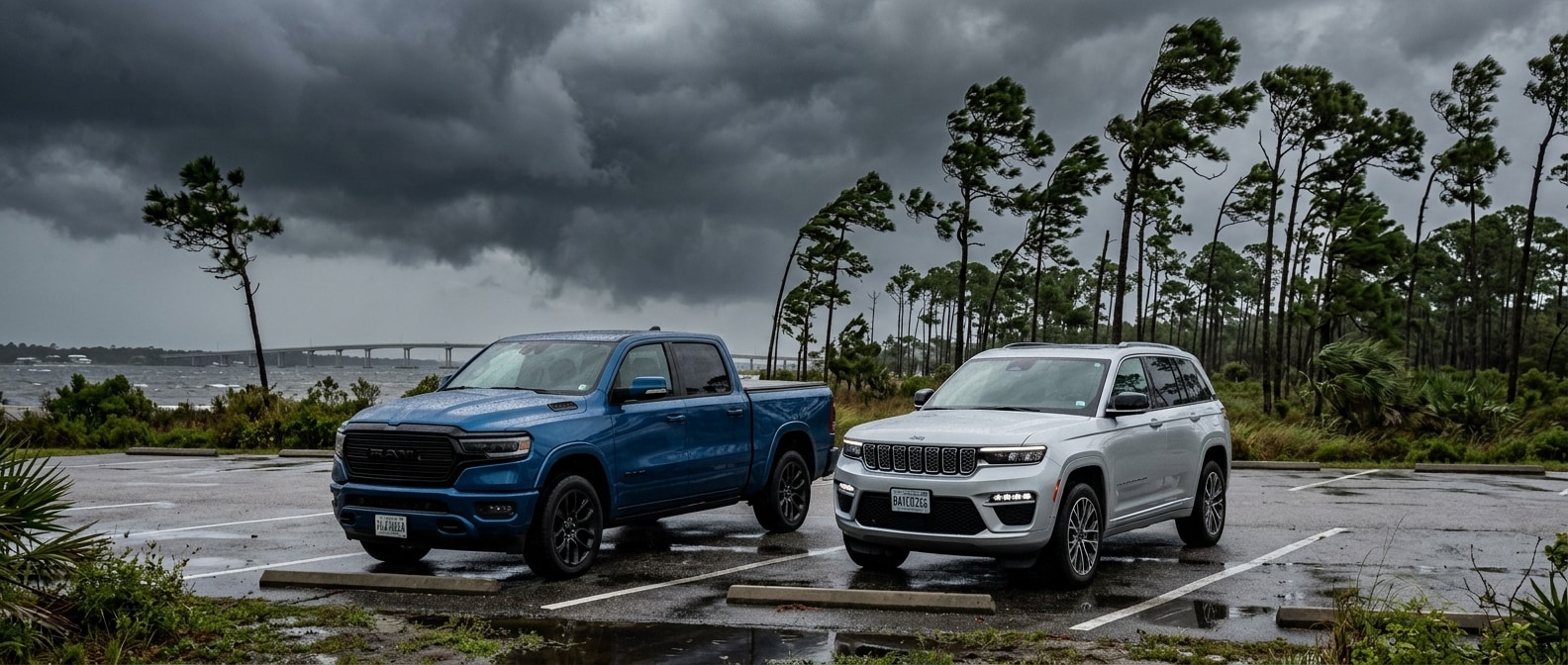
Park on the Florida Panhandle during a serious thunderstorm with both a Ram 1500 and a Jeep Grand Cherokee in your driveway, and you've already run this comparison in your head. One of these has a sealed cargo area and a steel roof over everything you care about. The other carries an open bed that faces down whatever the sky sends. That structural difference is the comparison nobody covers when storm season rolls in, and it matters more in Bay County than the generic advice to "park in a garage."
- The Jeep Grand Cherokee protects enclosed cargo completely from debris; the Ram 1500's open bed leaves tools and equipment fully exposed to falling branches and flying material without a hard tonneau cover.
- For parking through a storm, the Grand Cherokee wins on cargo protection; for moving out after roads flood, the Ram's higher stance and torque give you more options.
- Bay County averages about 80 thunderstorm days per year, per Bay County Emergency Management, making this a genuine seasonal decision.
- Comprehensive auto insurance generally covers storm debris damage including falling trees and flying objects. Florida's required liability coverage does not.
- Know your parking plan before the sky turns dark, not after.
What's the Real Difference Between These Two in a Storm?
Both trucks are built tough, so toughness isn't the split that matters here. The difference that counts in a storm is shape: the Grand Cherokee seals its cargo under a steel roof, while the Ram 1500 leaves its bed open to the sky. That geometry decides where your storm risk sits.
The Grand Cherokee is fully enclosed. Whatever you're hauling stays under a steel roof and behind glass. A branch comes down on the hood? A body panel repair, and your gear inside stays untouched. The Ram 1500 is a different shape entirely. That bed sits open to the sky, and in a Bay County storm with sustained winds throwing palm fronds, pine limbs, and roofing material, anything in the bed without a hard tonneau cover takes the hit directly. Neither vehicle can argue its way out of that.
| Storm Scenario | Ram 1500 | Jeep Grand Cherokee |
|---|---|---|
| Falling branch on roof | Steel cab protected; bed open to sky | Enclosed steel roof covers cabin and all cargo |
| Flying debris (shingles, signs) | Cab panels protected; bed and tailgate exposed | Full body panels protect all sides |
| Cargo and gear protection | Requires hard tonneau cover | Fully enclosed by design |
| Post-storm road flooding | Higher ride position aids mobility | Quadra-Lift raises clearance to 10.9 in. (Off-Road 2) |
| Parking in tight covered spots | Longer overall length requires planning | Easier to fit in most covered structures |
| Insurance coverage for debris | Comprehensive covers falling objects | Comprehensive covers falling objects |
Does Parking Location Matter More Than the Vehicle?
Parking location can matter more than the badge on the hood, though not entirely. A covered spot protects both trucks while an open driveway exposes both, and the vehicle's shape only decides who's still vulnerable once you're already under cover. Most storm prep content skips this part.
Bay County averages about 80 thunderstorm days each year. Those aren't hurricane numbers. They're the routine summer calendar, which means your parking habits from June through November build up the most storm exposure over time, well beyond the named events.
For both vehicles, the most protective move before a serious storm is relocating away from overhanging pine trees and older live oaks. The Panhandle's longleaf pines are enormous. In 60-plus mph gusts they shed limbs with real force, and the horizontal profile of a truck cab or an SUV roof makes a large target. Getting out from under that overhead exposure matters more than which vehicle you're driving.
The two designs diverge once you're under cover. The Grand Cherokee parked below a covered structure gives you protection on every axis, roof, cargo, and glass. The Ram 1500 in the same garage still has an open bed if you pull too far forward and the bed extends past the overhang. Situational awareness about where the bed ends relative to a covering structure is a real thing for truck owners in this market (position the truck with the tailgate under shelter when space runs short). None of that is hypothetical.
The other difference shows up after the storm. Bay County is highly prone to flood hazards associated with hurricanes, tropical storms, and rainfall with high intensity or duration. Standing water on Bay County roads clears more slowly in low-lying areas near the coast, and the Ram's higher clearance and available torque make it easier to move through that water to reach higher ground or restock supplies before drainage catches up. The advantage has nothing to do with debris protection. You feel it the morning after.
Practical Debris Protection: What Each Vehicle Does and Doesn't Do
The Ram 1500 cab is every bit as storm-worthy as the Grand Cherokee's structure, since steel is steel. The enclosed cab and the enclosed SUV face storm damage about equally, and the gap opens only at the Ram's open bed, which needs deliberate help the Jeep never asks for. Hurricane damage to vehicles typically falls into four categories: flying debris impact, flood water intrusion, fallen tree or structural damage, and high-wind displacement of exterior components. For the cab of the Ram and the full body of the Grand Cherokee, exposure to those four categories is roughly equal for a parked vehicle. Bumpers, fenders, hoods, and mirrors are the most frequently damaged body panels in storm events, and neither vehicle holds a structural advantage over the other for those components.
The Ram asks for help in three specific places.
Hard tonneau cover. A soft cover won't stop a falling branch. A hard folding or retractable tonneau cover adds real debris resistance to the bed and protects tools, equipment, and anything you'd rather not replace after a storm. Without one, the bed is open sky. Mopar makes factory-approved hard tonneau options specifically for the 1500 bed.
Gear relocation before a serious storm. Anything irreplaceable should come inside, not stay in the bed under a tarp. A tarp in 70-mph winds is decoration.
Glass exposure. Both vehicles have windshields and rear glass that flying debris can hit. Neither holds a meaningful advantage here. Wind and falling debris add a real layer of storm damage risk, and trees, roof tiles, and road signs can go airborne in high winds, shattering glass or damaging large sections of a vehicle. Parking with the front end facing away from the primary wind direction reduces frontal glass exposure for both, a small adjustment that costs nothing.
So Which Should You Pick for Bay County Storm Season?
Your pick depends on what your days in Panama City actually look like. Both handle a storm well once they're parked under cover, and the split shows up in the details: the Ram for work and post-storm mobility, the Grand Cherokee for sealed, protected cargo through the whole season.
The Ram 1500 is the right call if you're running a trade, hauling materials, or need a truck for the work week. A hard tonneau cover solves most of the open-bed vulnerability. Where the Ram earns its keep after a storm is on the road, since its stance and torque give you more options when surface water sits on US-98 or Bay County backroads before drainage catches up. You can move to higher ground and come back when roads clear with more confidence in a full-size truck than in a crossover.
The Jeep Grand Cherokee is the right call if you're mainly protecting passengers, daily gear, and family cargo through storm season. Everything stays sealed by default. The available Quadra-Lift air suspension raises to a maximum 10.9 inches of ground clearance in Off-Road 2 mode, which helps on standing water once a storm passes. It also fits more easily into tighter covered parking spots, which matters when you're hunting for a concrete structure to shelter under before conditions worsen.
One tradeoff is worth naming plainly. The Grand Cherokee has no bed. If you're a contractor or you regularly haul large materials, it doesn't replace the Ram, so you'd want both, or you accept that limit. The Ram without a tonneau cover leaves your cargo genuinely exposed. None of that knocks the truck. The design is simply built that way.
Browse our full inventory to compare trims and see what's currently available.
See Current New Vehicle Offers
Frequently Asked Questions
Does comprehensive auto insurance cover storm debris damage on a Ram 1500 or Grand Cherokee in Florida?
Generally, yes. Comprehensive auto insurance coverage often covers damage to a vehicle caused by hurricane debris during Florida storms and high-wind events, and that includes falling trees, flying roofing material, and wind-displaced objects. Many Florida drivers are surprised to learn that basic auto insurance coverage does not automatically cover storm-related vehicle damage. Florida's mandatory liability coverage protects other drivers and does nothing for your own vehicle if a pine branch lands on it. Check with your carrier before storm season about deductibles, since Florida policies sometimes carry separate hurricane deductibles tied to the vehicle's value.
Is a Ram 1500 bed cover worth buying before storm season in Bay County?
Yes, and a hard cover more so than a soft one. A soft tonneau doesn't provide meaningful resistance to a direct branch impact. A hard folding or retractable cover handles most of what a typical Bay County thunderstorm produces, meaning rain, small debris, and moderate flying material. For a named storm, anything genuinely valuable comes out of the bed entirely. The cover handles the incidental stuff, and it won't replace getting the truck to covered shelter before major conditions arrive.
How does the Ram 1500's ground clearance compare to the Jeep Grand Cherokee for post-storm flooding?
The Ram 1500's standard height gives it a natural advantage in deeper standing water. The Jeep Grand Cherokee's available Quadra-Lift air suspension raises clearance to 10.9 inches in Off-Road 2 mode, which helps a great deal when water sits on local roads. For routine Bay County drainage situations, both vehicles handle the post-storm environment well. Either way, avoid driving through water if you can't see the road surface clearly.
By the Bay Chrysler Dodge Jeep Ram Team | September 2026